Der Beitrag Exciting News: ecosio is Joining Vertex! erschien zuerst auf ecosio.
]]>Highlights of the Acquisition
Enhanced Capabilities
The acquisition combines ecosio’s automated B2B communication expertise, including Electronic Data Interchange (EDI) as well as Continuous Transaction Controls (CTC), with Vertex’s market leading indirect tax and compliance portfolio. The result is an unparalleled global solution for indirect tax reporting and compliance. Our businesses naturally complement each other’s capabilities, allowing us to offer a breadth of global solutions for EDI, e-invoicing and reporting.
Unified Vision
ecosio and Vertex share a commitment to innovation and excellence. Our aligned values and vision position us for significant growth and enhanced service delivery.
Future Benefits
As part of the Vertex family, we can now offer more opportunities for innovation, expanded capabilities, and increased knowledge-sharing. Our customers will benefit from comprehensive global solutions and enhanced support for their compliance and reporting requirements.
Seamless Integration
Both companies are committed to ensuring a smooth transition with no disruption in service. Our combined team will continue to provide the high-quality support and expertise you’ve come to expect.
This acquisition marks a significant milestone for both organisations, and we are confident it will lead to positive advances globally.
We invite you to share this exciting news with your network. If you have any questions or need further information, please reach out. Together, ecosio and Vertex are ready to take this market to new heights.
Thank you for your ongoing support and trust. Stay tuned for more updates as we embark on this exciting journey together!
Der Beitrag Exciting News: ecosio is Joining Vertex! erschien zuerst auf ecosio.
]]>Der Beitrag ecosio Insights: Digital Transformation Projects and the Role of B2B Integration erschien zuerst auf ecosio.
]]>To help provide some clarity regarding current B2B integration trends and the main challenges facing those businesses embarking on digital transformation projects, I sat down to discuss these topics and more with ecosio Co-founder and EDI expert Philipp Liegl. In the following interview, Philipp shares his thoughts on what successful digital transformation looks like, and how businesses can unlock sustainable growth and build stronger, more collaborative partnerships.
————————————————————————
How do you predict B2B integration will evolve over the next five to ten years?
In the next few years we should see automated system-to-system communication replacing manual methods like email, PDF and paper. I also expect to see better visibility of EDI and e-invoicing directly within ERP systems, as companies move away from a siloed approach in search of a unified solution.
As more countries introduce e-invoicing mandates, procure-to-pay and order-to-cash processes will also have to change accordingly, which will result in challenges for businesses operating across diverse regulatory environments. At the same time, tax compliance and supply chain operations are converging as governments demand greater digitalisation and real-time reporting. For organisations of all sizes, success in this new landscape will depend on embracing automation, enhancing integration, and addressing compliance as a strategic priority.
Is a universal document exchange format ever likely to happen?
Thanks to the rise of government-mandated e-invoicing formats, there are certainly signs that standardisation is improving. For example, UBL is becoming widely adopted across Europe due to its alignment with EN 16931 and Peppol. Meanwhile, UBL’s popularity is also growing outside of the EU, with countries such as Saudi Arabia recently adopting UBL subsets.
Yet, much like separate dialects of the same language, even within UBL, regional adaptations persist. Whether it’s UBL, EDIFACT, or EDIFACT-subsets like EANCOM, global standards are rarely used in their “vanilla” form as they are too generic to meet specific business needs. Ultimately, total standardisation will realistically never happen for this reason.
How do you see B2B integration fitting into broader digital transformation strategies?
While there are obviously benefits to digitising any manual process, such as submitting timesheets or holiday requests, the processes which have the greatest impact are those that cross organisational boundaries—such as exchanges with suppliers, customers or governments.
By automating the exchange of key B2B messages, like orders, invoices and delivery notes, businesses can not only reduce errors, but also enhance resilience and provide real-time visibility into critical operations. In turn, this enables organisations to operate with greater speed and confidence moving forward. As such, in my opinion, EDI and B2B automation should be at the very centre of digital transformation efforts.
Following the recent wave of e-invoicing mandates, do you expect to see similar regulations covering other B2B processes soon?
Absolutely! The main goal of the recent e-invoicing mandates in Europe has been to reduce the “VAT gap” caused by fraud and underreporting. But e-invoicing is only one of a number of ways governments can tackle this. Over the coming years we will undoubtedly see governments introduce legislation concerning other tax-relevant documents which provide proof that transactions are legitimate, such as delivery notes and probably also purchase orders.
Just as businesses reconcile invoices with delivery and purchase order records to confirm the validity of transactions, governments aim to ensure compliance by tracking the entire process. Accordingly, expanding automation requirements beyond e-invoicing would not only strengthen tax collection efforts, but also minimise fraud and promote greater transparency and accountability across B2B operations.
Are people’s expectations changing when it comes to B2B integration?
Definitely! In the past, EDI was typically managed via local software, which was reliant on the deep technical knowledge of internal individuals. Over the last decade there has been a clear shift towards externally managed solutions that are deeply integrated into businesses’ ERP systems. Just like we don’t expect to have to establish the technical connection ourselves when we make a phone call, businesses today expect their providers to handle all technical B2B integration intricacies for them behind the scenes. Plus, with governments mandating automation of more and more B2B processes, we’re seeing a growing demand for providers to offer a broader range of services. Where previously businesses may have had one provider for tax compliance, another for EDI, and an in-house solution for e-invoicing, these businesses are now looking for one provider that can handle all at once.
What role do you see technologies such as AI and machine learning playing in digital transformation projects?
AI and machine learning are certainly helping to enhance efficiency and streamline B2B integration processes, particularly in areas like mapping creation and pattern recognition. For example, machine learning can be used to flag potential issues that wouldn’t otherwise have been detected – such as if a regular purchase order doesn’t arrive when expected – allowing for proactive escalation.
AI does face limitations, however, as it operates based on patterns, probabilities and learned behaviours, which can lack the precision necessary for specific compliance tasks. In critical areas like business document mapping creation, for example, where 100% accuracy is essential, pure reliance on AI may still be risky, as errors could have significant consequences. That might change with the further development of these technologies. One thing is for sure: 100% deterministic behaviour is a must with all compliance operations. As long as AI is not able to meet that 100%, in can only play a supportive role.
How do you think the increasing automation of B2B processes will impact the roles and skills required in internal teams?
Regarding skills, those handling B2B integration need to have technical expertise in three key areas. First, they have to understand the choreography of document exchanges, including the sequence and interdependencies between documents like purchase orders and invoices. Second, they must understand the diverse payload formats used across different regions and industries. Finally, they must have technical communication channel expertise in order to navigate the varying API standards and complex authentication mechanisms required in different countries.
When it comes to who handles B2B integration, organisations have three options: develop in-house expertise, hire external contractors to manage the process, or enlist the help of specialised providers. One thing is true no matter what option is opted for, however; successful automation requires a dedicated owner to coordinate resources, ensuring accountability and alignment. B2B integration can no longer be managed as a side task by unrelated roles—it demands focused leadership to drive efficiency and reliability.
What are the key B2B integration challenges likely to be for businesses embarking on digital transformation projects?
I would say there are four key challenges. The first, and the biggest, will always be master data. Without clean, consistent master data even the best integration systems will struggle to function effectively. If someone could somehow eliminate all master data issues this would definitely be worthy of a Nobel prize in my book!
The second challenge is sorting a B2B integration team, as B2B integration is very much a people-driven initiative and isn’t something that can be handled as a side task. You need dedicated team members in key areas like order-to-cash and purchase-to-pay to make it work.
The third major challenge is process alignment, as many ERP systems still rely on outdated outputs, such as PDFs or paper documents, which aren’t designed for EDI. Before they can fully embrace integration, businesses must modernise these processes.
Last, but not least, is ERP system compatibility. Successful B2B integration requires a seamless flow of data in and out of ERP systems. Unfortunately, older or off-the-shelf solutions, such as AS400-based platforms, often aren’t ready for this level of integration. Any business with such systems will have to upgrade them or find workarounds if they want to achieve significant improvements.
————————————————————————
Want to learn more about current EDI trends?
In our new report, “The Future of B2B Integration“, we explore the findings from our recent survey. In this survey we asked professionals working with B2B automation technologies across various industries to share their perspectives on everything from e-invoicing to the role of EDI in building business resilience.
Trends covered include the growing importance of EDI, building resilience through automation, e-invoicing, and cloud migration.
Der Beitrag ecosio Insights: Digital Transformation Projects and the Role of B2B Integration erschien zuerst auf ecosio.
]]>Der Beitrag Introducing ecosio Flow: The Evolution of Web EDI erschien zuerst auf ecosio.
]]>The new look user dashboard of ecosio Flow
The journey so far
WebEDI set a high standard in providing a versatile, web-based platform for electronic data interchange (EDI). It simplified the exchange of business documents between companies, improving the speed, accuracy, and efficiency of business transactions. Now, ecosio Flow takes this functionality and enhances it in several significant ways.
“ecosio Flow represents our commitment to building solutions that meet the demands of today’s fast-paced, interconnected business environment. By combining the robust foundations of EDI technology with an innovative, modern web-based SaaS platform, we strive to provide the best platform experience for customers and partners.”
Matthias Lambrecht
Head of Product
How will users benefit?
With ecosio Flow, you benefit from…
Improved supplier network
By integrating supplier information and communication into one platform, ecosio Flow makes managing your supplier network effortless and efficient.
Revamped Web EDI
An integral part of ecosio Flow – our Supplier Activation solution -is now live. While Flow continues to provide a flexible EDI platform, our new and improved solution now includes more powerful features and an even more user-friendly interface.
New activation portal
Last, but not least, ecosio Flow is also a supplier activation portal. This intuitive platform facilitates the swift and efficient activation of new partners, making their integration into your business operations smoother and faster than ever before.
New and improved features
ecosio Flow also brings exciting improvements to our feature set. Our user-friendly dashboard has been redesigned for even easier navigation, allowing you to monitor all your EDI activities at a glance.
The comprehensive turnaround feature, a favourite among our users, now offers even more functionality, facilitating the easy conversion of incoming documents into outgoing ones and further reducing manual work.
We’ve made significant improvements to our process flows, which are now fully configurable to meet the unique needs of your company’s processes. This enhanced flexibility, complete with feature flags and other customisation options, offers a comprehensive view of your document’s journey within your EDI operations. It empowers you to pinpoint potential bottlenecks and areas for improvement with greater precision.
“Helping clients to streamline supplier activation has long been one of our main goals at ecosio Flow represents the culmination of years of innovation, development and persistence in this direction. It’s the missing link that transforms complex processes into a smooth, continuous flow of business operations that complements a complete EDI strategy.”
Marco Zlapetal
Managing Director & CTO, ecosio
Connect with Us
We are incredibly proud of ecosio Flow and have worked hard to ensure these updates and improvements will help you to optimise your workflows and boost productivity. To learn more about ecosio Flow and how it can revolutionise your processes, feel free to schedule a meeting with us. Contact us to arrange a time that suits you.
We look forward to introducing you to all the advantages ecosio Flow has to offer!
Learn more
To read more about the technical specifics and to see how ecosio Flow could benefit you, visit our dedicated product page.
Der Beitrag Introducing ecosio Flow: The Evolution of Web EDI erschien zuerst auf ecosio.
]]>Der Beitrag Is Cloud Migration the Future of B2B Integration? erschien zuerst auf ecosio.
]]>- Moving to the cloud cuts hardware and maintenance costs, improves reliability through redundant infrastructure, and delivers flexibility, scalability and resilience with better data visibility and automatic updates
- A recent survey found 65% of respondents expect cloud-based EDI to become the norm, while only 13% do not expect its popularity to grow
- Remaining on outdated on-premise systems can harm efficiency and increase long-term costs, especially when the total cost of ownership is underestimated by excluding time and personnel expenses
- Businesses still using locally-hosted software should assess whether cloud migration could improve efficiency and resilience, as migration projects do not have to be complex or disruptive
Over the past decade there has been a clear and continual shift by supply chain businesses away from hosting business-critical software locally. Whether it’s multiple department systems or just a lone software instance, the vast majority of businesses have participated in cloud migration to some extent, with Accenture calculating the adoption of cloud technologies to have grown from 82% to 95% between 2019 and 2021 alone.
When you consider the benefits of moving B2B processes to the cloud, it’s not hard to see why so many companies are doing so. From a cost perspective, moving to the cloud reduces expenses relating to hardware and maintenance. Further, while security concerns are often cited as a key reason not to move to the cloud, cloud-based solutions typically offer a redundant infrastructure, making them much more reliable than locally-hosted systems. Most compelling of all, however, is the flexibility, scalability and resilience offered by the cloud, as processes and resources can be adapted quickly and easily as needs change. What’s more, cloud-based solutions also often offer better data visibility and are typically updated automatically.
What we have found
In line with recent trends, in our recent survey we found that the vast majority of respondents (65%) expect cloud-based EDI to become the norm in the future, with only 13% of those surveyed not expecting cloud migration to become more popular.
The Future of B2B Integration Survey, 2024
What can you do?
If you are still running your systems via locally-hosted software, it’s worth considering if moving to the cloud could improve efficiency, flexibility and resilience. While sticking with your current solution may seem like the easier choice, migration projects don’t have to be difficult or disruptive, and sticking with an outdated system will cost your business dearly in the long run. When assessing your options, it’s also important to consider all related costs. Many businesses wrongly assume that on-premise solutions are more cost-effective purely because they fail to properly calculate the total cost of ownership by ignoring key factors such as time and personnel costs.
“Companies with modern technology architectures outperform their competitors with better customer service, more efficient operations, and stronger customer advocacy.”
Questions to ask yourself
- Would increased system flexibility help you in achieving strategic goals moving forward?
- How confident are you that you can retain sufficient in-house expertise to keep internal systems running smoothly as your business grows/evolves?
- Do you currently operate a redundant infrastructure or are you at risk of catastrophic data loss?
- Are you aware of what modern cloud-based B2B integration solutions can deliver?
- Could cloud migration benefit your business?
Want more information on EDI trends?
This article is based on a section from our recent report on The Future of B2B Integration, in which we share survey results as well as predictions concerning the most significant B2B integration trends. To download your free copy now, simply visit the report download page and enter your details!
Der Beitrag Is Cloud Migration the Future of B2B Integration? erschien zuerst auf ecosio.
]]>Der Beitrag Can Increased Automation Build Supply Chain Resilience? erschien zuerst auf ecosio.
]]>- The last five years has seen a surge in recognition by businesses of the importance of building supply chain resilience
- Automating key B2B processes minimises the potential for human error, improves speed, and frees up staff to focus on more valuable tasks
- In a survey of supply chain executives, 88% believe that optimising automated B2B processes can improve supply chain resilience, and over half predicted that efficient automation would improve it “substantially
- 62% of respondents saw automated B2B communication as “very important” to the success of their business moving forward, with none seeing it as unimportant or irrelevant
The last five years has seen a surge in recognition by businesses of the importance of building supply chain resilience. Global events have highlighted the dangers of being unable to react to disruptions, and organisations are increasingly aware of the value of flexibility and adaptability, particularly when it comes to critical B2B processes. Yet despite this, according to a recent KPMG survey, 47% of supply chain executives believe they are still “vulnerable to disruption”.
While there is obviously no way to predict the future, there are pragmatic steps that businesses can take to boost supply chain resilience. Perhaps the simplest and fastest of these to achieve is improving B2B automation. Not only does automating key processes minimise the potential for human error, it can also improve speed and free up staff members to focus on more valuable tasks. In the event of unforeseen circumstances, businesses thus benefit from increased flexibility, as the majority of business-critical tasks aren’t dependent on human intervention.
What our research shows
As part of a wider research project concerning B2B integration trends, we recently conducted our own cross-industry survey in which we asked people their views on the importance of B2B automation.
Of the over 100 supply chain executives we surveyed, 88% believe that optimising automated B2B processes can improve supply chain resilience. Further, over half of those surveyed predicted that efficient automation would improve supply chain resilience “substantially”.
Similarly, 62% of respondents saw automated B2B communication as “very important” to the success of their business moving forward, with none seeing it as unimportant or irrelevant.
The Future of B2B Integration Survey, 2024
What can you do?
Improve and expand automation of business-critical processes! Not only will expanding and optimising automated processes streamline processes and minimise the possibility of human errors, it will also free up internal teams to be able to focus on more value-adding activities.
In particular, introducing electronic data interchange (EDI) and e-invoicing can make a huge difference to the efficiency of day-to-day messaging and drastically improve supply chain resilience.
“As more of the supply chain becomes automated, roles can be redefined to focus on higher-value customer services, and new roles will emerge for humans that drive strategy and innovation.”
Questions to ask yourself
- Are existing B2B integration processes inhibiting your company’s ability to react quickly to market changes?
- Do you currently have business-critical processes that could be automated?
- Are any key supply chain operations reliant on one or two individuals?
- Have you considered investing in a Web EDI solution to extend automation across your entire partner landscape?
- Would internal team members be able to add more value elsewhere if EDI tasks were outsourced?
Want more information on EDI trends?
This article is based on a chapter from our white paper “The Future of B2B Integration – Market Trends Report”, in which we share survey results as well as predictions concerning the evolution of B2B integration. To download your free copy now, simply visit the white paper page and enter your details!
Discover more about our updated product, ecosio.flow.
Der Beitrag Can Increased Automation Build Supply Chain Resilience? erschien zuerst auf ecosio.
]]>Der Beitrag Should Data Accessibility Be a B2B Priority? erschien zuerst auf ecosio.
]]>Nowhere is this more true than with B2B integration processes. While electronic data interchange (better known as EDI) is increasingly central to supply chain success, the data exchanged by supply chain partners via EDI is often something of a black box when handled in-house. With relevant teams, such as Purchasing, unable to access data directly, bottlenecks quickly develop, undermining the benefits of automated B2B communication.
As future-thinking businesses are starting to recognise, however, issues like this aren’t difficult to eliminate. With customer and partner expectations continuing to rise, more and more businesses are prioritising B2B data accessibility in order to streamline operations and improve decision-making. According to a recent KPMG poll, 87% of supply chain executives now see increasing data accessibility as “critically important”, with 61% identifying it as “top priority”.
What we found
In line with KPMG’s findings, we also found in our recent survey that respondents were very confident in the ability for improved data accessibility and visibility to boost supply chain success, with 77% believing that it could have a substantial impact, and 100% believing it could boost success at least a fair amount.
Despite this universal recognition, however, it seems many businesses still have a long way to go to reach the desired level of data transparency. When asked to grade their company’s current data accessibility/visibility, only 56% of the B2B integration professionals we asked answered “good” or “very good”, with a worryingly high 44% responding “bad” or “very bad”.

What can you do?
If data accessibility is an issue in your business, enlisting the help of an experienced external provider may well be the answer. Rather than integrating new functionalities or managing a complete system migration project yourself, by opting for an external solution, you will benefit from faster migration times and tried and tested processes.
Questions to ask yourself
- Do all relevant teams have acceptable data accessibility currently?
- How easy is it for individuals to find data within your existing solution?
- Does your current B2B integration solution offer real-time visibility of message statuses?
- How important is it for your business to be able to make accurate predictions?
Want to see what else we found?
This article is based on a section from our recent report on The Future of B2B Integration, in which we share survey results as well as predictions concerning the most significant B2B integration trends. To download your free copy now, simply visit the report download page and enter your details!
Der Beitrag Should Data Accessibility Be a B2B Priority? erschien zuerst auf ecosio.
]]>Der Beitrag The Future of Supply Chains: Expert Insights erschien zuerst auf ecosio.
]]>To provide some insight into what the next few years are likely to hold for supply chain businesses, we asked ecosio co-founders and B2B integration experts Philipp Liegl and Marco Zaplatel to give us four key predictions. Here’s what they said…
#1 – Electronic data interchange (EDI) will continue to grow in popularity

Over the past two decades EDI has seen huge change. Thanks to dramatic advances in technology, not only is message exchange automation now possible across many more B2B processes, but crucially it is also now far more accessible. Whereas EDI was once a luxury open only to those businesses with extensive internal resources and technical expertise, today all businesses can experience the benefits of automated document exchange.
This accessibility, combined with other factors, such as the recent introduction of mandatory e-invoicing across much of Europe and the increased desire for supply chain sustainability in the wake of the recent pandemic, means that EDI’s popularity is only likely to grow further in the coming years. This is also echoed by recent research by Gartner, which predicts that a whopping 80% of B2B sales interactions between suppliers and buyers will occur in digital channels by 2025.
#2 – EDI will become increasingly central to business success
Due to factors such as the globalisation of markets, an ever-increasing demand for data visibility across supply chains, and the growing dependence of revenue upon successful data automation, businesses can no longer afford to treat EDI as an afterthought. What’s more, the financial benefits offered by EDI are only set to increase as technology continues to advance and improve the efficiency and transparency of automated data exchange. IDC research, for example, suggests modernised B2B integration could offer businesses a 308% ROI – or more than £3 in benefits per £1 invested!
It’s only logical, therefore, that the future of supply chains will see more and more businesses identify EDI as a critical component of ERP systems (as future-focussed organisations already do).
#3 – EDI will continue to become a “service”
Unfortunately, EDI’s growing popularity doesn’t mean automated document exchange with partners will get easier from a technical perspective. Rather, as businesses look to extend automation across more processes, and different countries introduce different regulations, operating a successful EDI solution will become harder for in-house teams. As a result we should see more and more businesses adopting an EDI as a Service solution as part of a so-called “postmodern” ERP system, in which a core ERP system is extended with tailored cloud-based solutions from independent providers. This way, businesses can enjoy all the benefits of efficient document exchange with none of the hassle and risk. Essentially, EDI is about to transform from a technology for enterprises to a core service for enterprises… a core service, which is yielded by external service providers.
#4 – Solution flexibility and scalability will become a must
Given the rapid pace at which tech is advancing and the volatility of modern supply chains, selecting an EDI solution that can evolve to suit changing needs will be a major concern for IT decision makers over the next few years. We expect to see more caution from buyers regarding potential future functionality changes and an increase in demand for cloud-based, modular solutions, in which updates are implemented on an ongoing basis by the provider and new features are added on a regular basis.
Conclusion
While what exactly the future of supply chains will be may be difficult to predict, what is certain is that cloud-based, EDI as a Service constitutes the only logical long-term option for many businesses. When it comes to key issues such as cost efficiency, sustainability and flexibility, there is simply no alternative.
At ecosio we’re always thinking of the future and pride ourselves of being ahead of the competition both in terms of technology and approach. While the ecosio cloud-based EDI solution (our Integration Hub) and dedicated document and integration engineers ensure you experience streamlined, hassle-free EDI today, our unique, cloud-based approach is designed to support you into the future. However your situation changes, our regularly updated, modular solutions and passionate EDI experts will ensure your solution remains successful. With “Connections That Work” you will experience the full potential and benefits of EDI with minimum effort.
Want to learn more about the future of supply chains?
This article is taken from our white paper Building Connections That Work: The ecosio Approach. To download your free copy today, simply follow this link and enter your details.
For a more detailed breakdown of the future of EDI, you may find our article on this topic interesting, too.
Der Beitrag The Future of Supply Chains: Expert Insights erschien zuerst auf ecosio.
]]>Der Beitrag How to Achieve B2B Process Automation Success erschien zuerst auf ecosio.
]]>Define your B2B process automation goals
The first and most important step in any complex business project is to define your goals. Even if your goals seem obvious, detailing exactly what you would like to achieve will help you to develop a roadmap, identify ways of measuring success, and prioritise resources effectively.
Sometimes, too, defining your specific goals will help to clarify to your team WHY you want to get to where you’re headed. Whether you’re looking to implement an e-invoicing solution or streamline communication with existing partners, agreeing on your exact goals will ensure everyone is on the same page and understands the plan and motivations.
Assess current capacity and internal resources
Once you’ve clarified your goals, the next step is to identify how able you are to achieve them with your current setup. This involves assessing both your technical capacity and the capability of your current personnel.
Technical capacity
When assessing technical capacity before a B2B process automation project, be sure to ask the following questions:
- Is our IT infrastructure able to support increased automation (e.g. via RPA, blockchain, API, EDI, etc.)?
- How well can our current systems integrate with electronic data interchange (EDI) and e-invoicing solutions?
- Would it be useful for different teams to have direct access to EDI/e-invoicing data so IT doesn’t become a bottleneck?
- Do we need redundant infrastructure?
- Are we likely to need the ability to convert messages to/from different EDI standards in the future?
- Are we likely to need the ability to send messages via different EDI protocols in the future?
- Will we need Peppol connectivity?
- Would a Web EDI solution be helpful to help automate exchanges with smaller suppliers?
- Would end-to-end visibility of EDI and e-invoicing data be helpful?
Personnel
When assessing the capacity of your existing team before starting your B2B process automation project, make sure to ask the following questions:
- Do we have sufficient technical expertise in-house?
- Would training be sufficient to upskill existing employees?
- Would our ability to operate be significantly disrupted by the absence or departure of certain individuals?
- How much time would team members be able to devote to new processes and tasks?
- Would team members be willing to adapt their roles and responsibilities if needed?
- How would pressure on internal resources be affected if B2B process automation requirements were to increase in the future?
- How will we keep track of new country-specific e-invoicing requirements?
After asking these questions you should have a clear picture of what level of automation is possible with your current system and which areas will need strengthening.
Consider outsourcing
For those businesses with limited internal resources, outsourcing is the obvious answer – particularly given the extent to which cloud computing has simplified external management of B2B process automation in recent years.
However, even those businesses with substantial internal resources may also benefit from outsourcing certain processes such as EDI or e-invoicing to specialised providers. Not only are such providers experts in these fields, and therefore able to implement processes and technical changes faster, they also typically offer added benefits such as redundant infrastructure, direct integration into your current ERP system, and simple scalability.
And perhaps most important of all, employing an external provider to manage B2B process automation enables your team to focus on what they do best!
Establish clear roles and responsibilities
For automation to succeed, everyone in your organisation needs to know their role in the process. Clear delineation of responsibilities ensures smooth implementation and ongoing management of B2B process automation efforts.
Make sure when assigning responsibilities not to forget potential future tasks though… as this can result in a decline in efficiency and enthusiasm.
For a detailed breakdown of the key roles in a typical EDI project, please see our dedicated blog article on this topic.
Prioritise data visibility and accessibility
Having automated processes is all well and good, but unless you have good visibility, efficiency can still suffer. No system is 100% error-free, and being able to identify an issue quickly and easily when one does arise can help ensure your system remains effective.
For example, the best EDI and e-invoicing solutions will enable users to search across all documents using any relevant identifier, and may even allow you to view the status of sent documents in real time.
Think long term!
When it comes to B2B process automation, change is the only constant. Technologies evolve, and so will your electronic data interchange (EDI) and e-invoicing needs.
Prioritising adaptability, scalability and sustainability is not just wise; it’s essential if you’re to be successful in the long term. Even if your EDI requirements are stable, your partner landscape is static and your internal team is committed right now, this will not always be the case. Unless your processes have been built with flexibility in mind, their efficiency will soon decline.
Don’t try to do too much too fast
Rome wasn’t built in a day, and neither is a robust B2B automation system. Start small, prioritise critical processes, and gradually expand your automation efforts to avoid errors and oversights.
For example, when onboarding EDI partners, rather than attempting to onboard all simultaneously, a more efficient approach would be to break your partners down into relevant groups (e.g. by country or value), and work through these groups one after the other.
Don’t be afraid to make big changes
Innovation often requires bold moves. While caution is wise, don’t shy away from making significant changes if they promise to improve B2B process automation.
As EDI and e-invoicing are so central to the everyday operations of modern day businesses, many people are scared to adapt running systems for fear of disrupting them. As a result, many businesses persevere with outdated technology for far too long. But of course, the longer you put off such a project, the less efficient your current solution will become!
While implementing a major B2B process automation project can be daunting, particularly for those who haven’t done so before, the benefits can be remarkable. Plus, thanks to the emergence of fully managed B2B process automation solution providers, there’s now no longer any need to stress about disruption to existing systems or insufficient internal resources!
Summary
In conclusion, achieving success in B2B process automation requires a strategic approach. By establishing clear roles, prioritising data accessibility, and adopting a measured approach to implementation, your business can harness the full potential of EDI, e-invoicing, and other B2B automation avenues to streamline operations, reduce costs, and enhance efficiency.
If you’re interested in learning more about how B2B process automation could transform your business, contact us to learn more about ecosio’s unique EDI solution.
Discover more about our updated product, ecosio.flow.
Der Beitrag How to Achieve B2B Process Automation Success erschien zuerst auf ecosio.
]]>Der Beitrag Common EDI Errors and How to Fix Them erschien zuerst auf ecosio.
]]>Thankfully there’s no need for EDI errors to be a common occurrence, though. In this article we’ll explore why EDI errors happen and what you can do to safeguard your system against them.
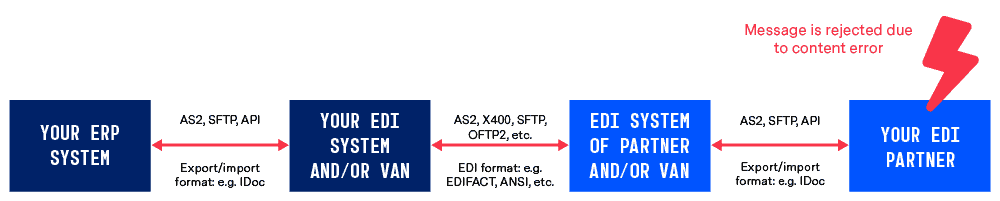
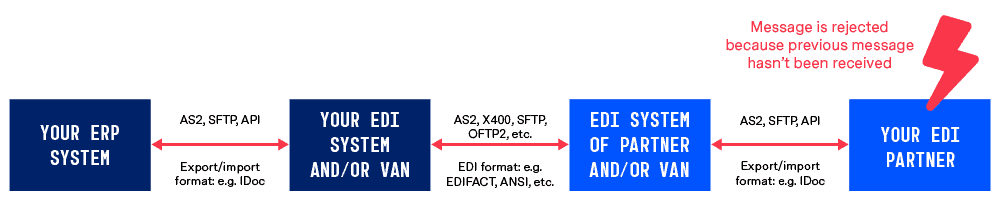
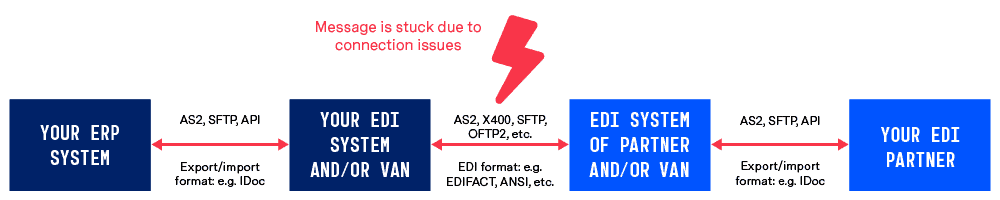
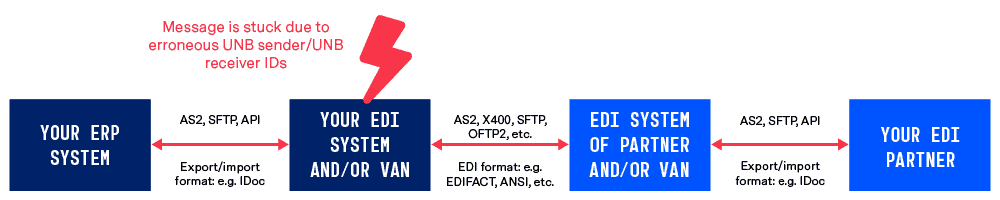
The architecture of a typical EDI landscape
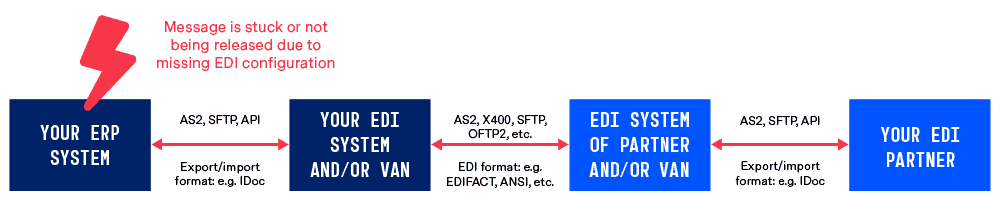
The typical modern EDI landscape has four main points (or ‘corners’, as they are often called). As shown in the diagram below, these are…
- Your ERP system
- Your EDI system and/or VAN
- The EDI system of your partner and/or VAN
- Your EDI partner’s ERP system
Although this model is the most efficient EDI landscape as far as the ease and efficiency of setting up EDI connections are concerned, the fact that multiple steps are involved means that there are several places where EDI errors can occur.

In the following section we’ll look at the five most common EDI error types and show you where each occurs on this same EDI architecture diagram.
The five most common EDI errors
1) Message content errors
What are message content errors?
Content errors happen when the EDI message in question contains missing or incorrect information. For example, a message may have the wrong item number (e.g. GTIN) or be missing a number such as the invoice recipient’s GLN (NAD+IV in case of EDIFACT).
How can I fix message content errors?
To correct content errors the exact source of the error needs to be located in the originating system (usually the ERP system) and manually updated.
How can I avoid message content errors?
Message content errors can be avoided if EDI onboarding is conducted correctly and master data is maintained properly. During EDI onboarding all potential message variants (e.g. in case of invoices) must be tested thoroughly. In addition, automated validations, which are executed as part of the document mappings, also help to prevent such errors.
Once a content error has been spotted in a message it is important to check that the issue didn’t stem from inaccurate master data, as the same error will happen again in the future if this was the cause and the master data is left unchanged.
2) Message sequence errors
What are message sequence errors?
Message sequence errors are when an EDI message is rejected because the intended target has not yet received a previous message. For example, if a buyer has not yet received an order response (ORDRSP), they may well not be able to acknowledge a despatch advice message (DESADV).
How can I fix message sequence errors?
In order to resolve this error the previous message in the workflow must be sent successfully. This may involve identifying and tackling a separate error, depending on why the previous message was not received.
How can I avoid message sequence errors?
Avoiding message sequencing errors requires your EDI solution to be set up in such a way that the system would recognise that the previous message has not yet been received and halt the transmission of further messages. Usually this can be achieved by setting up dedicated rules in the ERP system, preventing messages from being released where the necessary preceding documents have not yet been released.
3) Connection errors
What are connection errors?
Connection errors happen between your EDI provider/VAN and the EDI provider/VAN of your partner. For example, your EDI message may become stuck because an AS2 or X.400 server is not operational.
How can I fix connection errors?
Typically it isn’t possible for internal teams to resolve connection errors directly, as message exchange is normally handled by a service provider or VAN. However, good message monitoring processes will ensure you are aware of the issue as early as possible and can alert the relevant internal parties so they are informed about the connection outage. In addition your EDI service provider will have to try to restore the connection and resend any pending documents as soon as the connection is available again.
How can I avoid connection errors?
Due to the fact that EDI involves distributed systems where you are not in control of every node, you cannot fully avoid connection errors. The best way to reduce the impact of EDI connection errors is to work with an EDI service provider that offers proactive connection monitoring and error resolution. In case a connection error occurs, the EDI service provider will take all necessary steps to restore connectivity. In most cases your internal teams and business departments will not even realise that there was a connectivity hiccup.
Furthermore it helps to focus on EDI data visibility – e.g. integrating an EDI solution that utilises API. This way relevant internal teams such as procurement or sales can see when a connection issue arises as well and are proactively informed about the issue.
4) EDI routing errors
What are EDI routing errors?
EDI routing errors occur when the incorrect EDI sender/receiver configurations are present. For example, a message may become stuck due to erroneous UNB sender/receiver IDs in the case of EDIFACT.
How can I fix EDI routing errors?
Fixing an EDI routing error may require master data to be corrected and the message resent from your ERP system.
How can I avoid EDI routing errors?
An efficient EDI solution can avoid EDI routing errors by visualising the error directly in the ERP system. Consequently business users are immediately aware of the faulty configuration, can correct it and then resend the message. A proactive EDI service provider (such as ecosio) will also chase stuck messages and inform you proactively.
5) Configuration errors
What are configuration errors?
Configuration errors occur when key setups are missing in the ERP system. Without the correct logic in place, messages can become stuck, meaning potentially important information is never received. Usually this means that the necessary EDI messages are not being triggered in the ERP system, e.g. because the setup for a new Sold-to party is missing.
How can I fix configuration errors?
Fixing configuration errors will likely require master data updates. In addition it may also require technical work to ensure your EDI solution is integrated fully into your ERP system, e.g. by setting up validation routines which check for missing EDI configurations.
How can I avoid configuration errors?
In addition to maintaining good master data protocols, one good way to avoid configuration errors is to implement automated setup routines. This way business users cannot save new partner records (e.g. Bill-to or Sold-to), unless they have provided the necessary EDI configuration.
What can I do to avoid EDI errors?
In order to build a system resilient to EDI errors, there are two key steps businesses can take…
1) Ensure internal visibility of EDI traffic
If EDI errors are to be eliminated, business departments need visibility of the EDI process. Rather than EDI being a black box, with departments such as sales and procurement unable to access data, EDI traffic up to the EDI system and/or VAN of the EDI partner should ideally be visible directly in the ERP’s user interface for those who need it.
With good internal EDI data visibility, business users can easily see if something is wrong and react accordingly to prevent failure and frustration.
2) Establish reliable message monitoring processes
Whatever type of EDI solution you select, it is important to ensure that EDI traffic is supervised and overseen by experienced individuals.
For companies with extensive internal resources and EDI expertise it may be possible to do this in-house. For those businesses not in this situation, an EDI as a Service approach offers the most sensible solution. This way, not only are connections set up by your EDI provider, they are monitored and maintained by them too – leaving internal teams free to focus on more value-adding activities.
Want to eliminate EDI headaches once and for all?
EDI should be an asset, not a hassle, and the more time internal teams have to spend resolving EDI issues, the less they can devote to more value-adding activities.
At ecosio we’re well aware of just how difficult handling EDI can be for internal teams, which is why we’ve dedicated ourselves to helping businesses achieve maximum automation with minimum effort.
From initial setup right through to ongoing operation and error resolution, our EDI experts take care of all EDI tasks so you don’t have to. Plus, thanks to the modular and cloud-based nature of our solution, there’s no need to worry about the future, as your solution can easily be adapted to suit your changing needs.
Find out more about how ecosio could help you save time, save money, reduce risk and increase your competitive advantage, or get in touch today!
Der Beitrag Common EDI Errors and How to Fix Them erschien zuerst auf ecosio.
]]>Der Beitrag ecosio Becomes a Partner of GS1 UK erschien zuerst auf ecosio.
]]>GS1 has been leading the way in B2B integration and EDI message standards for over four decades. By providing standards for B2B and B2G exchanges, GS1 helps to simplify supply chain communication. Essentially, GS1 is responsible for clarifying the parameters for message exchanges across many industries and are constantly looking to update and improve standards to benefit those businesses that use them every day.
GS1 UK and ecosio
The UK arm of GS1, GS1 UK, is a not-for-profit organisation. Their goal, to “to harness the power of standards to transform the way people work and live”, is strikingly similar to ecosio’s own vision, “To maximise supply chain efficiency through automated B2B communication”.
As such it is no surprise that ecosio and GS1 UK have collaborated several times in the past, with ecosio co-founder Philipp Liegl speaking at several of their events.
A partnership is born
ecosio is now proud to be a partner of GS1 UK. We look forward to working directly with GS1 UK to help shape the future of GS1 standards and support industry-wide development.
Here you can see our partner listing on the GS1 UK site.
Want to learn more about EDI standards?
If you would like to learn more about how EDI standards work and how they are used to streamline business communication, why not check out the article about EDI file formats?
You may also be interested in our stat-packed, printable infographic which details five of the main benefits that EDI can offer…
We also have a multitude of free infographics, white papers and webinars that you may find interesting.
Der Beitrag ecosio Becomes a Partner of GS1 UK erschien zuerst auf ecosio.
]]>