Der Beitrag How to Plan an EDI Project Correctly erschien zuerst auf ecosio.
]]>- Ignorance of the different options available and haste to implement a solution are common reasons why businesses choose ill‑suited EDI systems, leading to higher operational effort later
- Take ownership of the planning stage internally and ensure it includes an EDI expert (internal or external) to retain visibility and control over decisions
- Ensure your business has sufficient resources to run and maintain whichever EDI solution you select
Given the importance of EDI in modern supply chains and the expensive consequences of implementing a poorly-suited solution, it has never been more important to plan EDI projects carefully. Unfortunately, planning remains an area that businesses often overlook when it comes to EDI. Thankfully, as you are reading this, this is unlikely to be true for you!
To help ensure you don’t experience the same issues as others, in this article we’ll briefly outline some of the most common mistakes made by businesses when preparing for an EDI implementation/migration project and what you can do instead during this stage to increase the chances of a successful outcome.
Where people go wrong
So why do so many businesses end up with an EDI solution that doesn’t fit their unique requirements well?
While there are many potential answers to this question, the most common reasons for this failure include ignorance of the different options available and haste to implement a solution. As a result, whilst they may gain the ability to trade automated messages with partners, businesses with little in-house EDI expertise, for example, often find themselves having to put in a lot more time and effort to the operation and maintenance of their new systems post-implementation than expected.
Similarly, by not considering future needs when selecting an EDI system, companies typically find themselves trapped in ill-suited solutions, with providers charging substantial amounts to implement the necessary upgrades.
For example, a supplier may initially intend to conduct all customer onboardings in-house and select a solution accordingly. However, after their trading partner network begins to grow and internal teams recognise how time-consuming managing partner onboarding internally can be, they may want their provider to handle future customer onboardings to prevent inhibiting future growth. More often than not this will not come cheap – especially if you are already tied into a long contract!
What you can do to improve the success of your EDI project
To achieve the best outcome for your EDI project, it is important to take ownership of the planning stage internally and not outsource this to a provider or consultant. You know your business better than anyone else, and by outsourcing the planning stage you sacrifice visibility and control of the process and subsequent decision.
It is imperative, however, that the planning stage includes an EDI expert, whether this is an internal or external person/team. For a business without in-house EDI expertise, for example, an ideal planning setup would be an internal decision-making team which understands the current and future needs of the business, supported by an experienced EDI vendor that can suggest improvements and cost-saving optimisations.
In terms of specific considerations during this stage, arguably the most important is to ensure your business has sufficient resources to run and maintain whichever EDI solution you select. A helpful breakdown of the amount of help provided by different types of EDI provider (and thus how much internal work will be required) can be found in our detailed infographic on this subject.
Want more information?
This article constitutes one of the seven mistakes we cover in our white paper The 7 Most Expensive Mistakes EDI Solution Buyers Make… And How to Avoid Them.
Download your copy of “7 Key EDI Mistakes to Avoid” and find out how you can boost the success of your EDI project and optimise existing processes, simply fill in your details.
Alternatively, if you have any questions about your particular situation or anything else EDI related, feel free to get in touch! We are always happy to help!
Der Beitrag How to Plan an EDI Project Correctly erschien zuerst auf ecosio.
]]>Der Beitrag The Benefits of E-invoicing – An Introduction erschien zuerst auf ecosio.
]]>On the one hand, this shift naturally means a change in invoicing processes – something that some may view with trepidation. On the other hand, however, e-invoicing brings many advantages to supply chain businesses. In this article we’ll explore these briefly in the context of the other commonly-used alternatives.

Paper invoicing
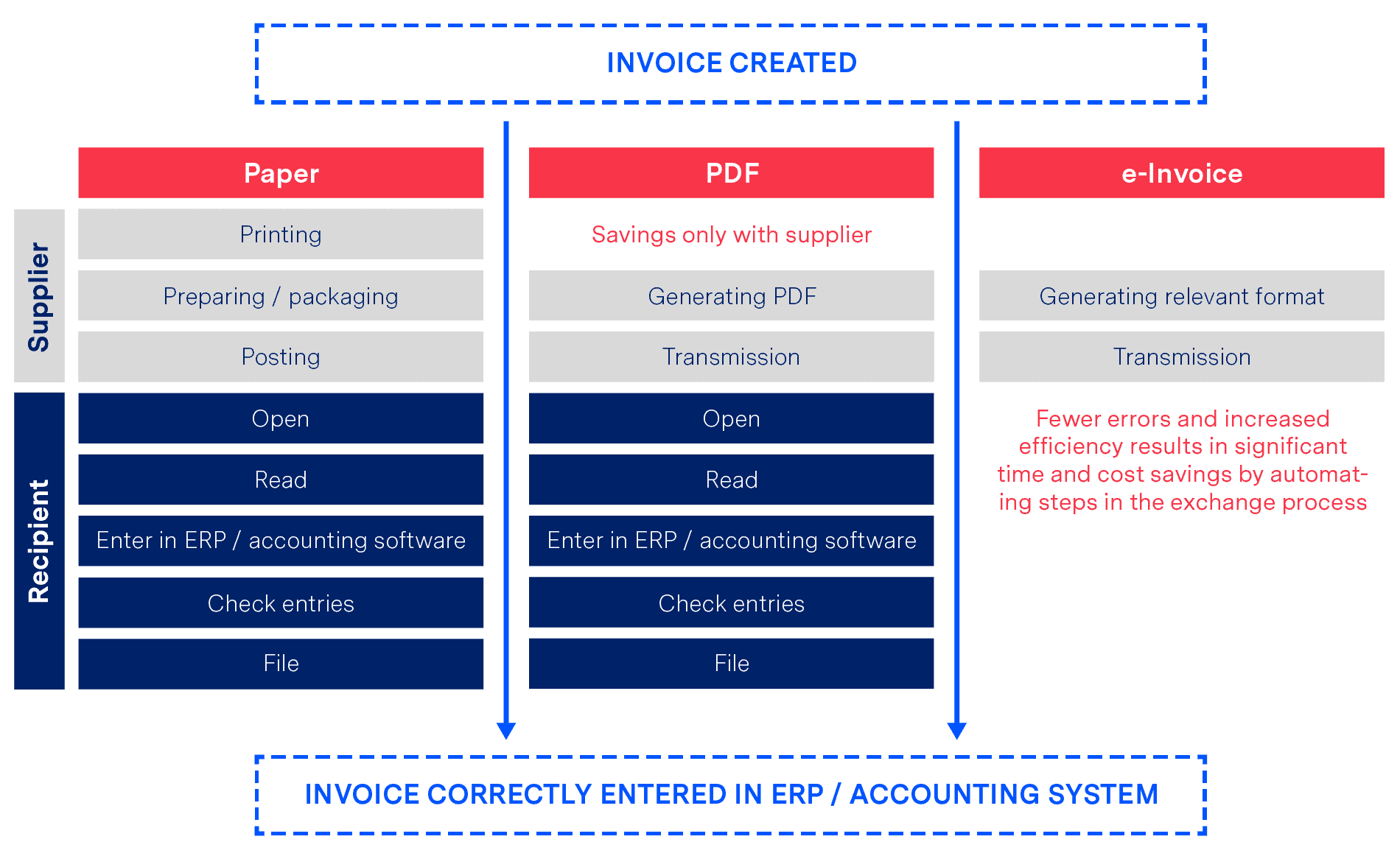
Surprisingly, paper invoices still make up a large percentage of the invoices exchanged today. Yet as the diagram below shows, this method is not only consumption heavy, it also requires significant effort compared to the alternative (e-invoicing).
The sender prints out the invoice, puts it in an envelope, stamps it and then posts it. However, the costs incurred are not limited to those relating to postage. Rather, it is the manual processes of invoice creation, which are reflected in personnel and infrastructure costs, that make the paper-based process expensive. Anyone who has ever written several invoices will be able to understand how complex and non-scalable paper-based invoicing is!
Interestingly enough, many also trust the post office “blindly” when sending invoices, simply assuming that the invoice will reach the recipient (which in most cases it does of course). However, a confirmation of receipt by the recipient is only available with the classic paper invoice for an additional charge.
PDF invoicing
Over the past decade more and more companies have moved from paper invoicing to PDF invoicing. This is due in part to the legal equivalence of the e-invoice with the paper invoice and the omission of the obligatory electronic signature. Instead of sending paper invoices, PDF documents are sent by email or offered for download. The latter option is mainly used in the B2C sector – e.g. when downloading the telecom bill.
For the sender of a PDF invoice, effort is reduced to the generation of the PDF (which is usually done automatically from the IT system) and the dispatch (which is also mostly done automatically). Admittedly this represents a significant improvement compared to paper invoicing.
However, the process is still problematic on the recipient’s side as they are still confronted with a media break, as with a paper invoice. In other words, the data cannot be transferred automatically from the PDF into the ERP/accounting system. Instead, the recipient is required to type it in manually or transfer it using copy & paste.
The reason for this is the PDF format itself. Unfortunately many people mistakenly believe PDF invoicing comes under the banner of e-invoicing. However this is not the case as a PDF is not a structured, machine-processable document format, but is instead designed to be human-readable. Formats such as XML, CSV or EDIFACT are far more suitable for automated document exchange.
E-invoicing
When an e-invoice is sent, the invoice is generated on the sender’s side in a machine-processable format (e.g. EDIFACT or XML) and then sent directly to the recipient’s IT system. There the e-invoice is absorbed by the IT system without human intervention and is immediately available for further processing (e.g. invoice verification and approval).
In contrast to paper or PDF invoices, no manual steps need to be taken and the process can be fully automated.
Furthermore, the sender (depending on the technical protocol used for invoice transmission) receives a corresponding confirmation as soon as the recipient has received the invoice.
So how do these methods compare in real terms?
The diagram below shows the steps involved in the sending and receipt of different types of invoice:
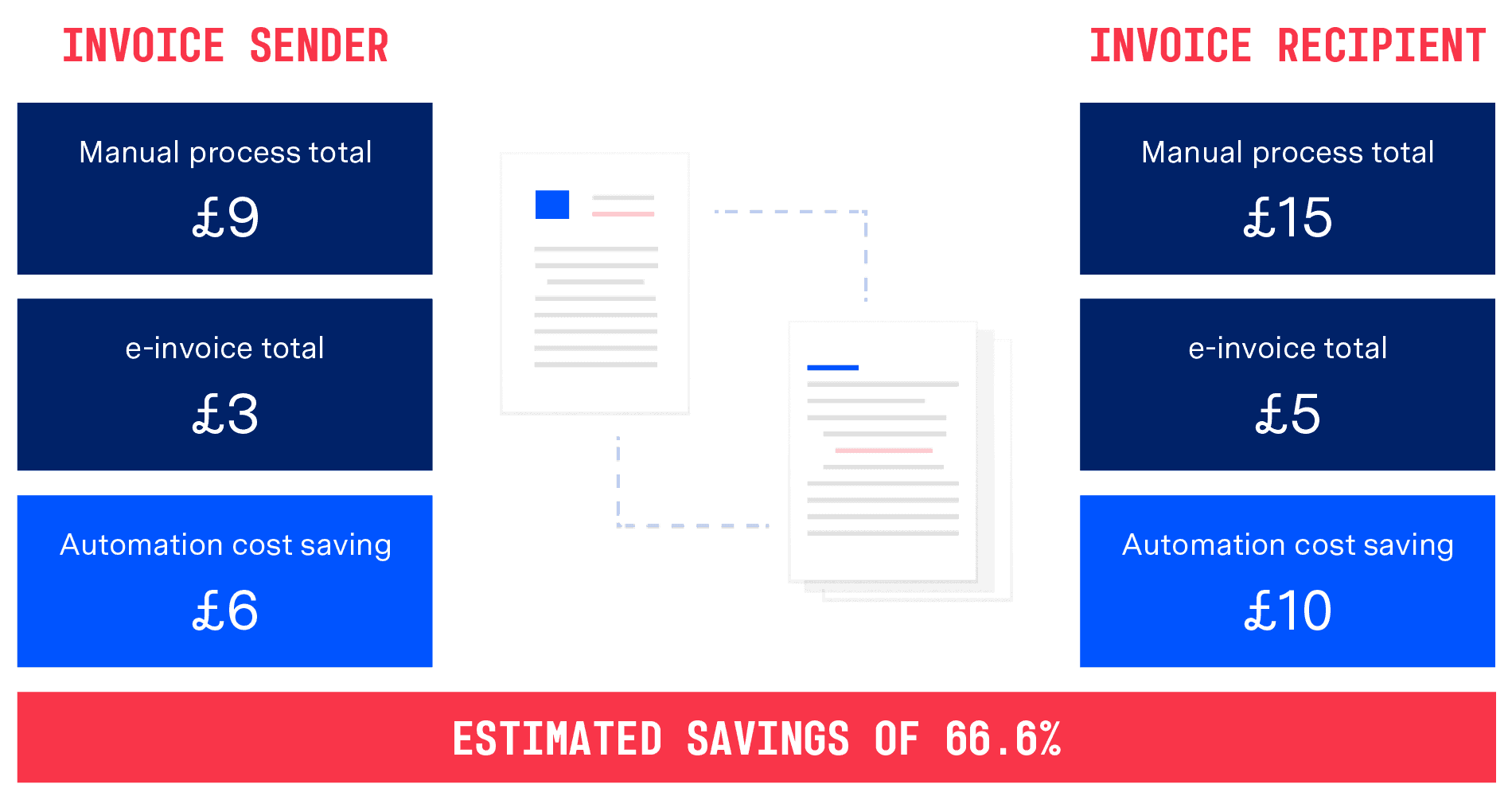
Predictably, the reduced steps also have a sizeable impact on cost. Based on numerous reports from IBM, GS1, EY and others the average cost for a company to process a single document manually is roughly around £15. These calculations consider FTE costs, opportunity costs of more value-adding activities, errors, delays and postage/fax fees (if relevant).
With an efficient EDI system in place the cost to send and receive an invoice can be reduced by two thirds!
The benefits of e-invoicing at a glance
So what are the specific benefits of using e-invoicing?
- Savings in time, shipping and personnel costs
The tedious paper-based invoicing process, from printing to postage, is completely avoided. Personnel who were previously responsible for invoicing can now be assigned to other activities. The company can concentrate on its core business again and doesn’t need to spend resources on complex support processes such as accounting. The recipient in turn is relieved from manually processing the received invoice, as the invoice data can be automatically transferred to the ERP/accounting system. - Reduced material costs
Costs for paper, printer, enveloping etc. are reduced. - Faster payment due to faster processing
The payment periods for invoices usually begin to run upon receipt of the invoice. As an electronically sent invoice is immediately available to the recipient, earlier and (hopefully) timely payments are the result. - Reduction of input errors
With the continuous automation of the invoicing process and the elimination of manual intervention, input errors are reduced to a minimum. - Simplification of archiving
According to legal regulations, companies must store invoices for future audits by the tax authorities. The length of time varies from country to country (usually between 5 and 10 years). Paper invoices are generally not well suited for long-term storage. Fire or water damage to the archive can potentially result in the loss of archived invoices. Consequences for the company in such cases can be very expensive – the tax authorities then typically start to estimate – mostly not to the advantage of the company. In the case of electronic invoice transmission, the invoice data is already available in electronic form and can therefore be very easily integrated into an electronic archiving system. With appropriate backups and data mirroring (which are standard in contemporary archiving systems), invoice data remains secure and available. - Less paper consumption
How ecosio can help
At ecosio we are experts in e-invoicing and were one of the first certified Peppol access point providers in Europe. Our team of EDI experts is well equipped to help your business benefit from automated invoicing not only with public bodies, but across your supply chain as a whole.
Uniquely, at ecosio we take care of virtually all the work necessary to allow you to trade structured electronic documents with your business partners. Unlike other so-called ‘managed’ solutions which offer customers minimal assistance when it comes to setup, testing, maintenance and error handling, ecosio offers a fully managed service, resulting in maximum efficiency with minimal internal effort. Every customer is assigned a dedicated project manager who will oversee implementation and ongoing operation of the solution, ensuring a successful outcome.
Your advantages with ecosio
- Compliance – No need to worry about e-invoicing regulations
- Cost-saving – Replace cost heavy manual processes with efficient automation
- Flexibility – Modular supply chain solutions to suit your needs
- Future-Proof – Automatic implementation of updates and renewal of certificates
- Peace of Mind – Comprehensive support and 24/7 monitoring
- Ease of Use – Direct integration in your ERP system via API
- Simplicity – One connection for all EDI partners
Find out more
To find out more about ecosio’s e-invoicing solution and how we could help you to experience the benefits of e-invoicing, get in touch today!
Chat with usDer Beitrag The Benefits of E-invoicing – An Introduction erschien zuerst auf ecosio.
]]>Der Beitrag How to Plan an EDI Project Correctly erschien zuerst auf ecosio.
]]>To help ensure you don’t experience the same issues as others, in this article we’ll briefly outline some of the most common mistakes made by businesses when preparing for an EDI implementation/migration project and what you can do instead during this stage to increase the chances of a successful outcome.
Where people go wrong
So why do so many businesses end up with an EDI solution that doesn’t fit their unique requirements well?
While there are many potential answers to this question, the most common reasons for this failure include ignorance of the different options available and haste to implement a solution. As a result, whilst they may gain the ability to trade automated messages with partners, businesses with little in-house EDI expertise, for example, often find themselves having to put in a lot more time and effort to the operation and maintenance of their new systems post-implementation than expected.
Similarly, by not considering future needs when selecting an EDI system, companies typically find themselves trapped in ill-suited solutions, with providers charging substantial amounts to implement the necessary upgrades.
For example, a supplier may initially intend to conduct all customer onboardings in-house and select a solution accordingly. However, after their trading partner network begins to grow and internal teams recognise how time-consuming managing partner onboarding internally can be, they may want their provider to handle future customer onboardings to prevent inhibiting future growth. More often than not this will not come cheap – especially if you are already tied into a long contract!
What you can do to improve the success of your EDI project
To achieve the best outcome for your EDI project, it is important to take ownership of the planning stage internally and not outsource this to a provider or consultant. You know your business better than anyone else, and by outsourcing the planning stage you sacrifice visibility and control of the process and subsequent decision.
It is imperative, however, that the planning stage includes an EDI expert, whether this is an internal or external person/team. For a business without in-house EDI expertise, for example, an ideal planning setup would be an internal decision-making team which understands the current and future needs of the business, supported by an experienced EDI vendor that can suggest improvements and cost-saving optimisations.
In terms of specific considerations during this stage, arguably the most important is to ensure your business has sufficient resources to run and maintain whichever EDI solution you select. A helpful breakdown of the amount of help provided by different types of EDI provider (and thus how much internal work will be required) can be found in our detailed infographic on this subject.
Want more information?
This article constitutes one of the seven mistakes we cover in our white paper The 7 Most Expensive Mistakes EDI Solution Buyers Make… And How to Avoid Them.
Download your copy of “7 Key EDI Mistakes to Avoid” and find out how you can boost the success of your EDI project and optimise existing processes, simply fill in your details.
Alternatively, if you have any questions about your particular situation or anything else EDI related, feel free to get in touch! We are always happy to help!
Der Beitrag How to Plan an EDI Project Correctly erschien zuerst auf ecosio.
]]>Der Beitrag The Benefits of E-invoicing – An Introduction erschien zuerst auf ecosio.
]]>On the one hand, this shift naturally means a change in invoicing processes – something that some may view with trepidation. On the other hand, however, e-invoicing brings many advantages to supply chain businesses. In this article we’ll explore these briefly in the context of the other commonly-used alternatives.
Paper invoicing
Surprisingly, paper invoices still make up a large percentage of the invoices exchanged today. Yet as the diagram below shows, this method is not only consumption heavy, it also requires significant effort compared to the alternative (e-invoicing).
The sender prints out the invoice, puts it in an envelope, stamps it and then posts it. However, the costs incurred are not limited to those relating to postage. Rather, it is the manual processes of invoice creation, which are reflected in personnel and infrastructure costs, that make the paper-based process expensive. Anyone who has ever written several invoices will be able to understand how complex and non-scalable paper-based invoicing is!
Interestingly enough, many also trust the post office “blindly” when sending invoices, simply assuming that the invoice will reach the recipient (which in most cases it does of course). However, a confirmation of receipt by the recipient is only available with the classic paper invoice for an additional charge.
PDF invoicing
Over the past decade more and more companies have moved from paper invoicing to PDF invoicing. This is due in part to the legal equivalence of the e-invoice with the paper invoice and the omission of the obligatory electronic signature. Instead of sending paper invoices, PDF documents are sent by email or offered for download. The latter option is mainly used in the B2C sector – e.g. when downloading the telecom bill.
For the sender of a PDF invoice, effort is reduced to the generation of the PDF (which is usually done automatically from the IT system) and the dispatch (which is also mostly done automatically). Admittedly this represents a significant improvement compared to paper invoicing.
However, the process is still problematic on the recipient’s side as they are still confronted with a media break, as with a paper invoice. In other words, the data cannot be transferred automatically from the PDF into the ERP/accounting system. Instead, the recipient is required to type it in manually or transfer it using copy & paste.
The reason for this is the PDF format itself. Unfortunately many people mistakenly believe PDF invoicing comes under the banner of e-invoicing. However this is not the case as a PDF is not a structured, machine-processable document format, but is instead designed to be human-readable. Formats such as XML, CSV or EDIFACT are far more suitable for automated document exchange.
E-invoicing
When an e-invoice is sent, the invoice is generated on the sender’s side in a machine-processable format (e.g. EDIFACT or XML) and then sent directly to the recipient’s IT system. There the e-invoice is absorbed by the IT system without human intervention and is immediately available for further processing (e.g. invoice verification and approval).
In contrast to paper or PDF invoices, no manual steps need to be taken and the process can be fully automated.
Furthermore, the sender (depending on the technical protocol used for invoice transmission) receives a corresponding confirmation as soon as the recipient has received the invoice.
So how do these methods compare in real terms?
The diagram below shows the steps involved in the sending and receipt of different types of invoice:
Predictably, the reduced steps also have a sizeable impact on cost. Based on numerous reports from IBM, GS1, EY and others the average cost for a company to process a single document manually is roughly around £15. These calculations consider FTE costs, opportunity costs of more value-adding activities, errors, delays and postage/fax fees (if relevant).
With an efficient EDI system in place the cost to send and receive an invoice can be reduced by two thirds!
The benefits of e-invoicing at a glance
So what are the specific benefits of using e-invoicing?
- Savings in time, shipping and personnel costs
The tedious paper-based invoicing process, from printing to postage, is completely avoided. Personnel who were previously responsible for invoicing can now be assigned to other activities. The company can concentrate on its core business again and doesn’t need to spend resources on complex support processes such as accounting. The recipient in turn is relieved from manually processing the received invoice, as the invoice data can be automatically transferred to the ERP/accounting system. - Reduced material costs
Costs for paper, printer, enveloping etc. are reduced. - Faster payment due to faster processing
The payment periods for invoices usually begin to run upon receipt of the invoice. As an electronically sent invoice is immediately available to the recipient, earlier and (hopefully) timely payments are the result. - Reduction of input errors
With the continuous automation of the invoicing process and the elimination of manual intervention, input errors are reduced to a minimum. - Simplification of archiving
According to legal regulations, companies must store invoices for future audits by the tax authorities. The length of time varies from country to country (usually between 5 and 10 years). Paper invoices are generally not well suited for long-term storage. Fire or water damage to the archive can potentially result in the loss of archived invoices. Consequences for the company in such cases can be very expensive – the tax authorities then typically start to estimate – mostly not to the advantage of the company. In the case of electronic invoice transmission, the invoice data is already available in electronic form and can therefore be very easily integrated into an electronic archiving system. With appropriate backups and data mirroring (which are standard in contemporary archiving systems), invoice data remains secure and available. - Less paper consumption
How ecosio can help
At ecosio we are experts in e-invoicing and were one of the first certified Peppol access point providers in Europe. Our team of EDI experts is well equipped to help your business benefit from automated invoicing not only with public bodies, but across your supply chain as a whole.
Uniquely, at ecosio we take care of virtually all the work necessary to allow you to trade structured electronic documents with your business partners. Unlike other so-called ‘managed’ solutions which offer customers minimal assistance when it comes to setup, testing, maintenance and error handling, ecosio offers a fully managed service, resulting in maximum efficiency with minimal internal effort. Every customer is assigned a dedicated project manager who will oversee implementation and ongoing operation of the solution, ensuring a successful outcome.
Your advantages with ecosio
- Compliance – No need to worry about e-invoicing regulations
- Cost-saving – Replace cost heavy manual processes with efficient automation
- Flexibility – Modular supply chain solutions to suit your needs
- Future-Proof – Automatic implementation of updates and renewal of certificates
- Peace of Mind – Comprehensive support and 24/7 monitoring
- Ease of Use – Direct integration in your ERP system via API
- Simplicity – One connection for all EDI partners
Find out more
To find out more about ecosio’s e-invoicing solution and how we could help you to experience the benefits of e-invoicing, get in touch today!
Der Beitrag The Benefits of E-invoicing – An Introduction erschien zuerst auf ecosio.
]]>Der Beitrag What Exactly Does an EDI Implementation Project Involve? erschien zuerst auf ecosio.
]]>Transitioning to a B2B integration solution that better suits your business’s needs can drastically improve efficiency and costs over the long term. Even when the benefits of upgrading existing B2B processes and providers are well understood, however, many decision makers still put off EDI implementation projects as they mistakenly believe that the process will be long and frustrating. As we will explore, this need not be the case.
In this article we’ll go through the different stages involved in an EDI implementation, shedding light on each step. Hopefully, by the end you will have a clearer picture of what’s required to achieve a successful outcome.
Choosing the right provider
Unsurprisingly, the first step in any successful EDI implementation project is selecting the right provider to move forward with. As EDI contracts are generally fairly long and EDI is integral to the success of supply chain businesses, this process should not be rushed!
Some key questions to ask when assessing and selecting a provider include:
- How much work are you willing to do internally?
- Do you have in-house EDI expertise?
- What are your possible future requirements?
- Do they offer an API connection?
- Are they able to help reduce VAN costs?
- Do they have the necessary certifications?
- Do they have sufficient technical expertise?
- Is the solution user-friendly?
- Do they offer round the clock message monitoring?
- How easy is it to get hold of someone if errors occur?
- Is the solution future-proof?
- Are there hidden costs?
Developing a project strategy
Once you have selected your provider it is then necessary to plan the most suitable strategy for EDI rollout (ideally with input from your new provider). More often than not the most effective method of EDI implementation involves a step-by-step approach to onboarding your partners, although this may not always be possible.
Three key questions to consider at this stage include:
- What is the proposed timeline?
- Are there any external factors that could influence this timeline that should be considered?
- What is the desired outcome?
Once you have agreed the timescale and desired outcome, the next step is to agree what order your partners should be onboarded in. This typically involves considering a number of different factors. These might include (for example):
- A partner’s value to your business
- Number of messages exchanged per month
- The potential for quick cost reduction (e.g. onboarding certain partners might enable you to remove unnecessary VAN costs)
- Urgency (e.g. if a business partner has changed EDI requirements and a new connection needs to be implemented asap)
- Location (e.g. by country)
- Current provider/solution
While your proposed EDI provider may be able to give valuable tips and suggestions to help you order your partners into suitable groups, this process should ideally be led by someone internal with a good knowledge of the partner network. After all – no-one knows your partners and their interaction with your business better than you!
Successful completion of this phase will ensure that you achieve the maximum value from your implementation in as little time as possible.
Connection to your ERP system
Though this step is not necessary for all solutions, it is essential if you want to benefit from good data visibility. An API connection (such as that offered by ecosio) allows for end-to-end message monitoring between you and your suppliers – all in your existing ERP interface, be that D365, NetSuite, SAP S/4HANA or any other system.
Apart from an API connection any other protocol of choice may be used to exchange data between your ERP system and your provider. In such cases AS2 or SFTP are generally the preferred methods. The one-time setup involves establishment and testing of the connection between you and your provider.
Testing and mapping setup
This stage requires significant experience and technical expertise. Essentially the success of this phase dictates the reliability of your partner connections and will determine how much work is required after go-live to correct errors and message failures.
In order to ensure your connections to your partners are dependable, mappings must be set up and tested thoroughly before anything is put live. This involves testing every possible iteration of all relevant document types. For example, oversights such as failing to test the exchange of invoices with and without VAT could cause big headaches following go-live.
As detailed in our useful infographic, the extent of assistance offered by solution providers during this stage varies widely. While those with on-premise solutions will have to conduct all mapping and testing in-house, those who opt for so-called “managed” EDI solutions may only receive basic mapping covering several standard document types. On the other hand, fully managed solution providers will need minimal input from their customers to complete a thorough testing process. Those who opt for such a solution should only be required to provide test data and check that information is correct from a business (not technical) perspective.
Breakdown of the technical steps of an ideal onboarding
Below is a breakdown of the many technical steps involved in a partner onboarding. It should be remembered, however, that while these are all important steps, the amount of assistance you will receive during these phases will vary hugely depending on which solution and provider you select.
| Reconciliation of communication protocols |
|
| Reconciliation of message format |
|
| Exchange of test messages |
|
| Parallel phase |
|
| Live operation |
|
For a more comprehensive overview of the supplier onboarding process, view our article “Supplier EDI Onboarding – The Seven Key Steps” on this topic.
What about ongoing support?
Although an EDI implementation project can be considered “done” once all connections have been put live and are working as expected, it should be remembered that EDI is an ongoing process. To ensure connections continue to function at maximum efficiency message monitoring is essential, while support and error resolution will also be needed from time to time.
If your provider does not offer sufficient support, internal processes must be put in place to ensure you are able to resolve issues quickly and efficiently before problems can escalate.
How ecosio handles EDI implementations
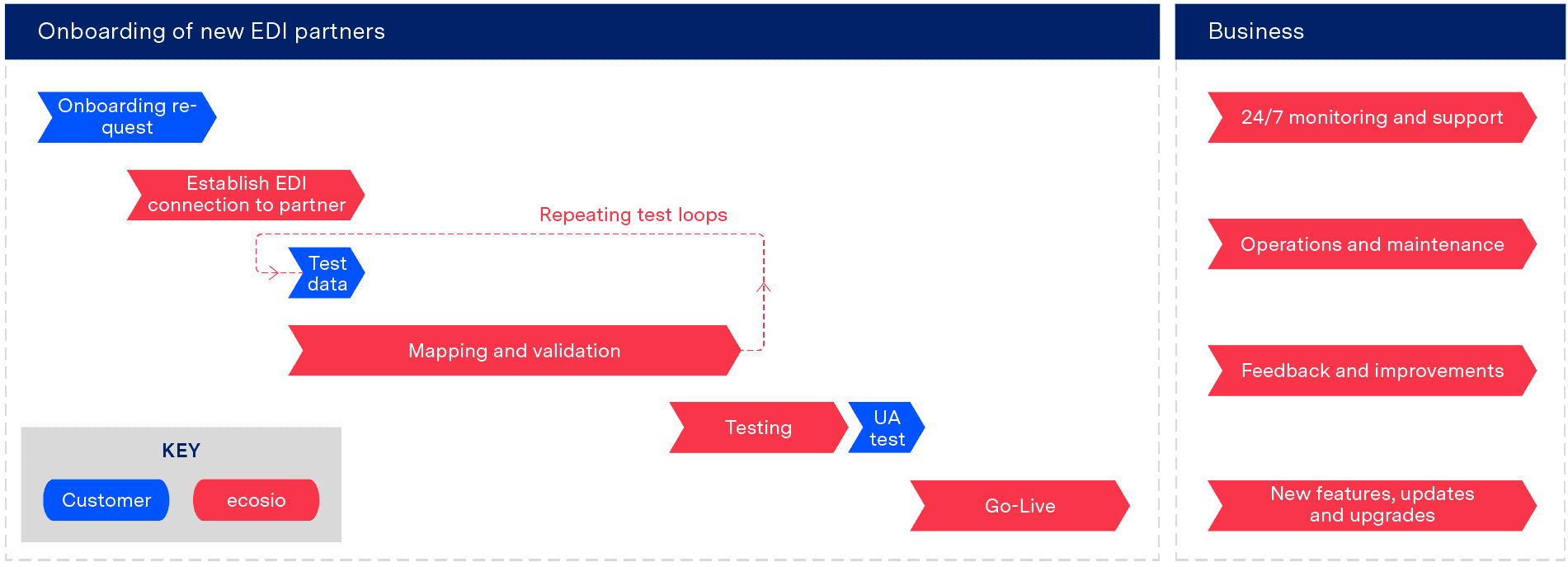
At ecosio we follow a phased approach. With every connection ecosio’s tried and tested process remains constant. The diagram below displays the steps involved in connecting new partners with ecosio.
As illustrated below (click to enlarge), ecosio’s process reduces the input needed from customers to the absolute minimum, both during and after go-live. We take care of everything, leaving businesses free to focus on what they do best!
During EDI implementation
To save you having to act as a middleman between us and your partners, we provide all customers with a dedicated project manager. As well as acting as a single point of contact for the company, they will chase your partners for the information necessary to ensure a strong and reliable connection is secured. All you have to do is provide us with test data.
After go-live
With ecosio, EDI does not end when the turn-key-ready connection is handed over – with us EDI is a continuous process. Customers will no longer have to endure the frustration of seeing cryptic error messages like “stuck in the first level”. ecosio’s operations team is always at hand to identify and resolve errors proactively.
What sets ecosio apart?
- Dedicated experts who are fully committed to EDI.
- Deep EDI process know how – not just EDI message jugglers, but experts, who can challenge an EDI message in detail if necessary.
- Excellent tool support custom-tailored to EDI projects. This facilitates the communication between all EDI partners and also among the EDI project managers and document mappers at ecosio.
- Dedicated test environment and fully functional test-bed, where connections can be tested until they are production-ready.
Find out more
To learn more about how we could help you to benefit from efficient EDI, get in contact today.
Der Beitrag What Exactly Does an EDI Implementation Project Involve? erschien zuerst auf ecosio.
]]>Der Beitrag Migration to SAP S/4HANA – 5 key considerations erschien zuerst auf ecosio.
]]>- Migrating to SAP S/4HANA is a complex, full ERP implementation, not a simple upgrade, so early planning is essential
- Archiving unused custom code and rethinking EDI integration can significantly streamline migration and reduce long-term effort
- Cloud-based, managed EDI solutions offer flexibility, 24/7 monitoring and reduced internal workload, especially important for S/4HANA Cloud setups
- Choosing the right EDI partner ensures long-term scalability, smooth onboarding, proactive support, and compatibility with SAP Cloud PI
While 2025 may signal many things to different people, for those working in IT for supply chain organisations currently using SAP systems, it is synonymous with one key deadline. 2025 is, of course, the deadline set by SAP for businesses to migrate to their new and improved system S/4HANA, after which supposedly they will no longer provide support for older systems. Whilst this may seem a generous deadline, as we shall explore in this article, transitioning to S/4HANA is by no means a simple process. In addition to the time-consuming exercise of migration itself, for those considering the move to S/4HANA the next few years offers a unique opportunity to refresh and update other key business processes, such as electronic data interchange (EDI), to ensure their businesses are in the best possible position when 2025 comes around.
In this article we’ll look at five key questions that anyone who is likely to be involved in coordinating a migration to S/4HANA should consider before proceeding.
1 – What iteration of S/4HANA is a good fit for your organisation?
Undoubtedly S/4HANA represents an exciting advance in ERP software and comes with considerable advantages. Key benefits include:
- Simplicity – The SAP Business Suite data model has been hugely simplified following the impact of the SAP HANA in-memory platform. Specifically, SAP has been able to remove (or reduce the number of) several table types from the data model. As a result, in addition to a significant reduction in your database’s memory footprint, your new system should also run faster.
- Ease of Use – Thanks largely to the above simplification, S/4HANA users also benefit from an improved user experience. S/4HANA makes heavy use of SAP’s new and improved user interface based on SAP Fiori apps.
- Future-proof solution – Another key benefit of transitioning to S/4HANA is the improved approach towards updates. Whereas previously new functionalities had to be manually switched on by in-house teams, with the S/4HANA cloud systems, updates will be implemented quarterly, removing the possibility of updates being delayed due to lack of in-house resources.
There are four basic options for businesses considering migration to SAP S/4HANA: self-hosted and on-premise, hosted by a hosting partner, private managed cloud and cloud ERP. The following Figure gives an overview of the different options.
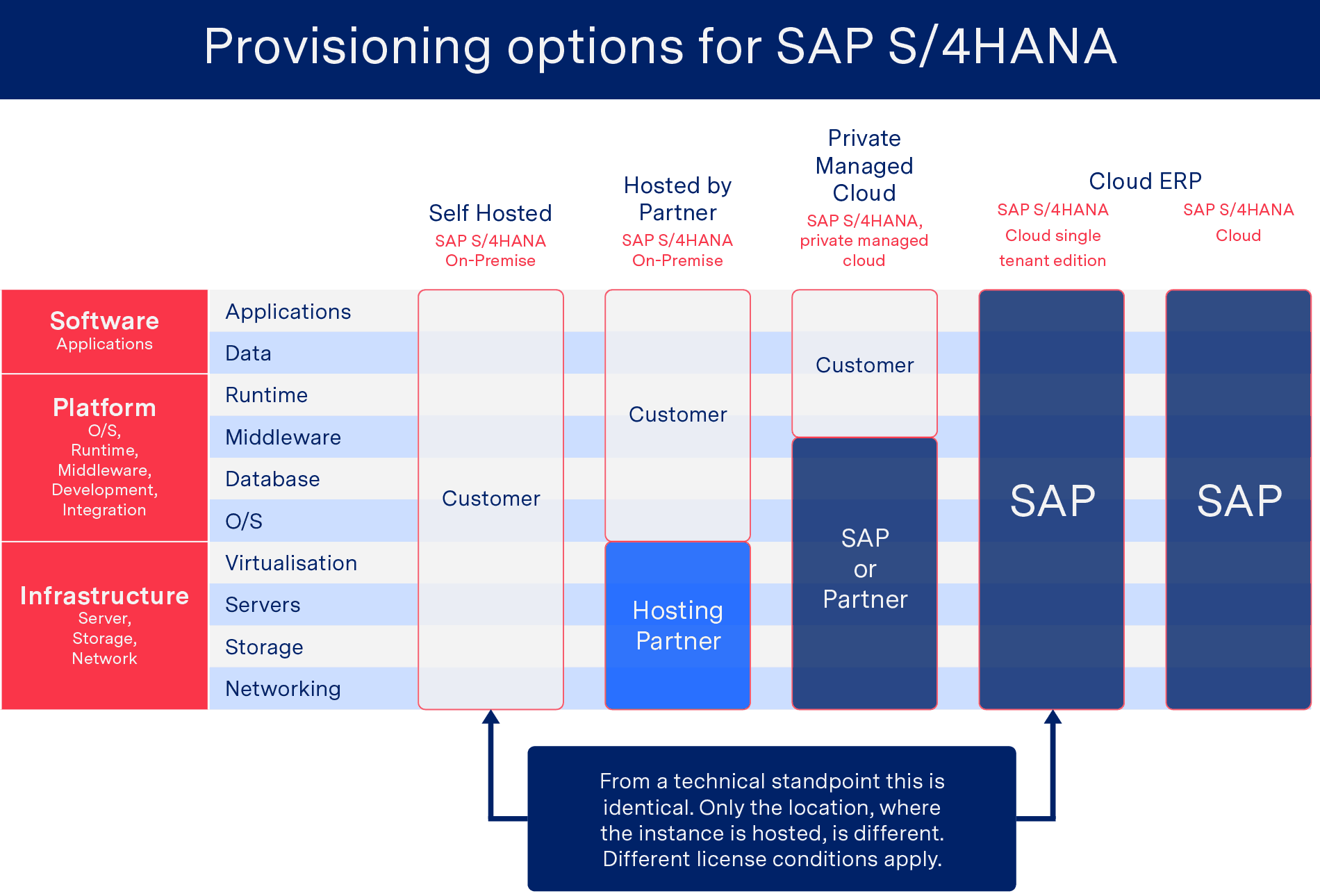
Migration to SAP S/4HANA – SAP Provisioning Platforms
The Cloud ERP solution is available in two different versions. The single tenant solution is hosted by SAP for a single tenant (= company), also allowing for company-specific code and system extensions. The SAP S/4HANA Cloud is a classic cloud-based software solution, where multiple different companies share the same SAP instance. The multi-tenant solution allows for less company-specific customisations than the Single Tenant Cloud edition. If a company seeks to implement custom adaptations or extensions to third party software solutions for the multi-tenant edition, they can be achieved through the SAP Cloud Platform.
It is important to remember, however, that every business is different and the most effective system for your company is unlikely to be any of the above ‘out-of-the-box’ solutions. Increasingly forward facing businesses are transitioning to so-called ‘postmodern’ ERP systems (those in which more suitable or tailored system packages from independent providers are integrated with standard ERP elements) in order to achieve the most efficient solution for them. Whilst postmodern ERP arrangements can prove complicated to set up and integration can, if handled poorly, jeopardise data integrity, intelligent integration of solutions better suited to your business’s needs (such as managed EDI) will produce a flexible and future-proof ERP environment.
Regardless of what system you are currently using or what version of S/4HANA you are looking to move to, the switch to S/4HANA is less of an upgrade and more of a full ERP implementation project. As migration is likely to be extremely heavy on in-house time and resources, it makes sense to consider what an optimum ERP landscape would look like for your business in advance of progressing with implementation. After all, if you are going to invest a huge amount of effort into the transition to S/4HANA, you may as well aim to finish with a system as closely tailored to your organisation’s needs as possible!
2 – “When should I start the migration process?”
According to SAP, moving from traditional SAP systems to SAP S/4HANA should take between 12 and 18 months. However, according to research from Gartner, companies that have already started the process have reported that migration to SAP S/4HANA can take far longer, with key steps potentially taking as long as the entire migration reportedly should.
“Migration” vastly underestimates the level and scope of transformation involved in adopting SAP S/4HANA. This is not a straightforward movement of your existing data and processes from one location to another. It’s more like you’re trying to relocate from the house you’ve lived in for the past 20 years to a more modern city apartment.
Wolfgang Platz – Founder & Chief Strategy Officer, Tricentis
With the above in mind, assuming you have identified the best ERP solution for you moving forward, it makes sense to start the migration process as early as possible. In addition to ensuring you have enough time to complete the transition to S/4HANA, starting the process earlier may save your business money, as implementation costs are likely to rise as the 2025 deadline approaches.
3 – Have you archived legacy data in preparation for migration to SAP S/4HANA?
Given the size of the task facing in-house IT teams, identifying effective methods of speeding up the migration process may prove crucial. With this in mind, perhaps the most worthwhile preparatory step a business can take in advance of transitioning is to archive legacy ERP custom code. Studies have shown that the majority of ABAP code is customer-specific code, a large proportion of which generally remains unused after being created. Migration to SAP S/4HANA offers a good opportunity to give your ERP system a spring clean. By completing this exercise in advance of migration you will benefit from a reduced migration volume and thus reduced financial and time costs. It really is a win-win!
4 – Should I move to a cloud-based EDI approach or will older EDI systems still be compatible?
With such a large-scale transition involving changing the source of EDI data (i.e. your ERP system) there will always be risks. Given the scope of the work involved in migration to SAP S/4HANA your EDI solution will inevitably be affected at some stage during the process. With this in mind it makes sense to use this as an opportunity to transition to a future-proof EDI solution. Moreover, thanks to the modern features of S/4HANA some older EDI solutions may simply not be compatible.
As explored in detail in our white paper in which we compare the benefits of on-premise and cloud-based EDI solutions, cloud-based EDI offers numerous advantages, such as flexibility, scalability and predictable pricing.
Significantly, while (as illustrated in the above diagram) the SAP S/4HANA multi-tenant cloud option offers only limited customisation, it is still possible for users with this system to integrate an external EDI solution into their ERP landscape. This means all users of S/4HANA have the opportunity to benefit from more efficient EDI in addition to the new features of S/4HANA, regardless of what system they opt for.
5 – Which cloud-based EDI approach shall I choose?
Thanks to the number of cloud-based EDI providers out there, selecting the right EDI partner can be a complicated process unless you know what to look for. Yet, much like deciding to upgrade your ERP to S/4HANA, selecting the right EDI solution for your business constitutes an important step towards future-proofing your organisation.
On the face of it, the most obvious candidate for a cloud-based EDI platform for businesses looking to move to S/4HANA is the SAP Cloud Platform Integration (or SAP Cloud PI for short). However, significantly SAP Cloud PI is an entirely unmanaged solution, meaning that everything is dependent on your in-house resources. Whilst this could potentially be a viable solution for businesses that have a wealth of in-house EDI expertise, for companies looking to optimise business data processes and streamline in-house resources a managed, cloud-based EDI solution represents a far more attractive option.
As we’ve already touched on, one of the common criticisms levelled at postmodern ERP setups is that the improved flexibility they offer comes at the price of additional complexity. However, when it comes to implementing a managed EDI solution with S/4HANA, whether your business opts for on-premise, private cloud or multi-tenant cloud, the end result will be a significant reduction in user complexity and required internal effort.
When considering potential managed EDI providers, make sure to consider the following:
- Are they compliant with SAP Cloud PI? – If you opt for either S/4HANA’s private cloud or multi-tenant cloud system, you will need to select an EDI provider (such as ecosio) that is compliant with SAP Cloud PI and can connect to your new ERP system. Unlike on-premise S/4HANA systems, where EDI connections can be set up via any channel (API, EPO Connector, SAP PI/PO, Business Connector, Local Converter etc.), with cloud-based S/4HANA systems, EDI integration must happen via SAP Cloud PI.
For businesses running both on-premise and cloud systems, SAP Cloud PI can be used as a gateway to connect all systems to the EDI provider. - Do they offer 24/7 monitoring? – Undoubtedly the biggest benefit of choosing a managed EDI service is that it should relieve you of the responsibility of monitoring incoming and outgoing data. Choosing a provider that offers effective, round-the-clock monitoring will mean you will no longer have to check that messages have been sent and received, that certificates have been renewed, or that the correct e-invoicing protocols are being followed.
- How comprehensive is their support? – Unfortunately, the level of support offered by EDI solution providers often leaves a lot to be desired. Asking about the specifics surrounding the support you can expect may help you avoid frustrating and potentially costly situations when you experience issues further down the line.
- How simple is partner onboarding? – The key here is to select a provider who will manage the onboarding process from start to finish. With a dedicated project manager partner onboarding becomes a simple and streamlined process. Choosing a provider who offers Web EDI is also essential if you want to connect to partners that don’t have EDI systems.
- Do they implement ongoing updates? – It makes sense that in order to future-proof your business you should select an EDI provider that is committed to implementing ongoing updates. For example, not every managed EDI provider provides access to Peppol, which can be disastrous when it comes to e-invoicing.
- Do they have “price cliffs”? – Again the key here is to think of your future needs as well as your current requirements. Many contracts include steep price rises (or “price cliffs”) if your EDI usage passes a certain point which can prove very costly.
Summary
In short, while 2025 may seem a long way off still, as we have covered, the journey to S/4HANA is a long one, and should ideally not be started without the necessary research and provisions. Given the scale of the task facing teams responsible for coordinating a migration to S/4HANA, it makes sense for decision-makers to use this time to consider what their ideal ERP would look like and upgrade or outsource other processes as necessary. Hopefully those who consider the above questions and make the effort to identify and implement the best solutions for them will ensure that 2025 starts to look less like a dark cloud on the horizon and more like the dawn of a new, more efficient era for their business.
Find out more
For more information about ecosio’s managed B2B integration solution and how it could help your business.
Alternatively, if you have questions about EDI and S/4HANA please contact us or use our chat – we are happy to help!
Discover more about our updated product, ecosio.flow.
SAP ERP and SAP S/4HANA are the trademarks or registered trademarks of SAP SE or its affiliates in Germany and in several other countries.
Der Beitrag Migration to SAP S/4HANA – 5 key considerations erschien zuerst auf ecosio.
]]>