Der Beitrag Is Cloud Migration the Future of B2B Integration? erschien zuerst auf ecosio.
]]>- Moving to the cloud cuts hardware and maintenance costs, improves reliability through redundant infrastructure, and delivers flexibility, scalability and resilience with better data visibility and automatic updates
- A recent survey found 65% of respondents expect cloud-based EDI to become the norm, while only 13% do not expect its popularity to grow
- Remaining on outdated on-premise systems can harm efficiency and increase long-term costs, especially when the total cost of ownership is underestimated by excluding time and personnel expenses
- Businesses still using locally-hosted software should assess whether cloud migration could improve efficiency and resilience, as migration projects do not have to be complex or disruptive
Over the past decade there has been a clear and continual shift by supply chain businesses away from hosting business-critical software locally. Whether it’s multiple department systems or just a lone software instance, the vast majority of businesses have participated in cloud migration to some extent, with Accenture calculating the adoption of cloud technologies to have grown from 82% to 95% between 2019 and 2021 alone.
When you consider the benefits of moving B2B processes to the cloud, it’s not hard to see why so many companies are doing so. From a cost perspective, moving to the cloud reduces expenses relating to hardware and maintenance. Further, while security concerns are often cited as a key reason not to move to the cloud, cloud-based solutions typically offer a redundant infrastructure, making them much more reliable than locally-hosted systems. Most compelling of all, however, is the flexibility, scalability and resilience offered by the cloud, as processes and resources can be adapted quickly and easily as needs change. What’s more, cloud-based solutions also often offer better data visibility and are typically updated automatically.
What we have found
In line with recent trends, in our recent survey we found that the vast majority of respondents (65%) expect cloud-based EDI to become the norm in the future, with only 13% of those surveyed not expecting cloud migration to become more popular.
The Future of B2B Integration Survey, 2024
What can you do?
If you are still running your systems via locally-hosted software, it’s worth considering if moving to the cloud could improve efficiency, flexibility and resilience. While sticking with your current solution may seem like the easier choice, migration projects don’t have to be difficult or disruptive, and sticking with an outdated system will cost your business dearly in the long run. When assessing your options, it’s also important to consider all related costs. Many businesses wrongly assume that on-premise solutions are more cost-effective purely because they fail to properly calculate the total cost of ownership by ignoring key factors such as time and personnel costs.
“Companies with modern technology architectures outperform their competitors with better customer service, more efficient operations, and stronger customer advocacy.”
Questions to ask yourself
- Would increased system flexibility help you in achieving strategic goals moving forward?
- How confident are you that you can retain sufficient in-house expertise to keep internal systems running smoothly as your business grows/evolves?
- Do you currently operate a redundant infrastructure or are you at risk of catastrophic data loss?
- Are you aware of what modern cloud-based B2B integration solutions can deliver?
- Could cloud migration benefit your business?
Want more information on EDI trends?
This article is based on a section from our recent report on The Future of B2B Integration, in which we share survey results as well as predictions concerning the most significant B2B integration trends. To download your free copy now, simply visit the report download page and enter your details!
Der Beitrag Is Cloud Migration the Future of B2B Integration? erschien zuerst auf ecosio.
]]>Der Beitrag How to Achieve B2B Process Automation Success erschien zuerst auf ecosio.
]]>Define your B2B process automation goals
The first and most important step in any complex business project is to define your goals. Even if your goals seem obvious, detailing exactly what you would like to achieve will help you to develop a roadmap, identify ways of measuring success, and prioritise resources effectively.
Sometimes, too, defining your specific goals will help to clarify to your team WHY you want to get to where you’re headed. Whether you’re looking to implement an e-invoicing solution or streamline communication with existing partners, agreeing on your exact goals will ensure everyone is on the same page and understands the plan and motivations.
Assess current capacity and internal resources
Once you’ve clarified your goals, the next step is to identify how able you are to achieve them with your current setup. This involves assessing both your technical capacity and the capability of your current personnel.
Technical capacity
When assessing technical capacity before a B2B process automation project, be sure to ask the following questions:
- Is our IT infrastructure able to support increased automation (e.g. via RPA, blockchain, API, EDI, etc.)?
- How well can our current systems integrate with electronic data interchange (EDI) and e-invoicing solutions?
- Would it be useful for different teams to have direct access to EDI/e-invoicing data so IT doesn’t become a bottleneck?
- Do we need redundant infrastructure?
- Are we likely to need the ability to convert messages to/from different EDI standards in the future?
- Are we likely to need the ability to send messages via different EDI protocols in the future?
- Will we need Peppol connectivity?
- Would a Web EDI solution be helpful to help automate exchanges with smaller suppliers?
- Would end-to-end visibility of EDI and e-invoicing data be helpful?
Personnel
When assessing the capacity of your existing team before starting your B2B process automation project, make sure to ask the following questions:
- Do we have sufficient technical expertise in-house?
- Would training be sufficient to upskill existing employees?
- Would our ability to operate be significantly disrupted by the absence or departure of certain individuals?
- How much time would team members be able to devote to new processes and tasks?
- Would team members be willing to adapt their roles and responsibilities if needed?
- How would pressure on internal resources be affected if B2B process automation requirements were to increase in the future?
- How will we keep track of new country-specific e-invoicing requirements?
After asking these questions you should have a clear picture of what level of automation is possible with your current system and which areas will need strengthening.
Consider outsourcing
For those businesses with limited internal resources, outsourcing is the obvious answer – particularly given the extent to which cloud computing has simplified external management of B2B process automation in recent years.
However, even those businesses with substantial internal resources may also benefit from outsourcing certain processes such as EDI or e-invoicing to specialised providers. Not only are such providers experts in these fields, and therefore able to implement processes and technical changes faster, they also typically offer added benefits such as redundant infrastructure, direct integration into your current ERP system, and simple scalability.
And perhaps most important of all, employing an external provider to manage B2B process automation enables your team to focus on what they do best!
Establish clear roles and responsibilities
For automation to succeed, everyone in your organisation needs to know their role in the process. Clear delineation of responsibilities ensures smooth implementation and ongoing management of B2B process automation efforts.
Make sure when assigning responsibilities not to forget potential future tasks though… as this can result in a decline in efficiency and enthusiasm.
For a detailed breakdown of the key roles in a typical EDI project, please see our dedicated blog article on this topic.
Prioritise data visibility and accessibility
Having automated processes is all well and good, but unless you have good visibility, efficiency can still suffer. No system is 100% error-free, and being able to identify an issue quickly and easily when one does arise can help ensure your system remains effective.
For example, the best EDI and e-invoicing solutions will enable users to search across all documents using any relevant identifier, and may even allow you to view the status of sent documents in real time.
Think long term!
When it comes to B2B process automation, change is the only constant. Technologies evolve, and so will your electronic data interchange (EDI) and e-invoicing needs.
Prioritising adaptability, scalability and sustainability is not just wise; it’s essential if you’re to be successful in the long term. Even if your EDI requirements are stable, your partner landscape is static and your internal team is committed right now, this will not always be the case. Unless your processes have been built with flexibility in mind, their efficiency will soon decline.
Don’t try to do too much too fast
Rome wasn’t built in a day, and neither is a robust B2B automation system. Start small, prioritise critical processes, and gradually expand your automation efforts to avoid errors and oversights.
For example, when onboarding EDI partners, rather than attempting to onboard all simultaneously, a more efficient approach would be to break your partners down into relevant groups (e.g. by country or value), and work through these groups one after the other.
Don’t be afraid to make big changes
Innovation often requires bold moves. While caution is wise, don’t shy away from making significant changes if they promise to improve B2B process automation.
As EDI and e-invoicing are so central to the everyday operations of modern day businesses, many people are scared to adapt running systems for fear of disrupting them. As a result, many businesses persevere with outdated technology for far too long. But of course, the longer you put off such a project, the less efficient your current solution will become!
While implementing a major B2B process automation project can be daunting, particularly for those who haven’t done so before, the benefits can be remarkable. Plus, thanks to the emergence of fully managed B2B process automation solution providers, there’s now no longer any need to stress about disruption to existing systems or insufficient internal resources!
Summary
In conclusion, achieving success in B2B process automation requires a strategic approach. By establishing clear roles, prioritising data accessibility, and adopting a measured approach to implementation, your business can harness the full potential of EDI, e-invoicing, and other B2B automation avenues to streamline operations, reduce costs, and enhance efficiency.
If you’re interested in learning more about how B2B process automation could transform your business, contact us to learn more about ecosio’s unique EDI solution.
Discover more about our updated product, ecosio.flow.
Der Beitrag How to Achieve B2B Process Automation Success erschien zuerst auf ecosio.
]]>Der Beitrag The Three Most Common EDI Pitfalls erschien zuerst auf ecosio.
]]>EDI PITFALL #1: Trying to do too much in-house
For businesses with large internal teams and a great deal of EDI expertise, handling EDI in-house may well be logical. Realistically, this solution only makes sense for very few businesses, however. Plus, even if you are a large player and you run a large EDI solution inhouse, there is potential for a fully managed EDI solution – e.g. on a “routing only” basis for instance. If you are considering handling EDI in-house, first ask yourself…
Will managing EDI in-house actually save me money?
When all the costs relating to mapping, message monitoring, partner communication, update installation, infrastructure hosting/renewal, staff etc. are factored in, inhouse solutions generally work out to be more expensive than fully managed solutions.
Will the solution be reliant on individuals?
No matter how well your solution is run, if its operation relies heavily on a few individuals your business is at risk. From sickness and injury to job change and retirement, there are many potential ways that a successful system can be disrupted when it is operated internally by a small number of people.
Does my team have the knowledge?
Unfortunately EDI expertise is rare. As a result, EDI tasks are often assigned to people for whom EDI is not their main area of expertise. What’s more these people also typically have to juggle EDI tasks with their other responsibilities. With time, such a situation can lead to a deterioration in efficiency and to a dependency on individual persons in the company.
Can my team cope with the workload?
Even if your team IS very experienced in EDI, change (e.g. to your EDI or ERP infrastructure) and growth (e.g. new onboardings or mergers/acquisitions) can still result in workloads increasing rapidly, which reduces the speed of potential expansion, multiplies the likelihood of errors occurring, and decreases the flexibility to react to upcoming changes.
Could staff be adding more value elsewhere?
By having to focus on message exchange, internal teams are also prevented from focussing on more value-adding activities. Moreover, with internal solutions the responsibility for successful message exchange lies completely with the company in question.
50% of respondents noted that moving to fully managed EDI freed up existing IT staff for other productive activities.
University of Tennessee Study
EDI PITFALL #2: Not looking at the bigger picture
Unfortunately, people are often unaware of how inefficient and complex their EDI solutions are. Instead of looking at the bigger picture and seeking to improve key processes, people are typically more concerned with ensuring their current system is running correctly. As a result, many businesses persevere with inefficient EDI systems for far too long. It’s important to remember that just because supply chains can be complex, it doesn’t follow that your EDI landscape has to be too.
With this in mind, it is important to…
Avoid multiple solutions where possible
As EDI needs change and partner networks grow, it’s common for more EDI connections to be added over time (e.g. to handle the routing of messages via a new Value Added Network (VAN)). This increases complexity, which in turn increases the time needed to complete operational tasks… and thus costs. Plus higher complexity means more chance of message failures occurring and difficulty in finding the error source quickly.
Implement a system that will allow for easy growth
Flexibility is key when selecting an EDI solution. By neglecting to implement a solution that can evolve alongside your business and in step with relevant industry and regulatory developments, you may be inhibiting your capacity to grow.
By 2025, 80% of B2B sales interactions between suppliers and buyers will occur in digital channels.
EDI PITFALL #3: Being scared of changing a running system
Given how central EDI is to modern supply chains, it’s understandable that decision makers want to avoid disruption at all costs. However, it is important to note the following…
Just because your system is running, it doesn’t mean it isn’t holding you back!
While EDI ostensibly serves just one main purpose – streamlining data exchange between business partners – EDI solutions differ greatly from one another in terms of the success with which they manage this and the benefits they offer to users. Those without fully managed EDI are missing out on the full potential EDI has to offer and will be at a competitive disadvantage!
Change doesn’t mean disruption
As all testing is conducted on a parallel system and thoroughly checked before being put live, there is no risk associated with moving to a fully managed solution.
Failing to switch will continue to hold you back
Ironically, by delaying switching to a more efficient and reliable solution out of fear of disrupting existing processes, you are taking a far bigger risk than by simply migrating!
By using electronic invoice messages for 84% of its purchase orders, the UK retail grocery sector saved £193m in one year.
Want more information?
This article is taken from our white paper “A CIO’s Guide to Electronic Data Interchange”. In this white paper we also explore the reasons behind the recent shift towards fully managed EDI, how an efficient EDI solution can benefit your business, and the simple steps you can take to ensure you select the right solution.
Download your free copy of “A CIO’s Guide to Electronic Data Interchange”, simply enter your details.
Alternatively, if you have any questions about your particular situation or anything else EDI related, please do not hesitate to get in touch! We are always happy to help however we can.
Der Beitrag The Three Most Common EDI Pitfalls erschien zuerst auf ecosio.
]]>Der Beitrag Four steps to help you identify which EDI solution is best for you erschien zuerst auf ecosio.
]]>To help we’ve identified four simple steps decision makers should take before selecting a provider…
1) Fully assess internal capability

Every business is different. Thus, in order to get the best possible solution for your particular situation, it’s important to first understand your capabilities fully. By conducting a thorough assessment of your current infrastructure, processes, technology and partner matrix you will gain a good idea of which type of solution a) you can handle, and b) will deliver the most efficient results. During this step it is important not to underestimate the work involved in maintaining a successful solution (from setup and partner onboarding to monitoring, error handling and updates).
2) Consider future needs

It’s only natural that as time passes and your partner network evolves, your EDI requirements will also change. As a result, selecting a flexible solution is imperative. Choosing a provider that can adapt to accommodate your needs will ensure your partner connections can continue to operate at maximum efficiency no matter what happens.
3) Look at what’s possible

As internal IT teams are typically focussed on running existing EDI processes, it is no surprise that many businesses are unaware of what’s possible today when deciding which EDI solution to choose. Further, this is often compounded by the fact that EDI projects can be rushed as teams hurry to find a solution to satisfy new requirements. As a result, businesses may not even be aware of the possibility of achieving a solution offering benefits such as a full-text search or deep ERP integration using API. Only by taking the time to investigate what is available can you be certain you are choosing the best solution for your business.
4) Check what the contract includes

Once you are aware of what EDI solutions CAN provide it’s important to know exactly what your provider WILL provide. Unfortunately, many EDI vendors appear to offer more than they actually do for the given price. Consequently businesses are faced with price cliffs and fees when adjustments and new functionalities are required (e.g. routing via a new protocol or post go-live support). As EDI contracts are typically fairly long, this can quickly add up! With this in mind, taking the time to investigate what your EDI contract does and doesn’t include is extremely important.
If you follow all of these steps choosing which EDI solution to go for should be simple!
Download our white paper to make sure you don’t repeat any other common EDI mistakes
Why ecosio may be the perfect choice
At ecosio we are convinced that there is no viable alternative to EDI. We care about every single EDI message and are passionate about enabling our customers to experience EDI’s full potential. We’re here to turn your EDI from a hurdle into a hero.
Through our comprehensive service, which includes building and testing all required mapping and routing, managing partner onboardings from start to finish, and round-the-clock monitoring, we ensure that minimal internal effort is required to achieve an optimal solution. In short, our EDI experts take care of everything so you can focus on what you do best! This way, we not only save you time and money, but also reduce risk and boost your competitive advantage.
Whether you are looking to consolidate complex existing processes into one unified cloud-based system, or are interested in implementing an EDI solution for the first time, our flexible Integration Hub and fully managed, modular services offer the perfect answer to your problems by providing Connections That Work.
What ecosio delivers
- 3 x accelerated time to value
- 70% faster onboarding times
- 40% savings realised when switching to ecosio (average)
- 88% realise both savings and accelerated speed when switching to ecosio
- 92% of customer expectations met or exceeded
Find out more
For more information on ecosio’s services and to find out how we can help your business in particular, visit our contact page to arrange a call with one of our experts today, email edi@ecosio.com or give us a ring on +44 20 3369 5760.
Der Beitrag Four steps to help you identify which EDI solution is best for you erschien zuerst auf ecosio.
]]>Der Beitrag How easy is handling EDI in-house? erschien zuerst auf ecosio.
]]>So how do you know if this approach is right for you? The key to answering this lies in asking the right questions and understanding what handling EDI in-house really involves.
Let’s start by looking at some crucial questions anyone considering handling EDI in-house should ask before making a decision…
Four key questions to ask
1 – Will managing EDI in-house actually save me money?
Ironically many CIOs invest in local EDI converter software (as opposed to a fully externally-managed EDI solution) in an attempt to save money. However, when the time and resource costs relating to document mapping, message monitoring, partner communication, update installation, error handling etc. are factored in, in-house solutions generally work out to be far more expensive than fully managed solutions.
2 – Does my IT team have the necessary know-how?
Unfortunately EDI expertise is rare. As a result, EDI tasks are often assigned to individuals for whom EDI is not their main area of expertise. What’s more these individuals also typically have to juggle EDI tasks with their other responsibilities. With time, such a situation can lead to a deterioration in efficiency.
3 – Can my team cope with the workload?
Even if your team IS very experienced in EDI, changing requirements can still result in workloads increasing rapidly, which reduces the speed of potential growth and multiplies the likelihood of errors occurring.
4 – Could staff be adding more value elsewhere?
By having to focus on time-intensive EDI tasks such as mapping and error resolution, internal teams are also prevented from focussing on more value-adding activities. Moreover, with internal solutions the responsibility for successful message exchange lies completely with the company in question.
What does handling EDI in-house actually involve?
In order to be able to answer some of the above questions, it is first necessary to understand exactly what is required of internal teams to operate an in-house system…
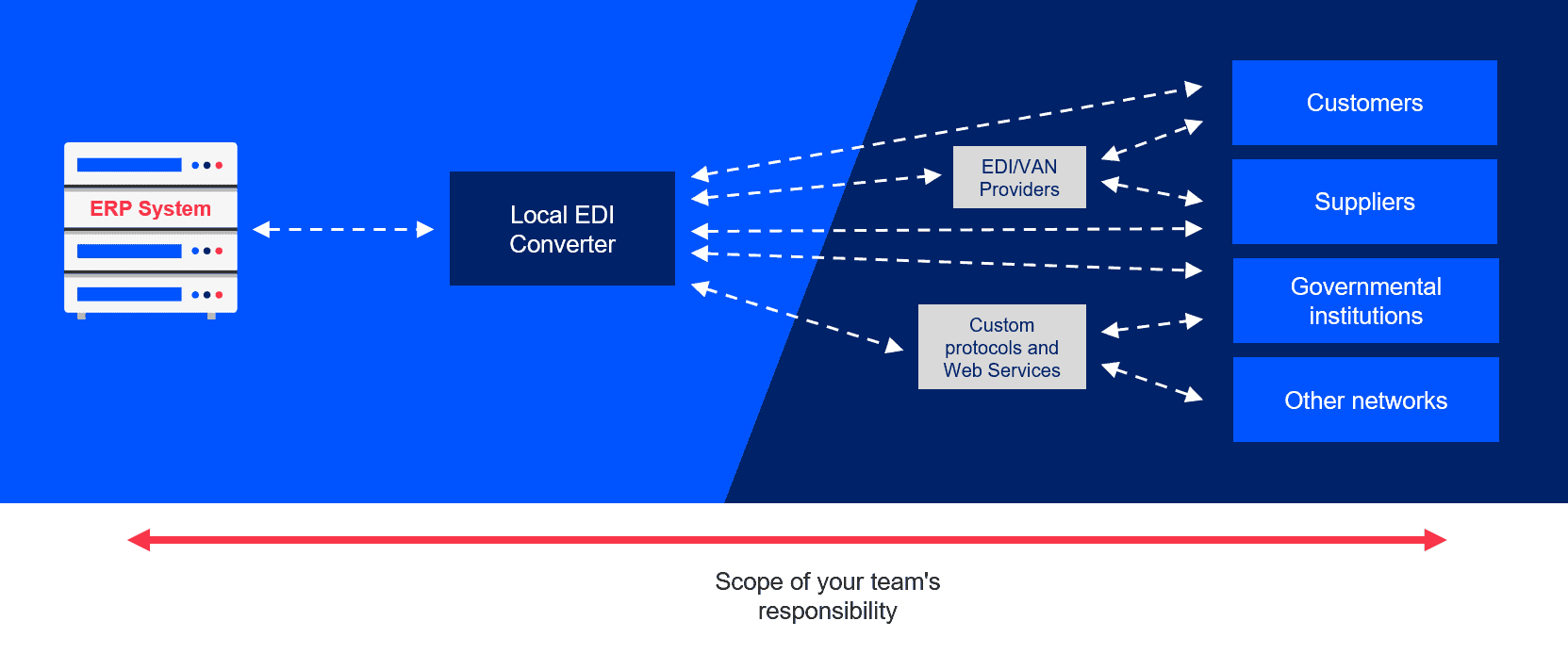
With an in-house solution, responsibility for the continued success and operation of EDI lies entirely with internal teams (as pictured below).
The main tasks
From a coarse-grained perspective, the main EDI tasks when handling EDI in-house are:
- Handling data correctly between the ERP system and the local EDI converter. In the case of SAP ERP systems for instance this means ensuring correct IDoc processing, both inbound and outbound.
- Setting up mappings between your in-house ERP format and your business partners’ formats.
- Operating the local EDI converter. EDI connections must be set up and maintained and the entire onboarding/maintenance communication with the various business partners and their EDI/VAN providers must be handled. Exchanged EDI data must also be monitored 24/7.
- Chasing and resolving errors with your business partners and their EDI or VAN providers.
Don’t forget redundancy!
Another key aspect of handling such business-critical and data-heavy IT processes in-house is safeguarding your business against system failure and data loss.
Worryingly most organisations handling EDI in-house neglect to invest in redundant servers to back up message exchange. By doing so businesses risk severe financial losses should total system failure occur, as such an event can impact an entire supply chain.
Of course, when managing EDI in-house, maintaining redundant servers does come with additional costs, however.
Have you considered fully managed EDI?
Because of the numerous complications associated with running EDI in-house, more and more businesses are turning to fully managed EDI, as it offers a simpler and more cost-effective solution.
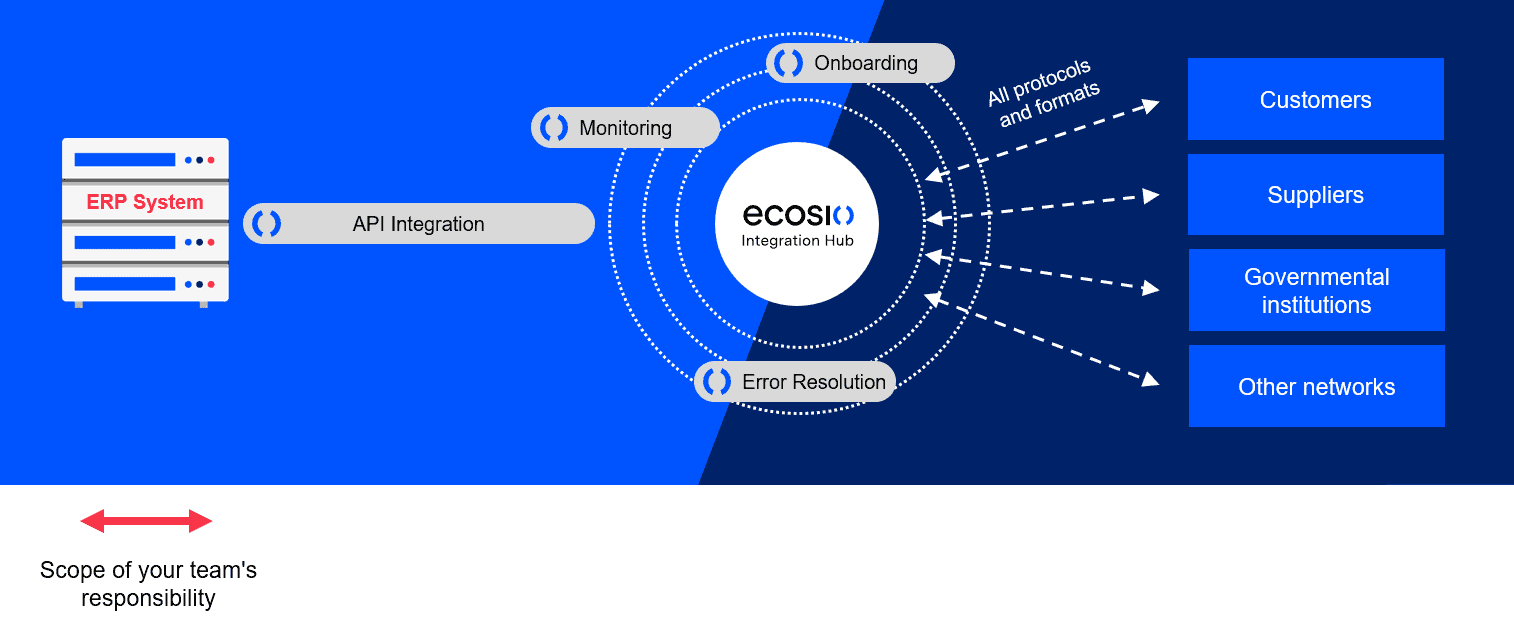
Unlike in-house scenarios, with fully managed EDI the responsibility of internal teams is limited to the ERP system only. As shown in the image below (and in even more detail in our helpful infographic comparing EDI solution types), all other EDI tasks are taken over by the fully managed EDI service provider. From connecting partners and resolving errors, to keeping on track of new regulations and installing updates, your provider takes care of everything, leaving existing teams free to focus on more value adding activities.
Fully managed EDI also offers flexibility and scalability, as your solution can be extended and adapted as necessary if and when requirements change.
Although not offered by every provider, the best EDI solutions (such as ecosio’s) also offer deep integration in your ERP system via an API connection. This connection provides full visibility of all processes, directly in your ERP’s user interface.
For a detailed comparison of what different EDI providers actually offer, please see our helpful infographic on this subject…
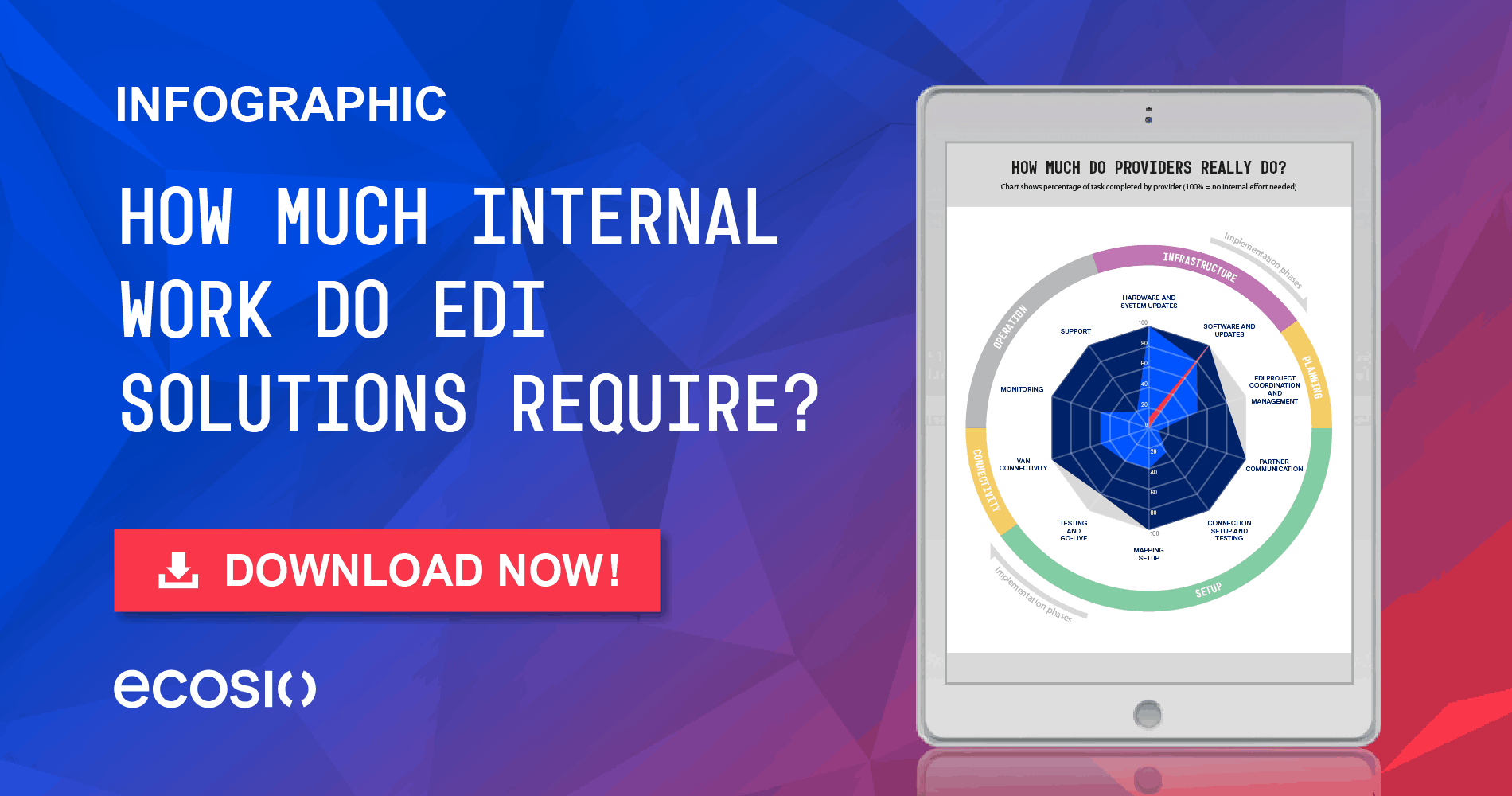
Want to maintain your local converter?
As we have already touched on, some companies do have specialised internal teams that are capable of operating and maintaining large scale EDI solutions. Nevertheless, the management of the hundreds of different EDI connections via a local converter solution in such cases still remains a huge challenge. In such cases a fully managed EDI service provider can help by taking over all routing tasks – the mappings still remain on the side of the local EDI converter.
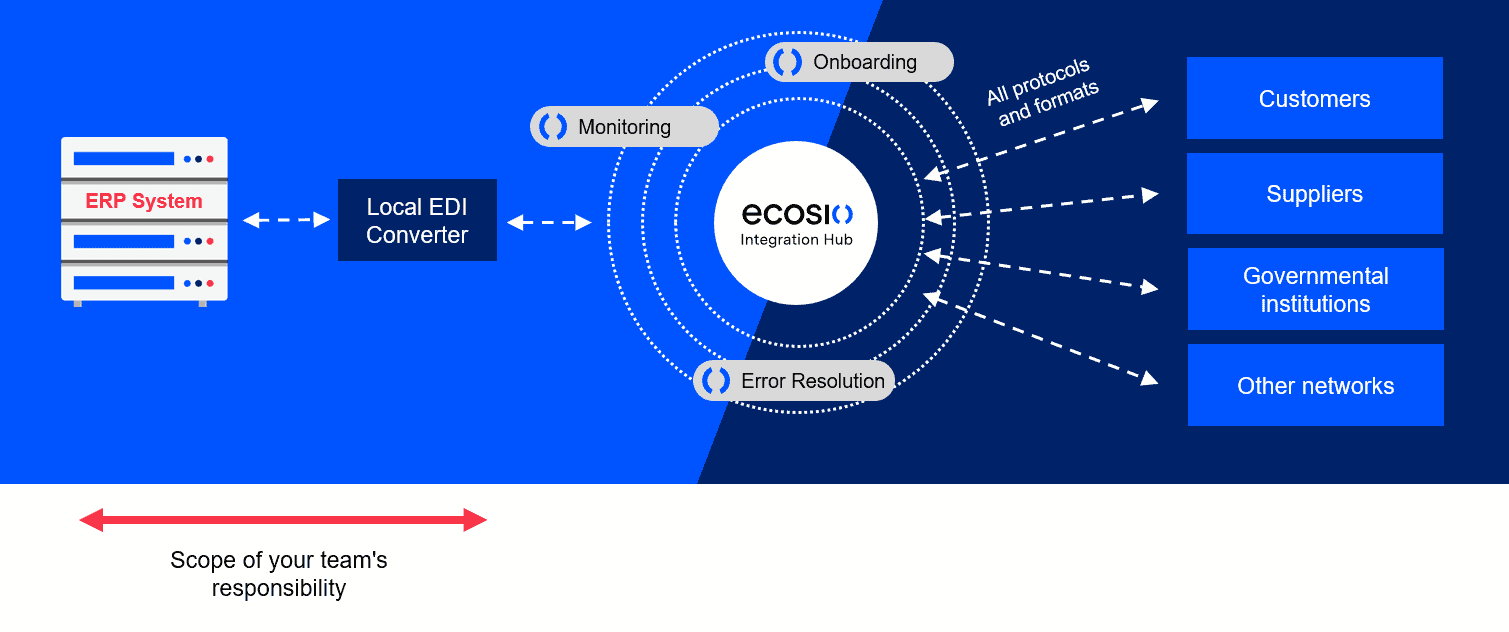
Want more information on what EDI solution suits your business best?
At ecosio we have handled EDI integrations for thousands of businesses across all industries and in a wide range of different ERP systems. As a result, we know exactly what works best when it comes to establishing reliable and future-proof EDI systems.
If you would like to discuss your particular situation with one of our EDI experts (with no obligation), get in touch today! We are more than happy to help you take the right next step.
Alternatively, check out our many helpful resources for more detailed information on everything from fully managed EDI to EDI integration in specific ERP systems.
Der Beitrag How easy is handling EDI in-house? erschien zuerst auf ecosio.
]]>Der Beitrag EDI Integration with Infor M3 erschien zuerst auf ecosio.
]]>Infor M3 and EDI – stronger together
Infor M3 is a particularly flexible ERP solution that can be operated both in the cloud and locally. Thanks to its capacity to help users manage the requirements of complex supply chains, Infor M3 is particularly popular with large and mid-sized companies. For such companies, EDI – i.e. the automation of previously time-consuming and error-prone manual message exchange processes – is a key consideration.
However, in many companies EDI and ERP exist side by side rather than as a homogeneous whole. When a local EDI converter is used instead of a fully managed, cloud-based EDI solution, some essential advantages are lost, including:
- Full end-to-end message transparency from sender to recipient.
- Relief of internal teams, self service functionality for specialised teams, and the elimination of any need for internal EDI know-how.
- Support of national e-invoice requirements across various countries (Italy, Hungary, Spain, etc.).
- EDI solution flexibility/scalability.
- Round-the-clock monitoring of data exchange and proactive troubleshooting by a specialised service provider.
The key to experiencing these benefits lies in deep integration of an EDI solution in Infor M3. But what is the best way to achieve such integration? Together with our Infor partner BE-terna, we have designed a particularly flexible and future-proof solution for this…
API as the game-changer
The best method to achieve seamless EDI integration in Infor M3 is via an API connection. API connections are characterised by the fact that access to data between your ERP and EDI service provider (e.g. ecosio) takes place directly via an integrated interface (i.e. the API) of the EDI service provider. This makes the B2B platform with the associated B2B network of the EDI service provider and the ERP solution a homogeneous whole. This in turn means, among other things, that the status of each message can be queried automatically and viewed in real time in your existing ERP system user interface. The potential for errors along the B2B message exchange is thus drastically reduced.
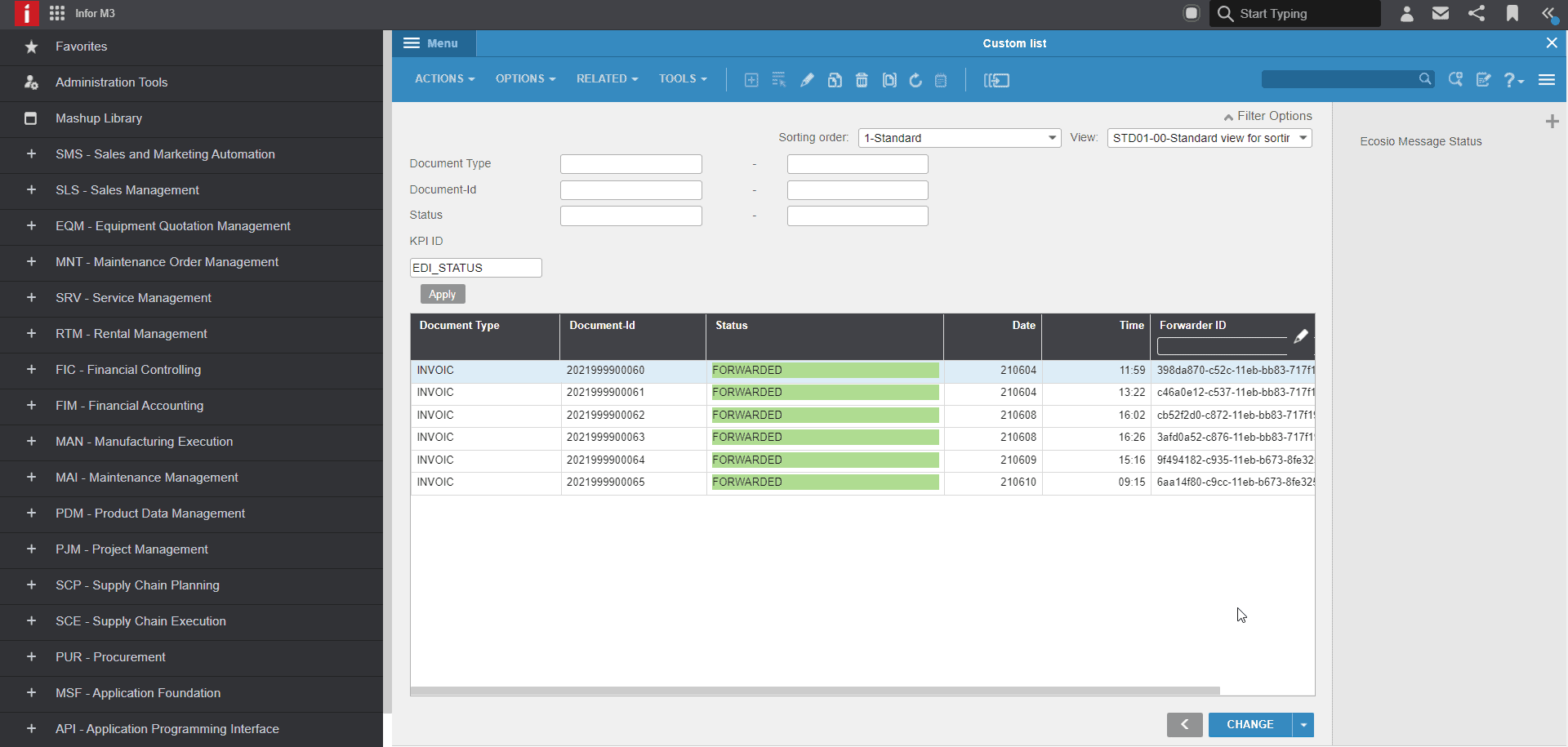
The status of each EDI message – directly viewable in the familiar user interface of Infor M3
EDI via API offers true end-to-end data transparency, making it extremely easy for users to identify and resolve any errors that occur. For example, suppose you are waiting for a response from a supplier regarding an order you sent… With EDI via API, you can immediately see directly in your ERP system if an order was not received from the supplier due to an error. Such visibility is not possible via an alternative connection, e.g. via SFTP.
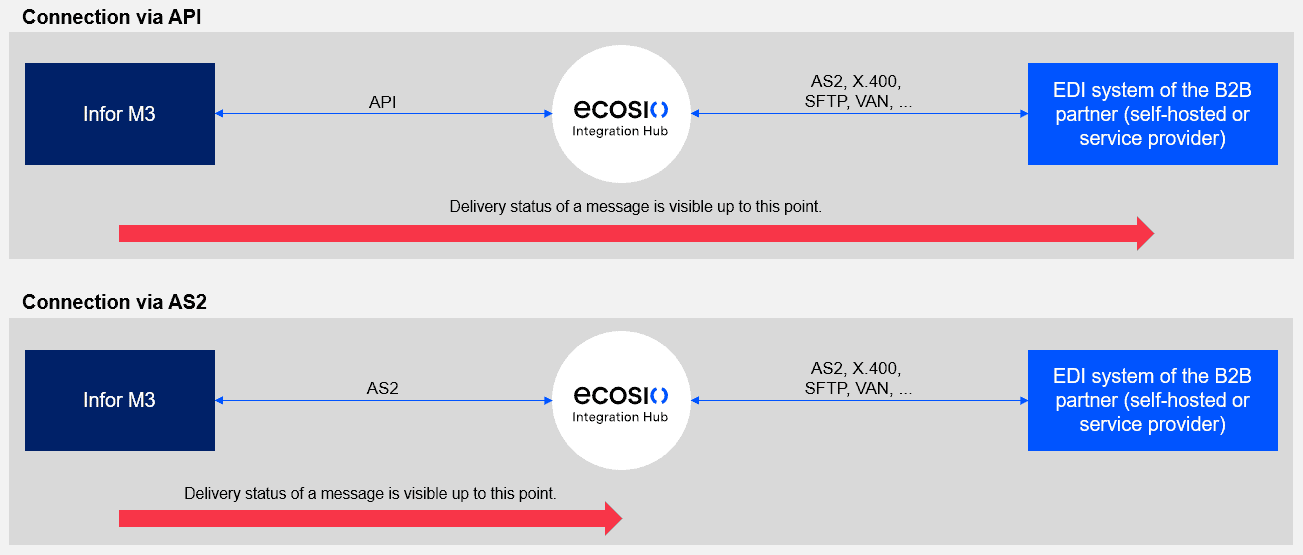
The delivery status can be viewed over the entire route of the message with an API connection
The use of EDI via API also offers the possibility of a full text search in Infor M3. This makes it much easier and faster to find documents when needed, as ecosio indexes all the content of a message as well as any associated metadata, such as AS2 message IDs, SFTP file name, etc. Furthermore, the newly updated ecosio Monitor (accessible via the familiar interface of Infor M3) allows users to track the history of any message.

The message history in the ecosio monitor, integrated in Infor M3
As the data exchange takes place via ecosio’s fully managed platform, all message traffic is continuously monitored. If there is a problem with a delivery, ecosio takes over the proactive troubleshooting and will carry out any required subsequent action, e.g. a new message dispatch. In the event that you need to intervene – for example, because something is missing from the message content – you will be proactively notified. No message is left stranded, meaning you can rest assured your message exchange is running smoothly and without errors.
An API connection makes EDI in Infor M3 more transparent, easier and, of course, more cost-efficient.
What do I have to do to achieve full EDI integration?
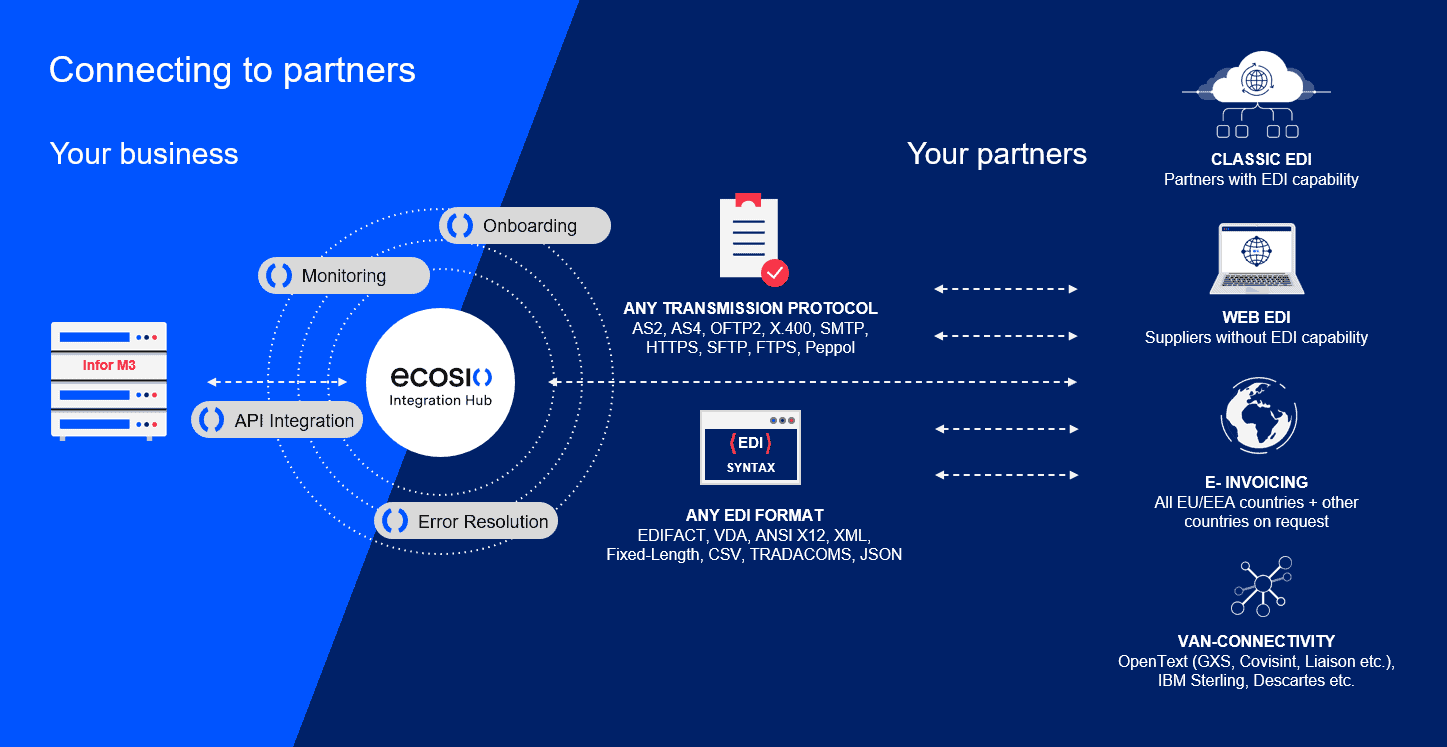
Not much – that’s the best part! The best fully managed EDI service providers (such as ecosio) offer API integration of all EDI functions (as well as Web EDI and e-invoicing) as a complete package. With ecosio, all this is delivered via just a single connection to the ecosio cloud-based EDI solution (our Integration Hub). This means that in addition to the benefits of seamless EDI integration in Infor M3, you also have the following advantages:
- ecosio takes over all EDI tasks, relieving internal teams and eliminating the need for in-house EDI expertise.
- The connection to the ecosio cloud-based EDI solution (our Integration Hub) enables the fulfilment of all current and future EDI or e-invoicing requirements in a flexible and scalable way.
- Dedicated ecosio Integration Engineers take care of all partner onboarding, monitor messages 24/7, and are always available as a clear point of contact for you.
- Future-proof EDI – the ecosio cloud-based EDI solution (our Integration Hub) is constantly updated and is thus always at the cutting edge of technology. ecosio’s multiple redundant server infrastructure enables updates to be installed during operation without affecting the uptime.
EDI made effortless with ecosio
The project implementation and EDI integration in Infor M3 is handled completely by ecosio – together with BE-terna as Infor M3 Customiser.
Still have questions about EDI, EDI integration and Infor M3?
ecosio is an exert when it comes to seamless integration of EDI and e-invoicing in ERP systems like Infor M3. If you are interested learning more about our unique EDI as a Service solution or have further questions, please contact us without obligation – we look forward to enabling you and your company to realise the full EDI potential in Infor M3!
Der Beitrag EDI Integration with Infor M3 erschien zuerst auf ecosio.
]]>Der Beitrag How to Plan an EDI Project Correctly erschien zuerst auf ecosio.
]]>- Ignorance of the different options available and haste to implement a solution are common reasons why businesses choose ill‑suited EDI systems, leading to higher operational effort later
- Take ownership of the planning stage internally and ensure it includes an EDI expert (internal or external) to retain visibility and control over decisions
- Ensure your business has sufficient resources to run and maintain whichever EDI solution you select
Given the importance of EDI in modern supply chains and the expensive consequences of implementing a poorly-suited solution, it has never been more important to plan EDI projects carefully. Unfortunately, planning remains an area that businesses often overlook when it comes to EDI. Thankfully, as you are reading this, this is unlikely to be true for you!
To help ensure you don’t experience the same issues as others, in this article we’ll briefly outline some of the most common mistakes made by businesses when preparing for an EDI implementation/migration project and what you can do instead during this stage to increase the chances of a successful outcome.
Where people go wrong
So why do so many businesses end up with an EDI solution that doesn’t fit their unique requirements well?
While there are many potential answers to this question, the most common reasons for this failure include ignorance of the different options available and haste to implement a solution. As a result, whilst they may gain the ability to trade automated messages with partners, businesses with little in-house EDI expertise, for example, often find themselves having to put in a lot more time and effort to the operation and maintenance of their new systems post-implementation than expected.
Similarly, by not considering future needs when selecting an EDI system, companies typically find themselves trapped in ill-suited solutions, with providers charging substantial amounts to implement the necessary upgrades.
For example, a supplier may initially intend to conduct all customer onboardings in-house and select a solution accordingly. However, after their trading partner network begins to grow and internal teams recognise how time-consuming managing partner onboarding internally can be, they may want their provider to handle future customer onboardings to prevent inhibiting future growth. More often than not this will not come cheap – especially if you are already tied into a long contract!
What you can do to improve the success of your EDI project
To achieve the best outcome for your EDI project, it is important to take ownership of the planning stage internally and not outsource this to a provider or consultant. You know your business better than anyone else, and by outsourcing the planning stage you sacrifice visibility and control of the process and subsequent decision.
It is imperative, however, that the planning stage includes an EDI expert, whether this is an internal or external person/team. For a business without in-house EDI expertise, for example, an ideal planning setup would be an internal decision-making team which understands the current and future needs of the business, supported by an experienced EDI vendor that can suggest improvements and cost-saving optimisations.
In terms of specific considerations during this stage, arguably the most important is to ensure your business has sufficient resources to run and maintain whichever EDI solution you select. A helpful breakdown of the amount of help provided by different types of EDI provider (and thus how much internal work will be required) can be found in our detailed infographic on this subject.
Want more information?
This article constitutes one of the seven mistakes we cover in our white paper The 7 Most Expensive Mistakes EDI Solution Buyers Make… And How to Avoid Them.
Download your copy of “7 Key EDI Mistakes to Avoid” and find out how you can boost the success of your EDI project and optimise existing processes, simply fill in your details.
Alternatively, if you have any questions about your particular situation or anything else EDI related, feel free to get in touch! We are always happy to help!
Der Beitrag How to Plan an EDI Project Correctly erschien zuerst auf ecosio.
]]>Der Beitrag How to Plan an EDI Project Correctly erschien zuerst auf ecosio.
]]>To help ensure you don’t experience the same issues as others, in this article we’ll briefly outline some of the most common mistakes made by businesses when preparing for an EDI implementation/migration project and what you can do instead during this stage to increase the chances of a successful outcome.
Where people go wrong
So why do so many businesses end up with an EDI solution that doesn’t fit their unique requirements well?
While there are many potential answers to this question, the most common reasons for this failure include ignorance of the different options available and haste to implement a solution. As a result, whilst they may gain the ability to trade automated messages with partners, businesses with little in-house EDI expertise, for example, often find themselves having to put in a lot more time and effort to the operation and maintenance of their new systems post-implementation than expected.
Similarly, by not considering future needs when selecting an EDI system, companies typically find themselves trapped in ill-suited solutions, with providers charging substantial amounts to implement the necessary upgrades.
For example, a supplier may initially intend to conduct all customer onboardings in-house and select a solution accordingly. However, after their trading partner network begins to grow and internal teams recognise how time-consuming managing partner onboarding internally can be, they may want their provider to handle future customer onboardings to prevent inhibiting future growth. More often than not this will not come cheap – especially if you are already tied into a long contract!
What you can do to improve the success of your EDI project
To achieve the best outcome for your EDI project, it is important to take ownership of the planning stage internally and not outsource this to a provider or consultant. You know your business better than anyone else, and by outsourcing the planning stage you sacrifice visibility and control of the process and subsequent decision.
It is imperative, however, that the planning stage includes an EDI expert, whether this is an internal or external person/team. For a business without in-house EDI expertise, for example, an ideal planning setup would be an internal decision-making team which understands the current and future needs of the business, supported by an experienced EDI vendor that can suggest improvements and cost-saving optimisations.
In terms of specific considerations during this stage, arguably the most important is to ensure your business has sufficient resources to run and maintain whichever EDI solution you select. A helpful breakdown of the amount of help provided by different types of EDI provider (and thus how much internal work will be required) can be found in our detailed infographic on this subject.
Want more information?
This article constitutes one of the seven mistakes we cover in our white paper The 7 Most Expensive Mistakes EDI Solution Buyers Make… And How to Avoid Them.
Download your copy of “7 Key EDI Mistakes to Avoid” and find out how you can boost the success of your EDI project and optimise existing processes, simply fill in your details.
Alternatively, if you have any questions about your particular situation or anything else EDI related, feel free to get in touch! We are always happy to help!
Der Beitrag How to Plan an EDI Project Correctly erschien zuerst auf ecosio.
]]>Der Beitrag Four Tips to Ensure Your EDI Integration Project is a Success erschien zuerst auf ecosio.
]]>To help those unsure of how best to approach an upcoming EDI integration project, in this article we’ll cover four key things you can do to ensure your project is a success.
1 – Consider your options
Given the far-reaching effects of B2B data exchange and the extent to which it can impact a business’s bottom line, it follows that due care should be taken to select a suitable solution. Unfortunately, as EDI capability is often sought reactively rather than as part of a long term strategy, however, many businesses fail to consider the numerous available solutions properly as part of a well-planned EDI intgration project.
A common example of such a situation might be:
A supplier is faced with an immediate request to enable the receipt of electronic purchase orders and the transmission of invoices over EDI. This customer is very important and therefore needs to be satisfied or will look for a different supplier.
The supplier tries to fulfill this need with minimal effort and in the minimum time. The decision process therefore does not involve a true internal discussion of the real needs and capabilities of internal teams such as current IT backend systems, the sales department, logistics etc.
Due to this, often the lowest bidder wins the race. Issues are not identified before the solution is purchased, resulting in more problems down the line when an ill-fitting EDI solution needs to be implemented.
As a result, EDI stakeholders are unhappy about the speed and quality of the implementation, encounter problems with its capability and ease of use and are
faced with additional charges to improve the EDI solution.
By taking the time to conduct a thorough internal requirement and capability audit, and using this information to select a suitable selection, all of the above issues can be avoided.
2 – Match your solution to available resources
Regardless of the breadth of your trading partner network, establishing, operating and maintaining a successful EDI system takes effort and expertise. Many businesses learn this the hard way, having attempted to implement and run a solution in-house and struggled to do so effectively without significant further investment.
Although on-premise EDI systems can work for those businesses that have a wealth of expertise and large IT teams, a much more sensible route for those not in this position and starting an EDI integration project is to opt for a fully managed provider that is able to greatly reduce the strain on internal resources (see our infographic for a detailed comparison of how much help EDI solution providers really offer). Whether it’s setting up new mappings for suppliers, ensuring compliance with ever-evolving e-invoicing regulations or implementing changes to existing protocols (e.g. moving from AS2 to AS4 in regard to Peppol), a fully managed EDI solution provider removes the need for considerable internal EDI resources. In turn, in-house teams are able to focus on more value-adding tasks.
Unlike on-premise solutions, fully integrated, managed solutions also offer much more flexibility. With a cloud-based system changes can be implemented quickly by the service provider, with minimum disturbance to day-to-day business operations. By selecting such a solution, businesses are therefore well positioned to deal with future changes and the potential for growth isn’t hampered by limited in-house EDI knowledge.
3 – Plan for post go-live
Many businesses focus so much on the technical aspects of the EDI integration project that they neglect to agree on important responsibilities and processes regarding the ongoing operation of the new solution.
Given the large amount of work that is required to operate and maintain on-premise EDI solutions, having efficient processes in place is particularly important for those businesses who choose to deal with EDI in-house. Unlike with managed solutions, where crucial tasks such as message monitoring, error handling and implementation of relevant updates are handled by the service provider, with on-premise solutions all of these tasks (and more) must be allocated to experienced individuals/teams.
By agreeing operational responsibilities at an early stage you will avoid potentially costly confusion later on. Moreover, early consideration of what resources are available to handle EDI tasks post-go-live may well influence your choice of solution.
4 – Don’t neglect future needs
As we have just mentioned, planning for the future is important when it comes to operational responsibilities. However, just as important is considering what your business’s future EDI needs are likely to be more generally.
Whether you have a well-defined plan for the growth of your business or not, failing to select a solution that can cope with a change in your EDI needs can prove very costly. Despite the fact that activation of new functionalities (such as exchanging via AS2) often requires little effort on the part of the EDI software vendor or EDI service provider, licensing costs can be associated with new protocols with some providers. These licensing costs add up to thousands of pounds with some solutions! With other solutions, additional protocols are included free of charge. With this in mind, it makes sense to select a flexible, modular solution that can be easily adapted to suit changing requirements at minimal expense. In particular, the solution’s extension capabilities must be precisely evaluated before a purchase decision is made and a potentially unfortunate lock-in effect has been created.
Want more information?
This article is taken from our white paper Unlocking the Secrets to Successful EDI Integration. This detailed white paper explores the development of ERP systems, how EDI fits into today’s systems, the benefits of a comprehensive and well-planned EDI integration project, and how to avoid common integration headaches.
Download your free copy of “Unlocking the Secrets to EDI / ERP Integration Success” and improve your chances of securing a solution that fulfills all your requirements whilst reducing internal effort,
Alternatively, if you have any questions about your unique situation or anything else relating to B2B integration, please do get in touch! We are always happy to help!
Der Beitrag Four Tips to Ensure Your EDI Integration Project is a Success erschien zuerst auf ecosio.
]]>Der Beitrag Supplier EDI Onboarding – The Seven Key Steps erschien zuerst auf ecosio.
]]>With this in mind, in this article we will take you chronologically through a thorough supplier EDI onboarding process, from kick-off to go-live – looking at what’s needed from you and your suppliers along the way. Hopefully by the end you will know exactly what a successful project involves and be more confident in making the right choice of solution.
Step 1 – Kick off and definition of EDI requirements
Unsurprisingly the first step in any supplier onboarding project is for your provider to identify exactly what it is that you want. Though there is no one way to achieve this, it is generally best if both you and your EDI provider have a clear point of contact, as this will increase the project’s speed and efficiency.
Once your internal team has been agreed, your provider will liaise with them to find out what your requirements are. This involves discussing:
- Processes – How are orders, deliveries and invoices handled?
- Document types – What document types need to be realised? For example, are you looking to trade invoices only, or do you also want to exchange other common document types, such as orders and despatch advices (aka INVOIC, ORDER and DESADV for EDIFACT messages and 810, 850 and 856 for X12 messages, for example). More sophisticated EDI integrations will also enable automated transmission of sales data reports (SLSRPT / 818), inventory reports (INVRPT / 846) and receiving advice messages (RECADV / 861).
- Message data granularity – Which data elements do you want to be included in each message? In addition to the basics (price, quantity, article number) do you require additional information, such as descriptions or best-before dates?
- Message / process semantics – What is the structure and content of your exchange messages? Usually the ERP system has a preferred (data model) exchange format. This needs to be communicated to the EDI provider for the creation of the dataΩmapping.
- Message protocols – How is your EDI data exchanged with your back-end system? This can be handled via a number of different protocols, such as API, SFTP and HTTPs.
It is tough to give an estimate of how long this process will take given the bespoke nature of the process, but if you are aware of your requirements in advance and have assigned a dedicated project leader internally, this step can take as little as a couple of days. Usually the process will take longer than this, however, and typically involves a fair amount of back and forth.
Step 2 – Creation of Message Implementation Guide (MIG)
Having completed the fact-finding step, your EDI provider will then create your message implementation guide (or MIG). A MIG is basically a ‘how to’ guide for your partners which details your business’s EDI requirements and the specifics of your preferred message formats etc. This normally takes around two days of work per MIG to complete.
As the success of this step has a knock-on impact on the success of the rest of the EDI onboarding process, it is particularly important that this is completed carefully. To ensure the reliability of the MIG, fully managed EDI providers, such as ecosio, will send sample messages to your system. They may even enlist the help of one of your close suppliers to conduct a parallel phase to check everything is functioning correctly. All that is required on your side is to check the messages and flag if anything needs altering.
Sadly, with non fully-managed EDI solutions this phase is often rushed, with little or no testing conducted, leading to errors further down the line.
Step 3 – Creation of Web EDI platform
If you are looking to automate as much as possible of your supply chain’s document exchange, you may also intend to connect suppliers who do not have EDI capability using Web EDI (see our white paper for more information on Web EDI and how it can benefit you).
If this is the case, it is important that the scope of your Web EDI platform matches the scope of message types used with suppliers via “classic” integrated EDI. For example, you may need to exchange non-mainstream documents such as SLSRPT, INVRPT or RECADV in addition to orders, despatch advices and invoices – in which case care should be taken to select a provider, such as ecosio, that can support this (as this functionality is rare).
Your Web EDI platform will be built in parallel with the creation of your MIG(s). This process involves a one-time connection of the EDI solution to your ERP system and subsequent configuring of the platform to meet your requirements. Your supplier should be able to send test documents via the platform according to your MIG (for you to then check). As with the creation of the MIG, you may also want to enlist the help of a close supplier to help test the platform before wider rollout.
As Web EDI requires suppliers to put in manual effort in order for you to experience full automation, platforms are not always hugely popular with suppliers. As a result, selecting a Web EDI system, like ecosio’s Web EDI solution, which is able to minimise effort on your suppliers’ side through features such as semi-automatic document creation, PDF printing and batch support can greatly increase take-up across your supply chain.
Step 4 – Prioritising / approaching your partners
Once your MIG and Web EDI platform have been created it is time to begin onboarding your partners. Before approaching them, however, it is important to agree a strategy with your EDI provider. With large supply chains, it can take a while for partners to be onboarded. As such it makes sense to prioritise onboarding certain partners first so you get maximum benefit from your new system. For example, you may wish to prioritise your biggest suppliers, or those with whom you are closest. As your EDI solution provider will have handled similar projects many times before, they should be able to offer valuable input here.
Once the supplier EDI onboarding strategy has been agreed, your provider should approach each supplier to clarify details such as identifiers (e.g. GLN number), current capabilities (e.g. what types of documents they can exchange via EDI) and which type of connection they would prefer (e.g. AS2, X.400, VAN etc.).
During this process your EDI provider should also share your new message guidelines with your suppliers, allowing them to know what your system requires and how to create valid outgoing documents, which brings us on to…
Step 5 – Message exchange testing / validation
The testing phase involves your provider sending your supplier documents in order for them to send back the necessary responses (e.g. an Order and Order Response).
If your supplier returns an incorrect message they should be informed by your provider what the errors are, enabling them to be corrected. This is known as validation.
Validation can be done manually by checking the message against the MIG. This is a tedious and error-prone method, however. Instead, validation is better handled automatically, by employing in-built validation checks on the integration software, or semi-automatically, by using external software capable of checking message syntax.
Automatic checks (such as those completed by ecosio’s cloud-based EDI solution (our Integration Hub)) can immediately return error reports via email or web portal to the document issuer. Manual checks, on the other hand, involve much more effort, meaning more time until the error report is ready
Once any errors have been corrected and your supplier is able to send a response that conforms to your MIG, the message will be sent to your internal team to check. If a fully managed provider is opted for, this checking should be the extent of the input required from you.
Step 6 – Go-live
When you are happy with the responses from your supplier the connection can be put live. In some cases you may wish to run a parallel phase (alongside a continuation of your previous message exchange method), for several months to ensure that everything is functioning smoothly.
With suppliers being connected via Web EDI the process is even simpler, as they simply need to be activated on the platform. If your Web EDI portal is sufficiently intuitive / user-friendly, training may not even be needed. Alternatively it can be provided in the form of pre-recorded videos / documentation.
Step 7 – Post go-live
Whilst go-live might well signal the end of the EDI onboarding process, it is far from the end of the work when it comes to ongoing document exchange with your partners. For example, your supplier may conduct (as ecosio does) ongoing validation mapping checks to ensure that message details match the requirements of your MIG – thus avoiding the complications associated with incorrect details being transmitted to your ERP.
In order to benefit from a successful and future-proof system, processes also need to be in place covering message monitoring and error handling. Significantly, with many solutions go-live effectively signals the end of your EDI partner’s active involvement, meaning these responsibilities fall to internal teams. However, this is not the case if a fully managed EDI provider such as ecosio is opted for.
Ideally your EDI provider will continue to oversee your business’s EDI connections, acting as a point of contact for your suppliers (both those using classic EDI and Web EDI) and working proactively to correct errors and ensure connections are functioning at maximum efficiency. This way you benefit from both more reliable EDI and the time and cost savings associated with less pressure on internal teams.
As your needs are likely to change over time, it also makes sense to consider investing in a solution that can adapt alongside your business. For example, clients of ecosio are able to add additional Supplier Relationship Management (SRM) modules as required.
Discover a fully managed approach to EDI onboarding with ecosio
As every supply chain is different, every business faces unique challenges when it comes to connecting to suppliers. To be successful, electronic data interchange requires not only technical expertise during set-up and onboardings, but also ongoing time and effort in the form of message monitoring, error handling and installation of updates etc. after go-live. Simply put, each of the steps we have covered is crucial to the lasting health and reliability of your EDI connections.
At ecosio we understand the effort involved in establishing and maintaining efficient EDI, which is why we aim to help businesses avoid the time and stress it can cause by minimising internal effort. As well as making sure connections are as secure as possible through conducting thorough testing, ecosio’s experts manage the entire EDI onboarding process, from kick-off to ongoing operation (unlike other providers). Essentially we do the work so you don’t have to! The upshot is a more cost-effective outcome, faster connections and peace of mind.
To find out more about ecosio’s fully managed solution and how we can help you benefit from simple, efficient and intelligent EDI, contact us today! We are always happy to answer your questions.
Der Beitrag Supplier EDI Onboarding – The Seven Key Steps erschien zuerst auf ecosio.
]]>