Der Beitrag AI and EDI: strengths, challenges and what to expect erschien zuerst auf ecosio.
]]>- AI can enhance EDI through error detection, data mapping, and predictive analytics, helping teams spot issues earlier and automate manual tasks
- OCR tools powered by AI enable fast document conversion, reducing reliance on manual data entry
- Key challenges include technical inaccuracies, legacy system compatibility, and data privacy concerns, requiring careful implementation
- AI is a valuable complement to EDI, but still needs human oversight to ensure accuracy and business context
AI is everywhere these days. From online shopping to booking a taxi, artificial intelligence is quietly transforming all sorts of everyday processes. But what about in the world of B2B communication – specifically electronic data interchange (EDI)? Can AI and EDI work together to improve your business operations?
In this article, we’ll explore how AI is starting to reshape EDI processes, where it shines, where it struggles, and what you should be aware of if you’re considering making AI part of your EDI strategy.
The rise of AI across business operations
Over the past decade, the adoption of AI across business sectors has skyrocketed. From a distant concept, AI has quickly become mainstream, with a recent Accenture report finding that 84% of executives “believe they won’t achieve their growth objectives unless they scale AI”. Amazingly, the same report also states that 75% of executives “believe they risk going out of business in five years if they don’t scale AI”.
More than many other sectors, supply chain businesses have been profoundly impacted by AI, largely due to their reliance on fast, high-volume data exchange and complex transactional processes. Among other things, these businesses are now leveraging AI to:
- Predict inventory needs
- Automate procurement workflows
- Optimise delivery routes
- Detect anomalies in real-time supply chain data
EDI and AI: potential utilisations
Error detection and correction
Possibly the simplest and most powerful way that AI and EDI can be combined is by using AI to spot errors. Specifically, as AI is extremely good at being able to spot anomalies in data patterns, it can be used to flag possible issues that humans might miss.
In traditional EDI, individuals only notice something is wrong when a shipment is late or an invoice goes missing. With AI, patterns are continuously monitored. If something’s off even a little bit, AI can raise the alarm early.
For example, if you usually receive 500 purchase orders every Wednesday and one week you only get 250, this change itself is not an error. However, such a pattern change can indicate something has gone wrong, and flagging this early enables relevant teams to investigate and rectify any possible issue before it develops.
Data mapping
Traditionally, setting up document mappings requires hours of manual effort and a great deal of technical expertise. Hypothetically AI can help automate parts of this process by “learning” from existing mappings and making appropriate suggestions.
Predictive analytics
AI doesn’t just see what has happened; crucially it can also predict what might happen next. By analysing past EDI data, AI can anticipate supply chain disruptions, helping you to plan ahead and avoid potential issues before they happen.
Document conversion
Imagine feeding a paper invoice into a system and having it instantly converted into an EDI-compliant format. AI-driven OCR (Optical Character Recognition) and data structuring tools are making this a reality, eliminating the need for error-prone manual data entry.
EDI and AI: key challenges
Although the potential of AI to streamline and simplify B2B processes is huge, it’s important to stay grounded. AI isn’t a magic wand… yet. There are still several issues and potential hazards associated with AI usage, including…
Technical inaccuracies
EDI isn’t a “one-size-fits-all” world. There are countless EDI formats (like EDIFACT, ANSI X12, and XML), as well as standards that vary by industry and region. Teaching an AI to handle all these perfectly is tricky and the results typically require significant fine-tuning.
In EDI even the smallest error can have a big impact. Consequently, if you ask an AI tool to convert a document into a certain EDI format, it may do it 99% correctly… but that 1% is a problem.
Diverse protocols of trading partners (when onboarding)
Different partners prefer different EDI protocols (AS2, OFTP2, SFTP, and so on). AI can help recommend configurations, but ensuring protocol compatibility still needs human oversight to ensure success.
Legacy systems compatibility
Many companies still rely on legacy ERP systems that weren’t built with AI in mind. Integrating modern AI solutions with these older environments can feel like trying to fit a square peg into a round hole.
Data privacy
Handling sensitive business data demands strict privacy controls. Using AI can introduce compliance risks if not managed carefully, particularly where cloud solutions are involved. It’s important to ensure that any AI system you use adheres to GDPR and other relevant standards.
Lack of context
AI can be impressive, but it doesn’t “understand” your business context the way a human does. It might suggest a mapping that looks technically correct but doesn’t make sense operationally. Without context, errors can easily slip through the cracks.
Conclusion
AI and EDI are a powerful combination, offering real potential to streamline processes, reduce manual work, and spot issues before they become problems. However, like any new tool, AI needs to be applied carefully, with an understanding of both its strengths and its current limitations.
See how ecosio can help you streamline your EDI processes
At ecosio, we’re passionate about making B2B integration effortless and that includes harnessing the best of AI where it genuinely adds value. If you’d like to learn more about how we can help you future-proof your B2B integration processes, get in touch today!
Der Beitrag AI and EDI: strengths, challenges and what to expect erschien zuerst auf ecosio.
]]>Der Beitrag Why EDI Transformation is Critical to the Success of Your Organisation erschien zuerst auf ecosio.
]]>- An EDI transformation project typically includes analysis of the current infrastructure, target definition, modernisation of existing EDI architecture, and implementation of new components
- Benefits include increased efficiency, improved data quality, more time for value-adding tasks, greater flexibility, easier partner integration, and future-proof systems
- Challenges include high investments, technical complexity, and resistance to change
- Tips for success are don’t underestimate internal effort, take future requirements into account, and don’t put the project off
Nowadays it’s no longer enough just to optimise processes – companies need to fundamentally rethink their approach to data communication in order to maintain their position in the market. To secure fast, automated and error-free communication with business partners, many businesses today are embarking on ambitious EDI transformation projects. But what exactly does an EDI transformation project involve, and how exactly can a successful project benefit your company?
What does an EDI transformation project involve?
An EDI transformation project typically consists of the following key steps:
- Analysis of the current infrastructure: evaluation of existing systems to identify weaknesses and opportunities for optimisation
- Target definition: Definition of requirements and targets, e.g. higher data quality or cost reductions
- System migration: Conversion to a more modern, often cloud-based, EDI solution
- Integration: Connection of new EDI solution to existing ERP system to ensure seamless communication
- Change management: Comprehensive training and clear process communication to make the transition easier for employees
Why is EDI transformation crucial for companies?
Companies that neglect to modernise their EDI systems run the risk of being left behind. Outdated systems can slow down data exchange, affect data quality and create security gaps. In order to remain competitive, companies must integrate modern technology in the form of cloud solutions, APIs and automated processes.
For those companies that do this successfully, the advantages are numerous, including…
- Increased efficiency: the automation and optimisation of processes reduces manual intervention and speeds up workflows
- Improved data quality: Modern EDI systems ensure accurate, error-free data transmission
- More time to focus on value-adding tasks: Automated processes ensure employees have more time for strategic activities
- Increased flexibility and scalability: With more streamlined EDI processes and better data visibility, companies can react quickly to market changes and adapt their processes accordingly
- Easier integration of new partners: A modern EDI infrastructure simplifies the integration of business partners and increases collaboration
- Future-proof systems and processes: With a continuously customisable EDI solution, companies remain competitive in the long term
What challenges do EDI transformation projects pose?
As with all large IT projects, success isn’t guaranteed, and there are generally hurdles along the way. When it comes to EDI transformation projects, the most common issues companies experience include…
High investments
Although not always the case, EDI transformation projects often require significant upfront investment. The costs can include new software and infrastructure, integration work, consultancy fees, and the time and personnel needed to manage change across systems and processes. For many organisations, this initial outlay can seem daunting, especially when existing systems are still operational, albeit inefficient. However, while the short-term costs are substantial, these investments are typically offset over time through improved operational efficiency, automation of manual tasks, fewer errors, and reduced long-term operating expenses. In this way, a well-executed EDI transformation not only pays for itself but also creates measurable value for the business.
Technical complexity
Integrating modern systems into existing IT infrastructures can be a challenge, especially if the old software has been heavily customised. This often requires complex customisations to make new technologies compatible with the old systems. These customisations require in-depth technical knowledge and careful planning to ensure a smooth integration. It’s important that the new systems work efficiently with the existing infrastructure without interrupting business processes. A strategic approach is therefore crucial for the long-term success of the integration.
Resistance to change
Employees who are used to old ways of working may resist the new technologies. However, thorough training and clear communication will help overcome this resistance.
Overcoming these challenges requires careful planning and expert support.
Three important tips for a successful EDI transformation project
- Don’t underestimate the internal effort: a successful transformation requires co-operation and the right resources in the team. Ensure that everyone involved is adequately trained and supported.
- Take future requirements into account: Choose an EDI solution that will grow with your business and can adapt when your needs change.
- Don’t put the project off: Start your EDI transformation as early as possible to avoid missing an opportunity to increase efficiency and gain a competitive advantage. By delaying, your existing solution will only become even more
Let us help you achieve EDI transformation success!
EDI transformation is not only a technical necessity, but also a strategic step to secure your long-term competitiveness. With ecosio, you can modernise your EDI processes and successfully meet the challenges of the digital future. Are you ready to take your EDI systems to the next level? Contact us to find out how you can become more efficient, flexible and future-proof with ecosio’s unique ED-as a Service approach.
We’re always happy to help!
Der Beitrag Why EDI Transformation is Critical to the Success of Your Organisation erschien zuerst auf ecosio.
]]>Der Beitrag ecosio Insights: Digital Transformation Projects and the Role of B2B Integration erschien zuerst auf ecosio.
]]>To help provide some clarity regarding current B2B integration trends and the main challenges facing those businesses embarking on digital transformation projects, I sat down to discuss these topics and more with ecosio Co-founder and EDI expert Philipp Liegl. In the following interview, Philipp shares his thoughts on what successful digital transformation looks like, and how businesses can unlock sustainable growth and build stronger, more collaborative partnerships.
————————————————————————
How do you predict B2B integration will evolve over the next five to ten years?
In the next few years we should see automated system-to-system communication replacing manual methods like email, PDF and paper. I also expect to see better visibility of EDI and e-invoicing directly within ERP systems, as companies move away from a siloed approach in search of a unified solution.
As more countries introduce e-invoicing mandates, procure-to-pay and order-to-cash processes will also have to change accordingly, which will result in challenges for businesses operating across diverse regulatory environments. At the same time, tax compliance and supply chain operations are converging as governments demand greater digitalisation and real-time reporting. For organisations of all sizes, success in this new landscape will depend on embracing automation, enhancing integration, and addressing compliance as a strategic priority.
Is a universal document exchange format ever likely to happen?
Thanks to the rise of government-mandated e-invoicing formats, there are certainly signs that standardisation is improving. For example, UBL is becoming widely adopted across Europe due to its alignment with EN 16931 and Peppol. Meanwhile, UBL’s popularity is also growing outside of the EU, with countries such as Saudi Arabia recently adopting UBL subsets.
Yet, much like separate dialects of the same language, even within UBL, regional adaptations persist. Whether it’s UBL, EDIFACT, or EDIFACT-subsets like EANCOM, global standards are rarely used in their “vanilla” form as they are too generic to meet specific business needs. Ultimately, total standardisation will realistically never happen for this reason.
How do you see B2B integration fitting into broader digital transformation strategies?
While there are obviously benefits to digitising any manual process, such as submitting timesheets or holiday requests, the processes which have the greatest impact are those that cross organisational boundaries—such as exchanges with suppliers, customers or governments.
By automating the exchange of key B2B messages, like orders, invoices and delivery notes, businesses can not only reduce errors, but also enhance resilience and provide real-time visibility into critical operations. In turn, this enables organisations to operate with greater speed and confidence moving forward. As such, in my opinion, EDI and B2B automation should be at the very centre of digital transformation efforts.
Following the recent wave of e-invoicing mandates, do you expect to see similar regulations covering other B2B processes soon?
Absolutely! The main goal of the recent e-invoicing mandates in Europe has been to reduce the “VAT gap” caused by fraud and underreporting. But e-invoicing is only one of a number of ways governments can tackle this. Over the coming years we will undoubtedly see governments introduce legislation concerning other tax-relevant documents which provide proof that transactions are legitimate, such as delivery notes and probably also purchase orders.
Just as businesses reconcile invoices with delivery and purchase order records to confirm the validity of transactions, governments aim to ensure compliance by tracking the entire process. Accordingly, expanding automation requirements beyond e-invoicing would not only strengthen tax collection efforts, but also minimise fraud and promote greater transparency and accountability across B2B operations.
Are people’s expectations changing when it comes to B2B integration?
Definitely! In the past, EDI was typically managed via local software, which was reliant on the deep technical knowledge of internal individuals. Over the last decade there has been a clear shift towards externally managed solutions that are deeply integrated into businesses’ ERP systems. Just like we don’t expect to have to establish the technical connection ourselves when we make a phone call, businesses today expect their providers to handle all technical B2B integration intricacies for them behind the scenes. Plus, with governments mandating automation of more and more B2B processes, we’re seeing a growing demand for providers to offer a broader range of services. Where previously businesses may have had one provider for tax compliance, another for EDI, and an in-house solution for e-invoicing, these businesses are now looking for one provider that can handle all at once.
What role do you see technologies such as AI and machine learning playing in digital transformation projects?
AI and machine learning are certainly helping to enhance efficiency and streamline B2B integration processes, particularly in areas like mapping creation and pattern recognition. For example, machine learning can be used to flag potential issues that wouldn’t otherwise have been detected – such as if a regular purchase order doesn’t arrive when expected – allowing for proactive escalation.
AI does face limitations, however, as it operates based on patterns, probabilities and learned behaviours, which can lack the precision necessary for specific compliance tasks. In critical areas like business document mapping creation, for example, where 100% accuracy is essential, pure reliance on AI may still be risky, as errors could have significant consequences. That might change with the further development of these technologies. One thing is for sure: 100% deterministic behaviour is a must with all compliance operations. As long as AI is not able to meet that 100%, in can only play a supportive role.
How do you think the increasing automation of B2B processes will impact the roles and skills required in internal teams?
Regarding skills, those handling B2B integration need to have technical expertise in three key areas. First, they have to understand the choreography of document exchanges, including the sequence and interdependencies between documents like purchase orders and invoices. Second, they must understand the diverse payload formats used across different regions and industries. Finally, they must have technical communication channel expertise in order to navigate the varying API standards and complex authentication mechanisms required in different countries.
When it comes to who handles B2B integration, organisations have three options: develop in-house expertise, hire external contractors to manage the process, or enlist the help of specialised providers. One thing is true no matter what option is opted for, however; successful automation requires a dedicated owner to coordinate resources, ensuring accountability and alignment. B2B integration can no longer be managed as a side task by unrelated roles—it demands focused leadership to drive efficiency and reliability.
What are the key B2B integration challenges likely to be for businesses embarking on digital transformation projects?
I would say there are four key challenges. The first, and the biggest, will always be master data. Without clean, consistent master data even the best integration systems will struggle to function effectively. If someone could somehow eliminate all master data issues this would definitely be worthy of a Nobel prize in my book!
The second challenge is sorting a B2B integration team, as B2B integration is very much a people-driven initiative and isn’t something that can be handled as a side task. You need dedicated team members in key areas like order-to-cash and purchase-to-pay to make it work.
The third major challenge is process alignment, as many ERP systems still rely on outdated outputs, such as PDFs or paper documents, which aren’t designed for EDI. Before they can fully embrace integration, businesses must modernise these processes.
Last, but not least, is ERP system compatibility. Successful B2B integration requires a seamless flow of data in and out of ERP systems. Unfortunately, older or off-the-shelf solutions, such as AS400-based platforms, often aren’t ready for this level of integration. Any business with such systems will have to upgrade them or find workarounds if they want to achieve significant improvements.
————————————————————————
Want to learn more about current EDI trends?
In our new report, “The Future of B2B Integration“, we explore the findings from our recent survey. In this survey we asked professionals working with B2B automation technologies across various industries to share their perspectives on everything from e-invoicing to the role of EDI in building business resilience.
Trends covered include the growing importance of EDI, building resilience through automation, e-invoicing, and cloud migration.
Der Beitrag ecosio Insights: Digital Transformation Projects and the Role of B2B Integration erschien zuerst auf ecosio.
]]>Der Beitrag How to Achieve B2B Process Automation Success erschien zuerst auf ecosio.
]]>Define your B2B process automation goals
The first and most important step in any complex business project is to define your goals. Even if your goals seem obvious, detailing exactly what you would like to achieve will help you to develop a roadmap, identify ways of measuring success, and prioritise resources effectively.
Sometimes, too, defining your specific goals will help to clarify to your team WHY you want to get to where you’re headed. Whether you’re looking to implement an e-invoicing solution or streamline communication with existing partners, agreeing on your exact goals will ensure everyone is on the same page and understands the plan and motivations.
Assess current capacity and internal resources
Once you’ve clarified your goals, the next step is to identify how able you are to achieve them with your current setup. This involves assessing both your technical capacity and the capability of your current personnel.
Technical capacity
When assessing technical capacity before a B2B process automation project, be sure to ask the following questions:
- Is our IT infrastructure able to support increased automation (e.g. via RPA, blockchain, API, EDI, etc.)?
- How well can our current systems integrate with electronic data interchange (EDI) and e-invoicing solutions?
- Would it be useful for different teams to have direct access to EDI/e-invoicing data so IT doesn’t become a bottleneck?
- Do we need redundant infrastructure?
- Are we likely to need the ability to convert messages to/from different EDI standards in the future?
- Are we likely to need the ability to send messages via different EDI protocols in the future?
- Will we need Peppol connectivity?
- Would a Web EDI solution be helpful to help automate exchanges with smaller suppliers?
- Would end-to-end visibility of EDI and e-invoicing data be helpful?
Personnel
When assessing the capacity of your existing team before starting your B2B process automation project, make sure to ask the following questions:
- Do we have sufficient technical expertise in-house?
- Would training be sufficient to upskill existing employees?
- Would our ability to operate be significantly disrupted by the absence or departure of certain individuals?
- How much time would team members be able to devote to new processes and tasks?
- Would team members be willing to adapt their roles and responsibilities if needed?
- How would pressure on internal resources be affected if B2B process automation requirements were to increase in the future?
- How will we keep track of new country-specific e-invoicing requirements?
After asking these questions you should have a clear picture of what level of automation is possible with your current system and which areas will need strengthening.
Consider outsourcing
For those businesses with limited internal resources, outsourcing is the obvious answer – particularly given the extent to which cloud computing has simplified external management of B2B process automation in recent years.
However, even those businesses with substantial internal resources may also benefit from outsourcing certain processes such as EDI or e-invoicing to specialised providers. Not only are such providers experts in these fields, and therefore able to implement processes and technical changes faster, they also typically offer added benefits such as redundant infrastructure, direct integration into your current ERP system, and simple scalability.
And perhaps most important of all, employing an external provider to manage B2B process automation enables your team to focus on what they do best!
Establish clear roles and responsibilities
For automation to succeed, everyone in your organisation needs to know their role in the process. Clear delineation of responsibilities ensures smooth implementation and ongoing management of B2B process automation efforts.
Make sure when assigning responsibilities not to forget potential future tasks though… as this can result in a decline in efficiency and enthusiasm.
For a detailed breakdown of the key roles in a typical EDI project, please see our dedicated blog article on this topic.
Prioritise data visibility and accessibility
Having automated processes is all well and good, but unless you have good visibility, efficiency can still suffer. No system is 100% error-free, and being able to identify an issue quickly and easily when one does arise can help ensure your system remains effective.
For example, the best EDI and e-invoicing solutions will enable users to search across all documents using any relevant identifier, and may even allow you to view the status of sent documents in real time.
Think long term!
When it comes to B2B process automation, change is the only constant. Technologies evolve, and so will your electronic data interchange (EDI) and e-invoicing needs.
Prioritising adaptability, scalability and sustainability is not just wise; it’s essential if you’re to be successful in the long term. Even if your EDI requirements are stable, your partner landscape is static and your internal team is committed right now, this will not always be the case. Unless your processes have been built with flexibility in mind, their efficiency will soon decline.
Don’t try to do too much too fast
Rome wasn’t built in a day, and neither is a robust B2B automation system. Start small, prioritise critical processes, and gradually expand your automation efforts to avoid errors and oversights.
For example, when onboarding EDI partners, rather than attempting to onboard all simultaneously, a more efficient approach would be to break your partners down into relevant groups (e.g. by country or value), and work through these groups one after the other.
Don’t be afraid to make big changes
Innovation often requires bold moves. While caution is wise, don’t shy away from making significant changes if they promise to improve B2B process automation.
As EDI and e-invoicing are so central to the everyday operations of modern day businesses, many people are scared to adapt running systems for fear of disrupting them. As a result, many businesses persevere with outdated technology for far too long. But of course, the longer you put off such a project, the less efficient your current solution will become!
While implementing a major B2B process automation project can be daunting, particularly for those who haven’t done so before, the benefits can be remarkable. Plus, thanks to the emergence of fully managed B2B process automation solution providers, there’s now no longer any need to stress about disruption to existing systems or insufficient internal resources!
Summary
In conclusion, achieving success in B2B process automation requires a strategic approach. By establishing clear roles, prioritising data accessibility, and adopting a measured approach to implementation, your business can harness the full potential of EDI, e-invoicing, and other B2B automation avenues to streamline operations, reduce costs, and enhance efficiency.
If you’re interested in learning more about how B2B process automation could transform your business, contact us to learn more about ecosio’s unique EDI solution.
Discover more about our updated product, ecosio.flow.
Der Beitrag How to Achieve B2B Process Automation Success erschien zuerst auf ecosio.
]]>Der Beitrag Choosing an EDI platform: a breakdown of your options erschien zuerst auf ecosio.
]]>- An EDI platform handles routing and mapping of automated B2B messages, but is just one part of a full EDI solution
- Platform types differ in flexibility, reliability, and visibility, especially between on-premise setups and cloud-based solutions
- Good platforms reduce internal effort and risk by supporting ERP integration, offering real-time message tracking, and ensuring infrastructure redundancy
- Choosing EDI as a Service delivers long-term scalability and expert-managed operations, freeing internal teams to focus on core tasks
If you want to be able to exchange automated messages with your business partners you’ll need an EDI platform. Unfortunately, knowing what platform is best for you can be difficult as there are several different types to choose from.
In this article we explore exactly what an EDI platform is, how platforms differ from one another and what the best platforms can deliver.
What is an EDI platform?
While “EDI platform” is often used interchangeably with “EDI solution”, it is important to note that these terms mean different things. As the image below illustrates, an EDI solution refers to the entire mechanism of exchanging B2B messages automatically – including all relevant technologies and processes. An EDI platform, by contrast, constitutes one of the main technical elements of the solution.
An easy way to think of it is to picture a successful EDI solution as a pie with three equal slices…
- Platform – An EDI platform provides the technical tools to achieve routing and mapping of messages. Good platforms may also offer Web EDI (which allows you to conduct automated communication with smaller suppliers) and deep ERP integration.
- Network – An EDI network connects you to business partners via a direct connection, third-party networks or VANs (Value Added Networks) as required.
- Service – In addition to powerful technology, experience and effort is required to plan and execute an EDI project – as well as to provide ongoing monitoring and maintenance. For businesses with minimal in-house EDI expertise, this is usually best left to an external provider.

How EDI platforms differ from one another
Flexibility
As your EDI needs are likely to change over time, having a platform that can accommodate new requirements quickly is important. However, not all EDI platforms are flexible. With on-premise systems, for example, adding the ability to exchange messages via a new protocol or standard can take time. On the other hand, such changes can be implemented quickly with cloud-based platforms. Typically, providers of cloud-based platforms will have set up thousands of EDI connections across all major formats and protocols, meaning engineers can often take advantage of existing EDI document mappings to implement changes very quickly.
At ecosio we also map via a canonical core EDI format, which further improves setup speed and flexibility.
Reliability
While it is obviously important that your EDI platform performs well before go-live, it is even more important that it remains efficient moving forward. This is something some platforms are far more able to offer than others. Crucially, for example, many platforms do not operate with a redundant infrastructure, meaning they leave users vulnerable to catastrophic data loss in the event of system failure.
Similarly, many platforms will not be updated automatically, which can lead to the erosion of efficiency over time. Even in those cases where updates are offered by the platform provider, often these will not be implemented automatically. Further, depending on the platform and provider, when updates are installed they can sometimes interrupt ongoing operations.
Data visibility
Another clear way in which EDI platforms differ is the extent of data visibility they offer users. With most platforms, visibility is limited to one side of the exchange (i.e. you can only see whether your messages have been sent or not). However, thanks to the benefits of API integration, with modern cloud-based solutions it is possible to achieve end-to-end message visibility, meaning you can see whether your partner has received a message in real time. Plus, in the case of message failure, the sender can see exactly where the failure happened, which in turn makes error resolution much faster and more efficient.
Setup, operation and maintenance
Even when two EDI platforms share the exact same technical capacity, it’s likely they will differ from one another when it comes to how much internal effort is required to set them up, operate them and maintain them. For example, with on-premise EDI platforms and platform as a service (PaaS) solutions, tasks such as testing connections, setting up mappings and monitoring message exchange are largely your responsibility. By contrast, with an EDI as a Service solution, all tasks relating to the setup, operation and maintenance of your EDI platform are handled for you by your provider.
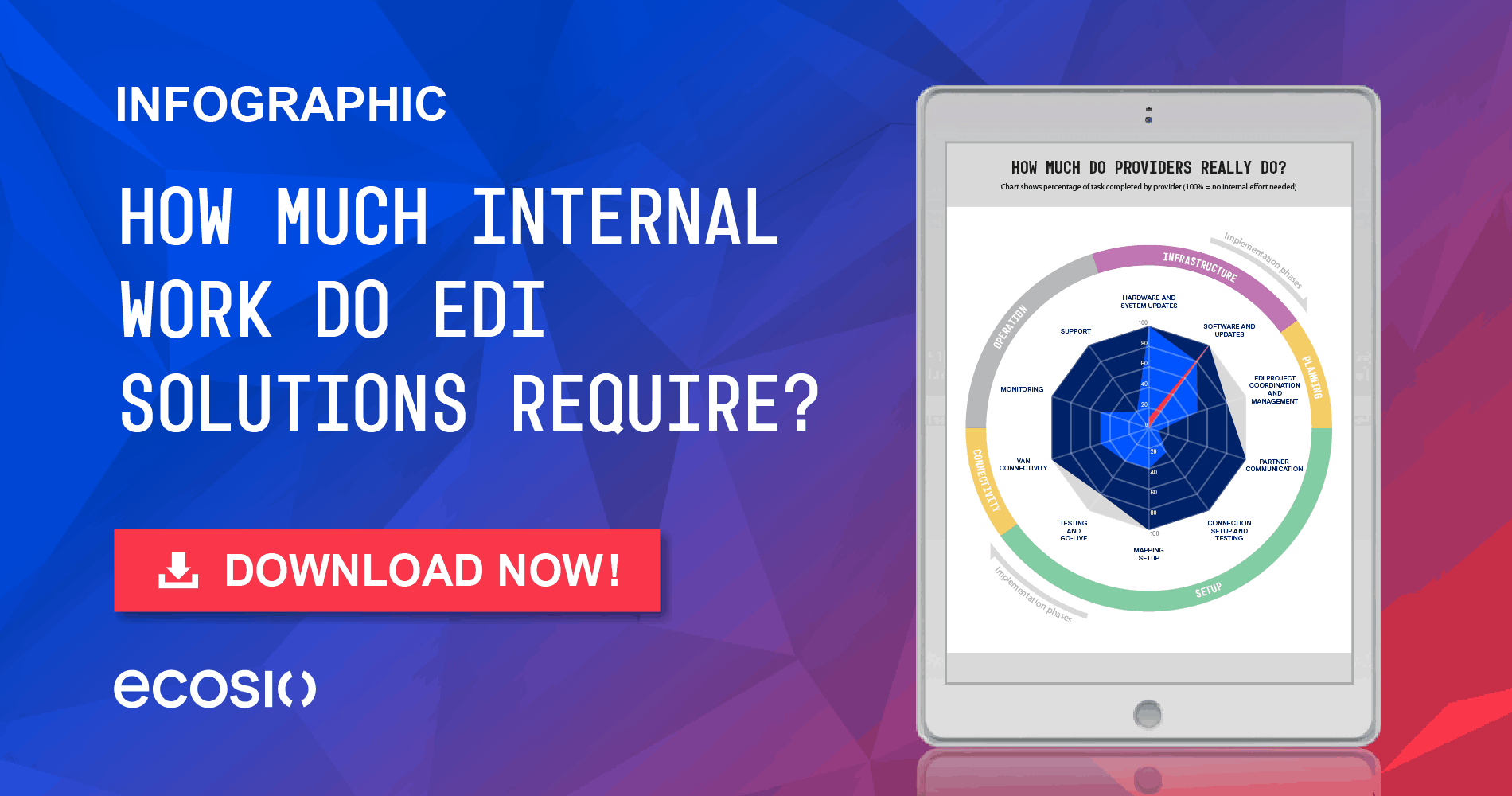
For a detailed breakdown of how different EDI solutions compare in terms of the amount of internal effort they require, please see our infographic on this subject here.
What a good EDI platform can do for you
- Save you time – A good platform can shorten error resolution time by offering deep ERP integration and full-text search across all EDI messages. This allows delivery errors to be spotted quickly. Intelligent tooling and automated testing can also prove very helpful in making partner onboardings faster and more efficient.
- Save you money – A good EDI platform will reduce the cost of manual tasks by enabling you to get your EDI connections to a working state faster. Flexible, cloud-based platforms can also support cost-efficient growth, as new features and connection types can be added in modular fashion without prohibitive “price cliffs”.
- Reduce risk – Successful EDI platforms will utilise redundant infrastructure to ensure the highest possible level of availability. The best platform providers will also implement updates proactively and may even offer continuous monitoring so that potential message delivery errors can be found and resolved.
- Increase competitive advantage – An efficient EDI platform allows partner requirements to be met both quickly and accurately, which in turn boosts business relationships. The platforms offered by EDI as a Service solutions also allow you to stay flexible in the long-run, as your platform can be easily adapted to suit changing requirements (e.g. introducing a Web EDI platform or fulfilling country-specific e-invoice requirements).
For a statistics-supported breakdown of the benefits of EDI more generally, please see our printable infographic here.
How ecosio’s EDI platform works
At ecosio our powerful EDI platform is connected directly to your ERP system via our unique API. As a result, not only are you able to send automated messages to partners via any protocol and in any EDI format, you also benefit from access to the real-time delivery status of all incoming and outgoing EDI messages in your existing ERP user interface.
Significantly, our platform is only one element of our EDI solution, which also includes our extensive network and comprehensive service. By providing these three elements as part of a single solution, we are able to offer customers EDI as a Service.
EDI as a Service involves facilitating automated B2B communication between business partners and providing flexible and futureproof EDI services via a single fully managed connection to the cloud. By taking care of everything from the initial partner approach to ongoing operation, we enable you to experience maximum automation of document exchange processes with minimum internal effort.
The sustainable, cloud-based design of our Integration Hub, which is constantly being improved, enables us to optimise our solutions for flexibility, reliability and user experience. Meanwhile, our outstanding support and round-the-clock monitoring means you can be sure your commerce-critical data is in safe hands – leaving you to concentrate on what your business does best.
Want to learn more?
At ecosio EDI is who we are. With our unique EDI as a Service solution we’ve helped hundreds of businesses to experience the significant benefits of automated message exchange… and we can do the same for you too!
If you would like to learn more about our approach and the specifics of our EDI platform, get in touch today. We look forward to helping you turn EDI from a hurdle into a hero.
Discover more about our updated product, ecosio.flow.
Der Beitrag Choosing an EDI platform: a breakdown of your options erschien zuerst auf ecosio.
]]>Der Beitrag EDI integration: what is it and how can it help your business? erschien zuerst auf ecosio.
]]>- EDI integration automates B2B document exchange between ERP systems, eliminating manual input and reducing error
- It can be implemented via local software, cloud platforms, or EDI as a Service, each requiring different levels of internal effort and expertise
- Fully managed EDI solutions save time and cost, offering ERP integration, project management, and proactive support
- Efficient EDI integration improves partner relationships and scalability, while reducing operational risk through automation and monitoring
In modern commerce, messaging automation is becoming increasingly crucial. Not only are order turnaround times shrinking year on year, there is now also a growing expectation that the parties involved in an interaction should have full visibility of the process, from the initial order right through to fulfilment.
As we’ll explore in this article, central to enabling the streamlining of essential business processes is EDI (Electronic Data Interchange) integration – and particularly cloud-based integration, with Gartner recently noting that “there is no business strategy without a cloud strategy”.
But before we look at the different ways integration can be handled, let’s look at what EDI integration is…
What is EDI integration?
EDI integration is the means by which business partners’ ERP systems are able to exchange business critical messages (e.g. purchase orders or invoices) with one another automatically.
Once EDI integration has been set up, effectively the ERP systems of the companies involved can talk directly to one another via the common EDI language that has been agreed. Unlike sending/receiving an order via email or post, which involves many steps, including waiting for the message to be delivered, opening it, extracting the relevant information and inputting it elsewhere (also referred to as a media break), with EDI integration all this is done instantly and automatically.
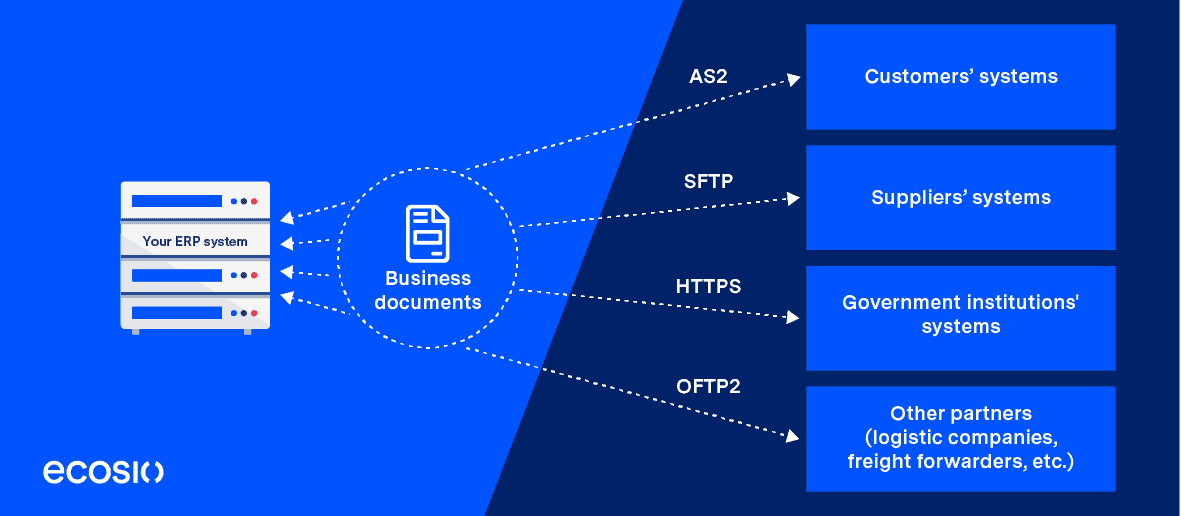
Below is a diagram showing a typical EDI integration landscape. Electronic business documents are exchanged between various business partners using certain electronic protocols. Usually the business partners in an EDI transaction are along the value chain of a company – suppliers on the procurement side and customers on the distribution side. Other partners include logistic service providers, banks, etc. Another growing trend concerns governmental institutions demanding the transmission of electronic invoices via a centralised system – e.g. FatturaPA in Italy or NAV in Hungary.
What’s involved in setting up EDI integration?
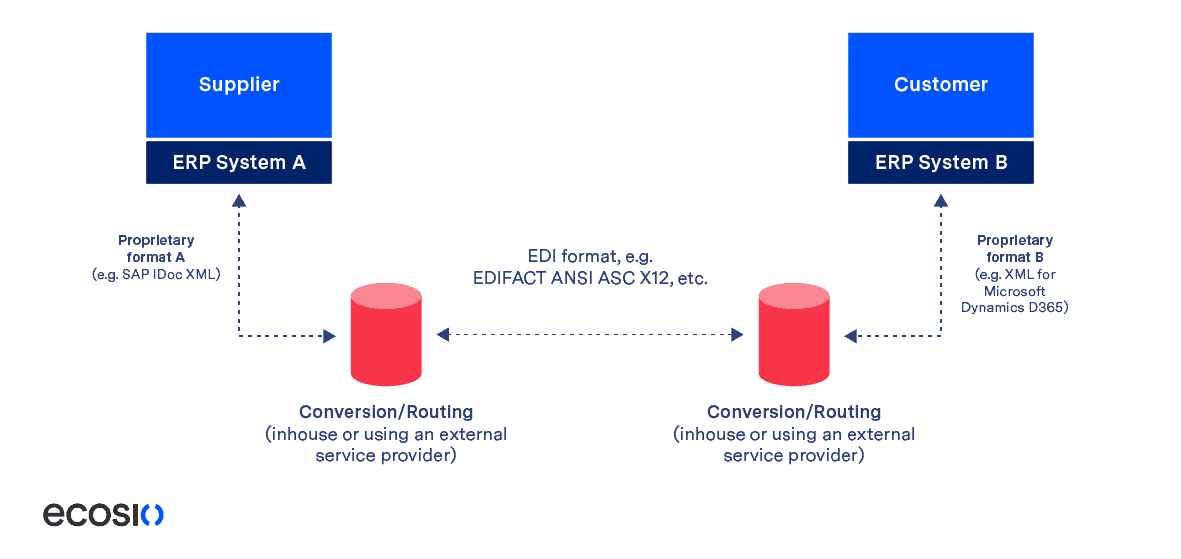
From a technical perspective, for EDI integration to work, both parties must first agree on the transmission protocol to be used and the format of the messages. Both parties must also be able to export messages from their ERP system and convert them to the EDI message format. Vice versa a conversion from the EDI format to the ERP system’s import format and the automated import into the ERP system must also be possible..
The image below shows a technical breakdown of a typical EDI connection between a supplier and customer.
Practically, an EDI integration project involves five stages:
- Assessing your requirements – Before selecting a solution you first need to work out which processes you want to automate, what the technical parameters of your ERP system are, how much internal capacity you have, who your EDI partners are, what document formats might be needed, and what volume of messages you expect to be exchanging.
- Choosing your EDI provider – Armed with the knowledge of your requirements and internal capacity you are in a good position to choose an EDI provider. During this stage it is important to think about future growth and to investigate what providers are really offering – particularly when it comes to support and pricing.
- Planning implementation – This step involves drawing up a project plan with clear priorities and timelines. For example, a key task during this stage is to agree in what order partners should be onboarded.
- The technical implementation – This stage involves agreeing transmission channels, protocols and message formats with partners. It also involves organising and overseeing testing, parallel operation of EDI and existing processes (e.g. based on paper), and then go-live. The extent to which you are responsible for these steps depends on which approach you opt for (as we shall explore in the next section).
- Ongoing operation – Once your system is up and running, it needs to be monitored constantly to make sure any errors that occur aren’t allowed to escalate. Your solution may also need to be updated and adjusted as needs change.
If you would like a more comprehensive breakdown of what the EDI implementation process involves, you can find one here.
How can EDI integration be achieved?
There are three main routes businesses can take when it comes to achieving EDI integration. These are…
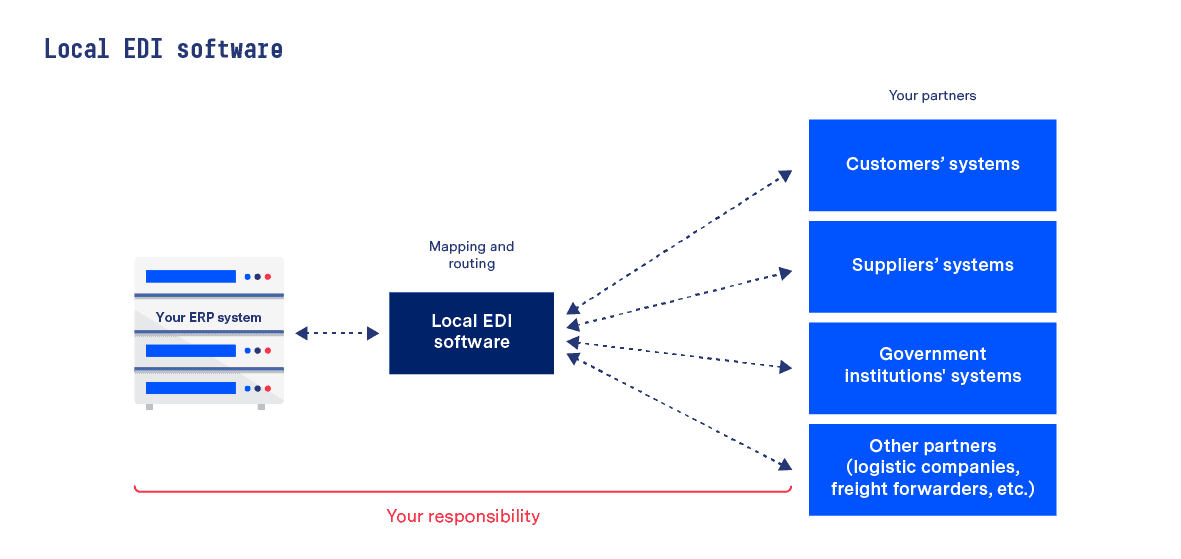
1) Use a local EDI software (aka EDI converter)
For companies with a substantial amount of EDI expertise and sufficient internal resources, using local EDI software can be a viable solution. Essentially this is an additional piece of software that enables your business to transform messages into whichever different structured formats are required and to route them to your business partners via different transmission protocols.
It is important to note that this approach requires all EDI tasks to be undertaken in-house, however. Setup, testing, onboarding, mapping, routing, monitoring, error resolution and updates – all of which take time, effort and technical knowledge – must all be handled by your business.
Typically such EDI software solutions are also not integrated into your ERP system directly, meaning that access to EDI information requires a separate login and is often limited to IT teams. Thus, there is no end-to-end message visibility directly in the ERP system (i.e. being able to see whether or not your messages have been received or where sending has failed).
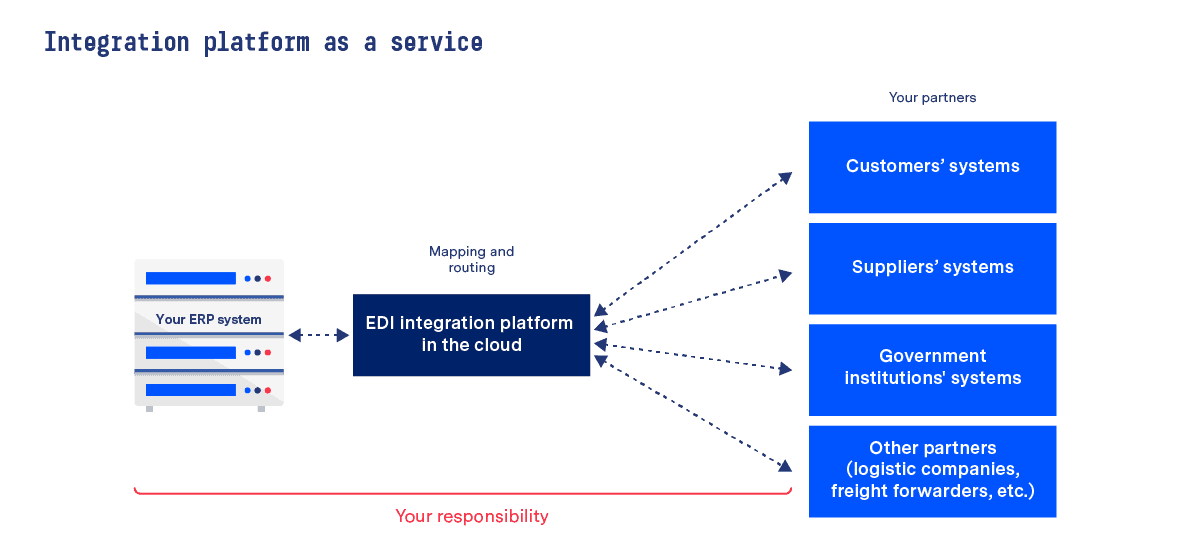
2) Use an integration platform as a service solution
Using an EDI integration platform as a service approach enables you to retain full control of all EDI aspects such as routing and mapping. Technically, the solution is similar to a local EDI converter, with the major difference being that an integration platform as a service solution offers the capabilities of an EDI converter in the cloud. As with using a local EDI converter, however, this solution still requires substantial internal input and expertise.
Similar to local converter approaches, internal teams need to balance partner onboarding and testing etc. with existing work. Likewise, while the platform may come with some out-of-the-box features, the ongoing operation and connection maintenance again falls to you alone.
The major advantage of an integration platform as a service solution compared to a local converter is the fact that the integration platform as a service solution is constantly updated. Thus, the underlying technology doesn’t age, as is the case with local converters if they aren’t regularly updated (which usually comes with a price tag).
3) Use EDI as a Service
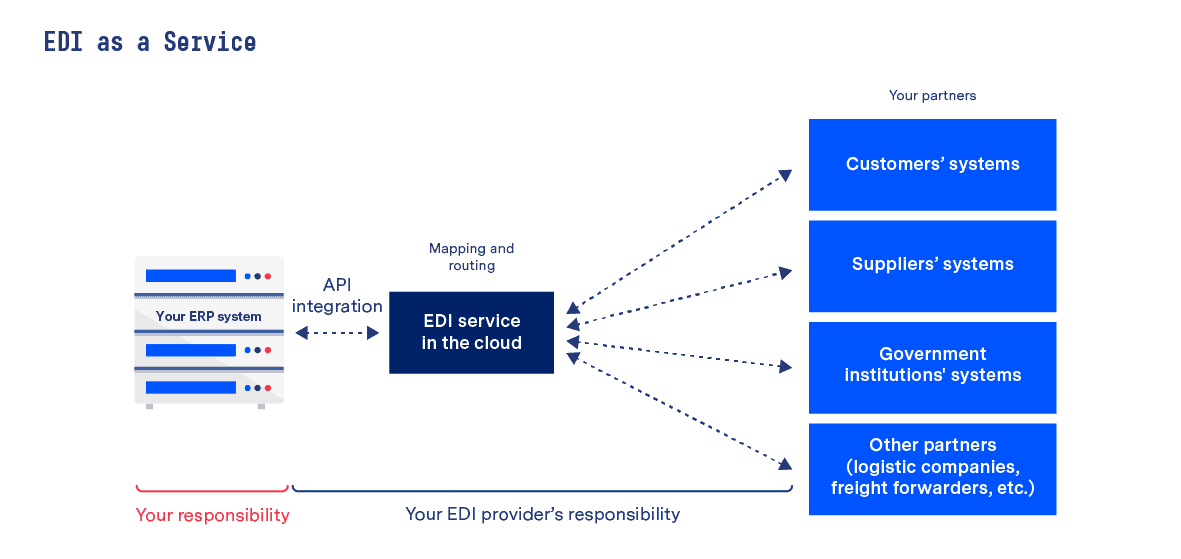
For businesses without extensive internal resources, opting for an EDI as a Service approach typically represents the most logical choice. In this option all of the EDI work is taken over by your provider via the cloud – from project management and technical setup right through to ongoing monitoring and support. Essentially EDI as a Service turns EDI from something that requires a lot of internal time, effort and expertise to something that simply works quietly in the background without you needing to worry about it.
Crucially, too, this option is also much more future-proof, as EDI as a Service solutions can respond quickly to any changes in your requirements – something that is tricky when some/all EDI tasks are handled in-house.
What benefits can efficient EDI integration offer my business?
By enabling you to exchange automated messages with your business partners and eliminate manual processes, EDI offers huge benefits to companies. For example, according to research conducted by GS1, the UK grocery sector saved over £650 million in one year alone through the use of EDI!
However, the extent of the benefits offered by EDI is dependent on which type of solution is opted for. For the purposes of this article we will look at the potential additional benefits for businesses that opt for an EDI as a Service model, as this offers the most advantages. With such a solution, in addition to experiencing the advantages of automated B2B message exchange, businesses can…
Save time
As well as reducing the time needed for partner onboardings through external project management and use of intelligent tooling, the best EDI integration solutions also shorten error resolution time by offering deep ERP integration and full-text search across all EDI messages. Additionally, in solutions where the majority of EDI tasks are handled externally, internal teams are able to focus more on core competencies.
Save money
EDI solutions that offer EDI on a pay-per-use basis can reduce total cost of ownership (TCO) of B2B processing. Similarly, being able to hand time-intensive EDI tasks such as partner onboarding to your provider can save you money. Plus, choosing a solution that is flexible and that can grow as your requirements change will ensure you continue to reap the benefits of EDI into the future, without encountering prohibitive “price cliffs”.
Reduce risk
While all EDI minimises the potential for human error, the best EDI solutions go further, offering round-the-clock monitoring of the technical infrastructure to ensure errors are detected and resolved as quickly as possible. Good EDI providers will also offer a redundant infrastructure to safeguard you from any severe data loss. EDI as a Service solutions will also proactively update your solution on a regular basis so it is always performing at optimum level.
Gain a competitive advantage
When all EDI tasks are undertaken by external experts businesses are able to focus on their core business. Meanwhile the ability to meet partner requirements faster and more accurately also boosts business relationships.
External management of EDI also allows companies to stay flexible in the long-run, as changes such as fulfilling country-specific e-invoicing requirements can be met easily whenever the need arises.
For more information on the benefits that EDI can deliver, why not download our printable, stat-filled infographic.
Interested in seeing how EDI integration could benefit you?
At ecosio we are experts in EDI integration and offer a solution that provides full EDI capability within your existing ERP system. What’s more, as we offer an EDI as a Service approach, there is virtually no work required from you to set up, test and monitor your solution.
If you would like to know more about how streamlined EDI integration with ecosio could transform your B2B processes and benefit your business, get in touch today. We are always happy to help!
Der Beitrag EDI integration: what is it and how can it help your business? erschien zuerst auf ecosio.
]]>Der Beitrag The Three Most Common EDI Pitfalls erschien zuerst auf ecosio.
]]>EDI PITFALL #1: Trying to do too much in-house
For businesses with large internal teams and a great deal of EDI expertise, handling EDI in-house may well be logical. Realistically, this solution only makes sense for very few businesses, however. Plus, even if you are a large player and you run a large EDI solution inhouse, there is potential for a fully managed EDI solution – e.g. on a “routing only” basis for instance. If you are considering handling EDI in-house, first ask yourself…
Will managing EDI in-house actually save me money?
When all the costs relating to mapping, message monitoring, partner communication, update installation, infrastructure hosting/renewal, staff etc. are factored in, inhouse solutions generally work out to be more expensive than fully managed solutions.
Will the solution be reliant on individuals?
No matter how well your solution is run, if its operation relies heavily on a few individuals your business is at risk. From sickness and injury to job change and retirement, there are many potential ways that a successful system can be disrupted when it is operated internally by a small number of people.
Does my team have the knowledge?
Unfortunately EDI expertise is rare. As a result, EDI tasks are often assigned to people for whom EDI is not their main area of expertise. What’s more these people also typically have to juggle EDI tasks with their other responsibilities. With time, such a situation can lead to a deterioration in efficiency and to a dependency on individual persons in the company.
Can my team cope with the workload?
Even if your team IS very experienced in EDI, change (e.g. to your EDI or ERP infrastructure) and growth (e.g. new onboardings or mergers/acquisitions) can still result in workloads increasing rapidly, which reduces the speed of potential expansion, multiplies the likelihood of errors occurring, and decreases the flexibility to react to upcoming changes.
Could staff be adding more value elsewhere?
By having to focus on message exchange, internal teams are also prevented from focussing on more value-adding activities. Moreover, with internal solutions the responsibility for successful message exchange lies completely with the company in question.
50% of respondents noted that moving to fully managed EDI freed up existing IT staff for other productive activities.
University of Tennessee Study
EDI PITFALL #2: Not looking at the bigger picture
Unfortunately, people are often unaware of how inefficient and complex their EDI solutions are. Instead of looking at the bigger picture and seeking to improve key processes, people are typically more concerned with ensuring their current system is running correctly. As a result, many businesses persevere with inefficient EDI systems for far too long. It’s important to remember that just because supply chains can be complex, it doesn’t follow that your EDI landscape has to be too.
With this in mind, it is important to…
Avoid multiple solutions where possible
As EDI needs change and partner networks grow, it’s common for more EDI connections to be added over time (e.g. to handle the routing of messages via a new Value Added Network (VAN)). This increases complexity, which in turn increases the time needed to complete operational tasks… and thus costs. Plus higher complexity means more chance of message failures occurring and difficulty in finding the error source quickly.
Implement a system that will allow for easy growth
Flexibility is key when selecting an EDI solution. By neglecting to implement a solution that can evolve alongside your business and in step with relevant industry and regulatory developments, you may be inhibiting your capacity to grow.
By 2025, 80% of B2B sales interactions between suppliers and buyers will occur in digital channels.
EDI PITFALL #3: Being scared of changing a running system
Given how central EDI is to modern supply chains, it’s understandable that decision makers want to avoid disruption at all costs. However, it is important to note the following…
Just because your system is running, it doesn’t mean it isn’t holding you back!
While EDI ostensibly serves just one main purpose – streamlining data exchange between business partners – EDI solutions differ greatly from one another in terms of the success with which they manage this and the benefits they offer to users. Those without fully managed EDI are missing out on the full potential EDI has to offer and will be at a competitive disadvantage!
Change doesn’t mean disruption
As all testing is conducted on a parallel system and thoroughly checked before being put live, there is no risk associated with moving to a fully managed solution.
Failing to switch will continue to hold you back
Ironically, by delaying switching to a more efficient and reliable solution out of fear of disrupting existing processes, you are taking a far bigger risk than by simply migrating!
By using electronic invoice messages for 84% of its purchase orders, the UK retail grocery sector saved £193m in one year.
Want more information?
This article is taken from our white paper “A CIO’s Guide to Electronic Data Interchange”. In this white paper we also explore the reasons behind the recent shift towards fully managed EDI, how an efficient EDI solution can benefit your business, and the simple steps you can take to ensure you select the right solution.
Download your free copy of “A CIO’s Guide to Electronic Data Interchange”, simply enter your details.
Alternatively, if you have any questions about your particular situation or anything else EDI related, please do not hesitate to get in touch! We are always happy to help however we can.
Der Beitrag The Three Most Common EDI Pitfalls erschien zuerst auf ecosio.
]]>Der Beitrag Four steps to help you identify which EDI solution is best for you erschien zuerst auf ecosio.
]]>To help we’ve identified four simple steps decision makers should take before selecting a provider…
1) Fully assess internal capability

Every business is different. Thus, in order to get the best possible solution for your particular situation, it’s important to first understand your capabilities fully. By conducting a thorough assessment of your current infrastructure, processes, technology and partner matrix you will gain a good idea of which type of solution a) you can handle, and b) will deliver the most efficient results. During this step it is important not to underestimate the work involved in maintaining a successful solution (from setup and partner onboarding to monitoring, error handling and updates).
2) Consider future needs

It’s only natural that as time passes and your partner network evolves, your EDI requirements will also change. As a result, selecting a flexible solution is imperative. Choosing a provider that can adapt to accommodate your needs will ensure your partner connections can continue to operate at maximum efficiency no matter what happens.
3) Look at what’s possible

As internal IT teams are typically focussed on running existing EDI processes, it is no surprise that many businesses are unaware of what’s possible today when deciding which EDI solution to choose. Further, this is often compounded by the fact that EDI projects can be rushed as teams hurry to find a solution to satisfy new requirements. As a result, businesses may not even be aware of the possibility of achieving a solution offering benefits such as a full-text search or deep ERP integration using API. Only by taking the time to investigate what is available can you be certain you are choosing the best solution for your business.
4) Check what the contract includes

Once you are aware of what EDI solutions CAN provide it’s important to know exactly what your provider WILL provide. Unfortunately, many EDI vendors appear to offer more than they actually do for the given price. Consequently businesses are faced with price cliffs and fees when adjustments and new functionalities are required (e.g. routing via a new protocol or post go-live support). As EDI contracts are typically fairly long, this can quickly add up! With this in mind, taking the time to investigate what your EDI contract does and doesn’t include is extremely important.
If you follow all of these steps choosing which EDI solution to go for should be simple!
Download our white paper to make sure you don’t repeat any other common EDI mistakes
Why ecosio may be the perfect choice
At ecosio we are convinced that there is no viable alternative to EDI. We care about every single EDI message and are passionate about enabling our customers to experience EDI’s full potential. We’re here to turn your EDI from a hurdle into a hero.
Through our comprehensive service, which includes building and testing all required mapping and routing, managing partner onboardings from start to finish, and round-the-clock monitoring, we ensure that minimal internal effort is required to achieve an optimal solution. In short, our EDI experts take care of everything so you can focus on what you do best! This way, we not only save you time and money, but also reduce risk and boost your competitive advantage.
Whether you are looking to consolidate complex existing processes into one unified cloud-based system, or are interested in implementing an EDI solution for the first time, our flexible Integration Hub and fully managed, modular services offer the perfect answer to your problems by providing Connections That Work.
What ecosio delivers
- 3 x accelerated time to value
- 70% faster onboarding times
- 40% savings realised when switching to ecosio (average)
- 88% realise both savings and accelerated speed when switching to ecosio
- 92% of customer expectations met or exceeded
Find out more
For more information on ecosio’s services and to find out how we can help your business in particular, visit our contact page to arrange a call with one of our experts today, email edi@ecosio.com or give us a ring on +44 20 3369 5760.
Der Beitrag Four steps to help you identify which EDI solution is best for you erschien zuerst auf ecosio.
]]>Der Beitrag How easy is handling EDI in-house? erschien zuerst auf ecosio.
]]>So how do you know if this approach is right for you? The key to answering this lies in asking the right questions and understanding what handling EDI in-house really involves.
Let’s start by looking at some crucial questions anyone considering handling EDI in-house should ask before making a decision…
Four key questions to ask
1 – Will managing EDI in-house actually save me money?
Ironically many CIOs invest in local EDI converter software (as opposed to a fully externally-managed EDI solution) in an attempt to save money. However, when the time and resource costs relating to document mapping, message monitoring, partner communication, update installation, error handling etc. are factored in, in-house solutions generally work out to be far more expensive than fully managed solutions.
2 – Does my IT team have the necessary know-how?
Unfortunately EDI expertise is rare. As a result, EDI tasks are often assigned to individuals for whom EDI is not their main area of expertise. What’s more these individuals also typically have to juggle EDI tasks with their other responsibilities. With time, such a situation can lead to a deterioration in efficiency.
3 – Can my team cope with the workload?
Even if your team IS very experienced in EDI, changing requirements can still result in workloads increasing rapidly, which reduces the speed of potential growth and multiplies the likelihood of errors occurring.
4 – Could staff be adding more value elsewhere?
By having to focus on time-intensive EDI tasks such as mapping and error resolution, internal teams are also prevented from focussing on more value-adding activities. Moreover, with internal solutions the responsibility for successful message exchange lies completely with the company in question.
What does handling EDI in-house actually involve?
In order to be able to answer some of the above questions, it is first necessary to understand exactly what is required of internal teams to operate an in-house system…
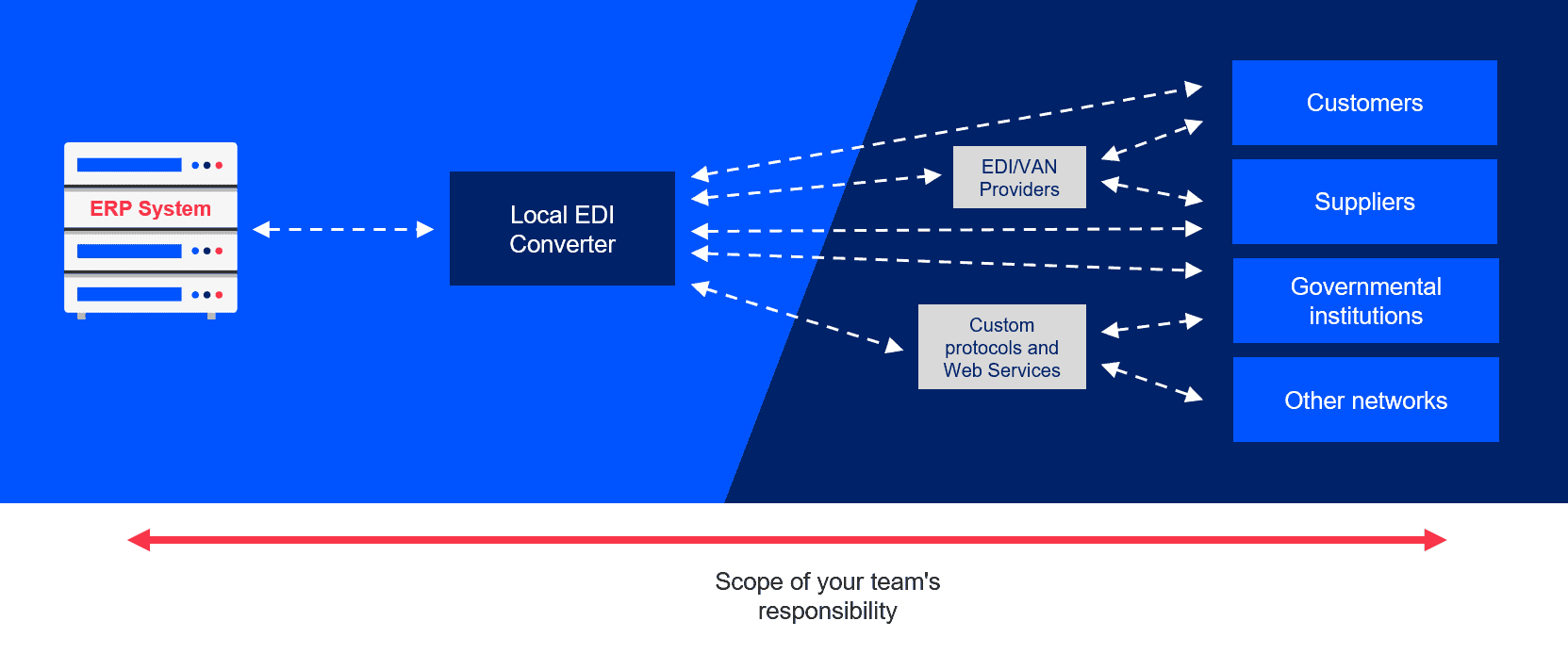
With an in-house solution, responsibility for the continued success and operation of EDI lies entirely with internal teams (as pictured below).
The main tasks
From a coarse-grained perspective, the main EDI tasks when handling EDI in-house are:
- Handling data correctly between the ERP system and the local EDI converter. In the case of SAP ERP systems for instance this means ensuring correct IDoc processing, both inbound and outbound.
- Setting up mappings between your in-house ERP format and your business partners’ formats.
- Operating the local EDI converter. EDI connections must be set up and maintained and the entire onboarding/maintenance communication with the various business partners and their EDI/VAN providers must be handled. Exchanged EDI data must also be monitored 24/7.
- Chasing and resolving errors with your business partners and their EDI or VAN providers.
Don’t forget redundancy!
Another key aspect of handling such business-critical and data-heavy IT processes in-house is safeguarding your business against system failure and data loss.
Worryingly most organisations handling EDI in-house neglect to invest in redundant servers to back up message exchange. By doing so businesses risk severe financial losses should total system failure occur, as such an event can impact an entire supply chain.
Of course, when managing EDI in-house, maintaining redundant servers does come with additional costs, however.
Have you considered fully managed EDI?
Because of the numerous complications associated with running EDI in-house, more and more businesses are turning to fully managed EDI, as it offers a simpler and more cost-effective solution.
Unlike in-house scenarios, with fully managed EDI the responsibility of internal teams is limited to the ERP system only. As shown in the image below (and in even more detail in our helpful infographic comparing EDI solution types), all other EDI tasks are taken over by the fully managed EDI service provider. From connecting partners and resolving errors, to keeping on track of new regulations and installing updates, your provider takes care of everything, leaving existing teams free to focus on more value adding activities.
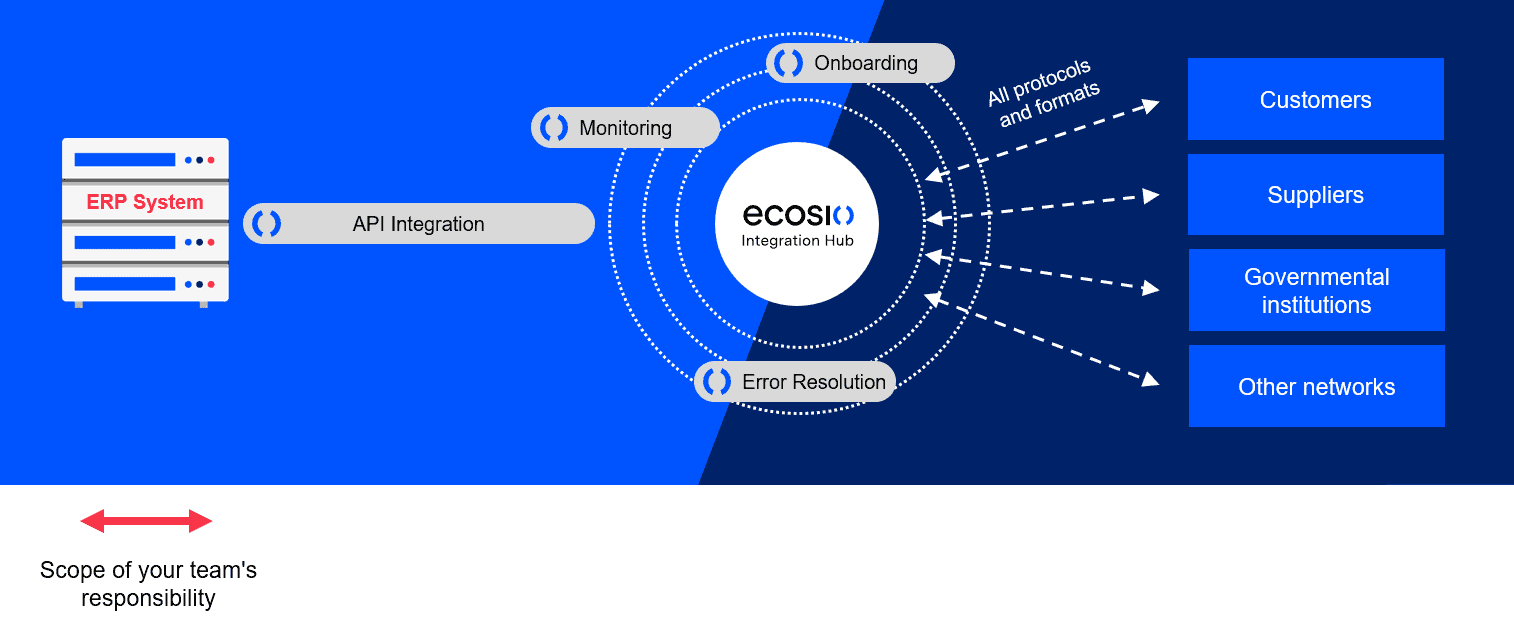
Fully managed EDI also offers flexibility and scalability, as your solution can be extended and adapted as necessary if and when requirements change.
Although not offered by every provider, the best EDI solutions (such as ecosio’s) also offer deep integration in your ERP system via an API connection. This connection provides full visibility of all processes, directly in your ERP’s user interface.
For a detailed comparison of what different EDI providers actually offer, please see our helpful infographic on this subject…
Want to maintain your local converter?
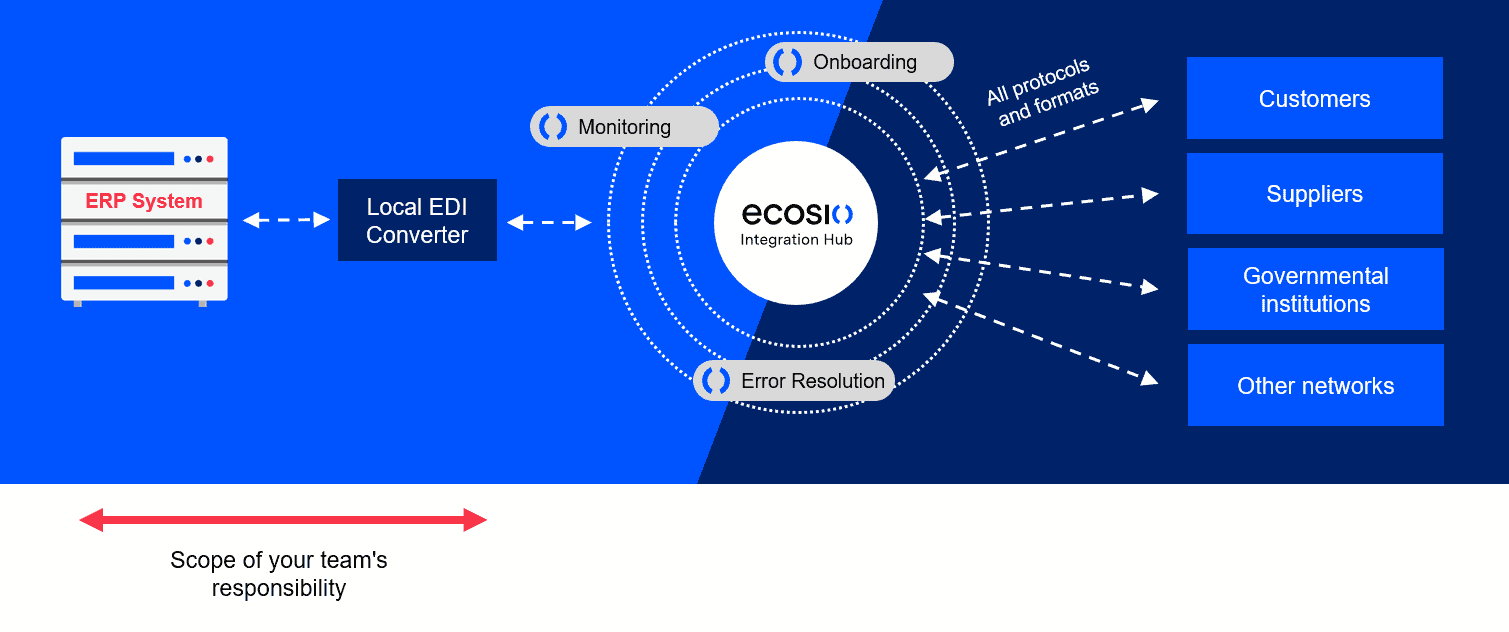
As we have already touched on, some companies do have specialised internal teams that are capable of operating and maintaining large scale EDI solutions. Nevertheless, the management of the hundreds of different EDI connections via a local converter solution in such cases still remains a huge challenge. In such cases a fully managed EDI service provider can help by taking over all routing tasks – the mappings still remain on the side of the local EDI converter.
Want more information on what EDI solution suits your business best?
At ecosio we have handled EDI integrations for thousands of businesses across all industries and in a wide range of different ERP systems. As a result, we know exactly what works best when it comes to establishing reliable and future-proof EDI systems.
If you would like to discuss your particular situation with one of our EDI experts (with no obligation), get in touch today! We are more than happy to help you take the right next step.
Alternatively, check out our many helpful resources for more detailed information on everything from fully managed EDI to EDI integration in specific ERP systems.
Der Beitrag How easy is handling EDI in-house? erschien zuerst auf ecosio.
]]>Der Beitrag EDI Integration with Infor M3 erschien zuerst auf ecosio.
]]>Infor M3 and EDI – stronger together
Infor M3 is a particularly flexible ERP solution that can be operated both in the cloud and locally. Thanks to its capacity to help users manage the requirements of complex supply chains, Infor M3 is particularly popular with large and mid-sized companies. For such companies, EDI – i.e. the automation of previously time-consuming and error-prone manual message exchange processes – is a key consideration.
However, in many companies EDI and ERP exist side by side rather than as a homogeneous whole. When a local EDI converter is used instead of a fully managed, cloud-based EDI solution, some essential advantages are lost, including:
- Full end-to-end message transparency from sender to recipient.
- Relief of internal teams, self service functionality for specialised teams, and the elimination of any need for internal EDI know-how.
- Support of national e-invoice requirements across various countries (Italy, Hungary, Spain, etc.).
- EDI solution flexibility/scalability.
- Round-the-clock monitoring of data exchange and proactive troubleshooting by a specialised service provider.
The key to experiencing these benefits lies in deep integration of an EDI solution in Infor M3. But what is the best way to achieve such integration? Together with our Infor partner BE-terna, we have designed a particularly flexible and future-proof solution for this…
API as the game-changer
The best method to achieve seamless EDI integration in Infor M3 is via an API connection. API connections are characterised by the fact that access to data between your ERP and EDI service provider (e.g. ecosio) takes place directly via an integrated interface (i.e. the API) of the EDI service provider. This makes the B2B platform with the associated B2B network of the EDI service provider and the ERP solution a homogeneous whole. This in turn means, among other things, that the status of each message can be queried automatically and viewed in real time in your existing ERP system user interface. The potential for errors along the B2B message exchange is thus drastically reduced.
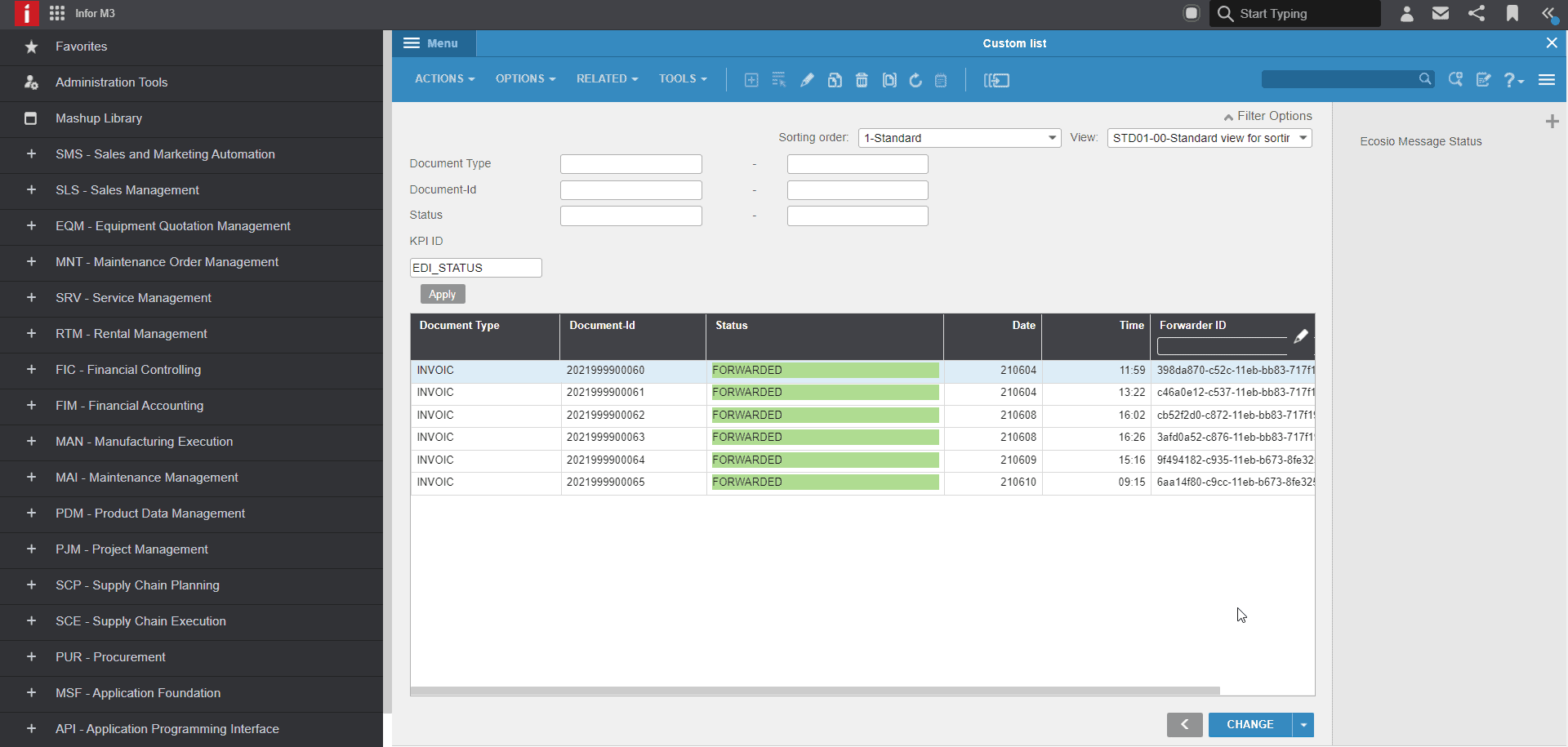
The status of each EDI message – directly viewable in the familiar user interface of Infor M3
EDI via API offers true end-to-end data transparency, making it extremely easy for users to identify and resolve any errors that occur. For example, suppose you are waiting for a response from a supplier regarding an order you sent… With EDI via API, you can immediately see directly in your ERP system if an order was not received from the supplier due to an error. Such visibility is not possible via an alternative connection, e.g. via SFTP.
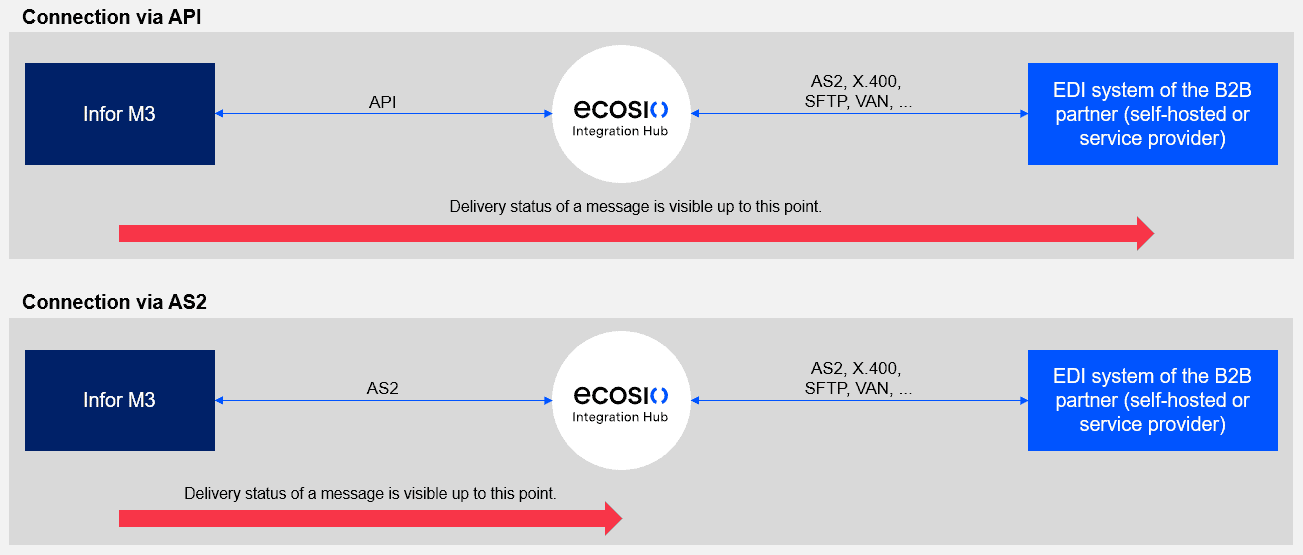
The delivery status can be viewed over the entire route of the message with an API connection
The use of EDI via API also offers the possibility of a full text search in Infor M3. This makes it much easier and faster to find documents when needed, as ecosio indexes all the content of a message as well as any associated metadata, such as AS2 message IDs, SFTP file name, etc. Furthermore, the newly updated ecosio Monitor (accessible via the familiar interface of Infor M3) allows users to track the history of any message.

The message history in the ecosio monitor, integrated in Infor M3
As the data exchange takes place via ecosio’s fully managed platform, all message traffic is continuously monitored. If there is a problem with a delivery, ecosio takes over the proactive troubleshooting and will carry out any required subsequent action, e.g. a new message dispatch. In the event that you need to intervene – for example, because something is missing from the message content – you will be proactively notified. No message is left stranded, meaning you can rest assured your message exchange is running smoothly and without errors.
An API connection makes EDI in Infor M3 more transparent, easier and, of course, more cost-efficient.
What do I have to do to achieve full EDI integration?
Not much – that’s the best part! The best fully managed EDI service providers (such as ecosio) offer API integration of all EDI functions (as well as Web EDI and e-invoicing) as a complete package. With ecosio, all this is delivered via just a single connection to the ecosio cloud-based EDI solution (our Integration Hub). This means that in addition to the benefits of seamless EDI integration in Infor M3, you also have the following advantages:
- ecosio takes over all EDI tasks, relieving internal teams and eliminating the need for in-house EDI expertise.
- The connection to the ecosio cloud-based EDI solution (our Integration Hub) enables the fulfilment of all current and future EDI or e-invoicing requirements in a flexible and scalable way.
- Dedicated ecosio Integration Engineers take care of all partner onboarding, monitor messages 24/7, and are always available as a clear point of contact for you.
- Future-proof EDI – the ecosio cloud-based EDI solution (our Integration Hub) is constantly updated and is thus always at the cutting edge of technology. ecosio’s multiple redundant server infrastructure enables updates to be installed during operation without affecting the uptime.
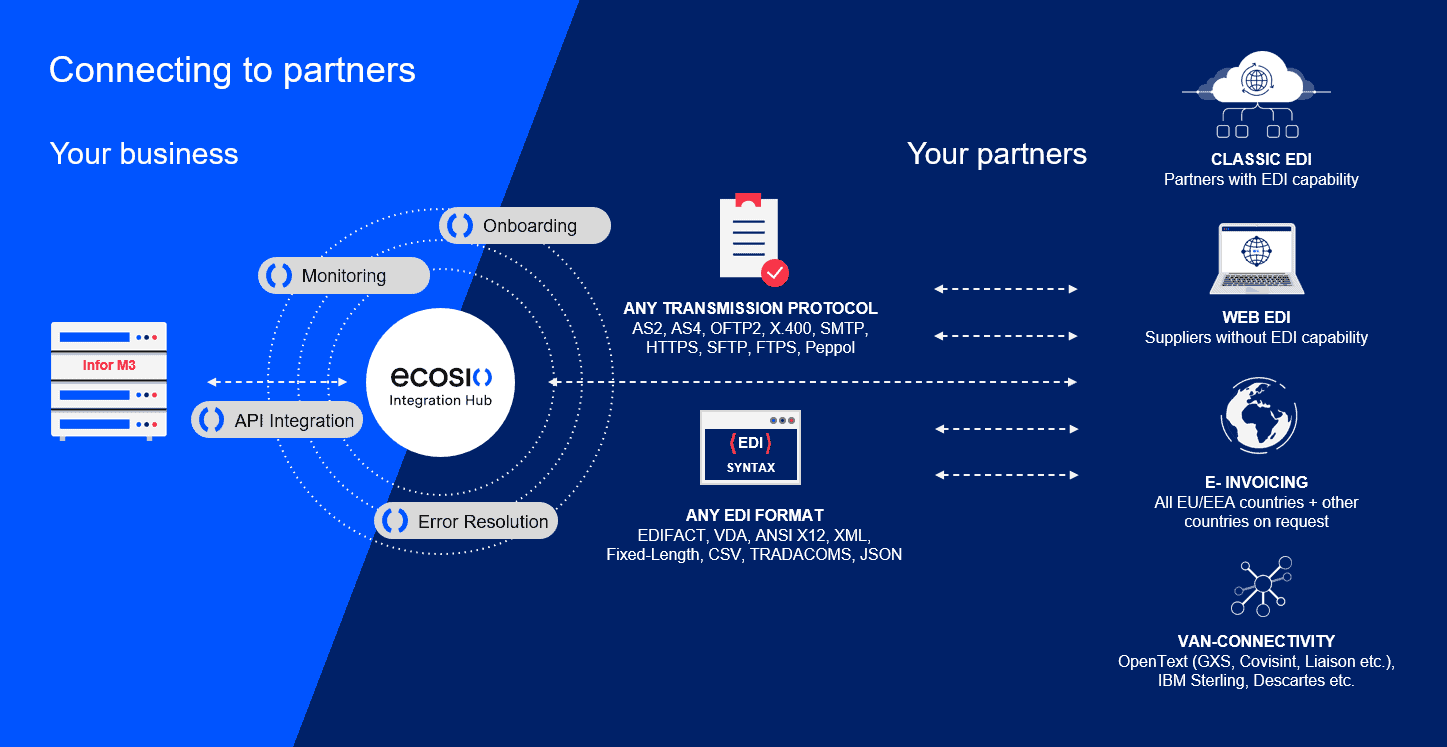
EDI made effortless with ecosio
The project implementation and EDI integration in Infor M3 is handled completely by ecosio – together with BE-terna as Infor M3 Customiser.
Still have questions about EDI, EDI integration and Infor M3?
ecosio is an exert when it comes to seamless integration of EDI and e-invoicing in ERP systems like Infor M3. If you are interested learning more about our unique EDI as a Service solution or have further questions, please contact us without obligation – we look forward to enabling you and your company to realise the full EDI potential in Infor M3!
Der Beitrag EDI Integration with Infor M3 erschien zuerst auf ecosio.
]]>