Der Beitrag What is Master Data and Why Does it Matter? erschien zuerst auf ecosio.
]]>The answer to these problems lies in ensuring your business has reliable master data. But what is this exactly, how can accurate it impact your B2B processes, and what does a good master data system look like? Let’s explore…
What is master data?
Master data, as the name suggests, is the most important data held by a business. Typically this data is information that is high level and non-transactional, and therefore likely to be more stable, used more frequently, and most useful for reporting and informing future strategy. While different industries and individual companies may treat different data elements as master data, common examples of master data elements include basic information such as the name of a supplier/customer and product reference numbers.
Given the nature of master data, this information is often used across multiple platforms and software programs in a business. To avoid inconsistencies and confusion, it is important that the exact same identifiers are used for master data elements – whatever these identifiers are (numbers, letters, words, codes etc.). Good master data management therefore involves ensuring that there is a single central record of certain data elements (e.g. supplier name), which data is pulled directly from when used in transactions and messages etc. This way, when information needs to be changed, all that is required to ensure that the new, correct data is used across the business is for the master data element to be updated.
The problems with having poor master data and processes
Although every supply chain business depends on the successful exchange of data to/from partners, many do not have reliable master data lists. This can be caused by a number of factors, such as the existence of multiple data lists that need to be consolidated (common after mergers and acquisitions), or simply a lack of prioritisation of data management by IT teams. Similarly, some companies may have well-maintained master data lists, but lack the necessary processes to ensure that data is used correctly.
Whatever the reason behind a company experiencing issues with master data, however, the resultant issues are the same. These fall into three main categories:
1) Errors
First and foremost, the most apparent issue relating to poor or inconsistent master data is the increased capacity for errors. An incorrect address, for example, can lead to delays and frustration on both ends of a transaction as messages/orders do not reach the intended recipient. Similarly, erroneous item prices and account numbers can cause huge repercussions for the company and individuals at fault.
2) Reduced capacity for performance analysis
With poor data management, seemingly simple tasks, such as identifying which customers are most valuable to your business or which products are most popular, become difficult. Without the ability to pull reliable reports on B2B information and KPIs (key performance indicators), it becomes tricky to identify both how you are currently performing and what can be done to improve moving forward.
3) Inefficiency
With reliable data, data entry and data processing are fast and simple. Sadly this is not the case in businesses without good data processes. In businesses with messy data, automation is extremely difficult; information in individual transactions typically needs to be checked, interpreted and inputted manually if costly errors are to be avoided. Manual data processing is not a viable long term solution for growing businesses, however, as human errors are unavoidable – plus staffing costs will quickly eclipse the cost of investing in an automated system.
Master data: a crucial first step towards wider automation
Over recent decades automation has grown from being a “nice to have” to an essential part of modern supply chains. From internal system automation to the exchange of structured electronic messages between partners (known as electronic data interchange, or EDI), virtually every stage of the trading cycle can now be improved by intelligent technology. The pace of business today is such that manual processes are simply unable to compete in terms of efficiency and cost effectiveness
Without reliable master data it is difficult for any level of supply chain automation to be implemented. Think of your ideal, cost- and time-effective business processes as a house you want to build. In such a scenario your master data elements are the bricks. If they are inconsistent or poorly cast, this will have an impact on the stability of the whole structure.
As a result, for any supply business looking to move towards automation of any kind, taking the time to build a reliable master data list and accompanying processes is an important first step. Unfortunately, as building master data and conducting master data synchronisations can be time consuming, many businesses put these tasks off until they are absolutely necessary. When they then come to implement an EDI solution this leads to unnecessarily time-consuming migrations and customer onboardings.
Once I have sorted my master data – what next?
If you would like to find out more about what kind of automation it is possible once you have cleaned up your master data, why not read our article What is Electronic Data Interchange and What are the Benefits of EDI? If you would like to know more about what implementing an EDI system entails, you may also be interested in this article, where we explore this process in detail.
Alternatively, if you have any other questions regarding this topic or anything relating to B2B integration please do feel free to get in touch.
Der Beitrag What is Master Data and Why Does it Matter? erschien zuerst auf ecosio.
]]>Der Beitrag Supplier EDI Onboarding – The Seven Key Steps erschien zuerst auf ecosio.
]]>With this in mind, in this article we will take you chronologically through a thorough supplier EDI onboarding process, from kick-off to go-live – looking at what’s needed from you and your suppliers along the way. Hopefully by the end you will know exactly what a successful project involves and be more confident in making the right choice of solution.
Step 1 – Kick off and definition of EDI requirements
Unsurprisingly the first step in any supplier onboarding project is for your provider to identify exactly what it is that you want. Though there is no one way to achieve this, it is generally best if both you and your EDI provider have a clear point of contact, as this will increase the project’s speed and efficiency.
Once your internal team has been agreed, your provider will liaise with them to find out what your requirements are. This involves discussing:
- Processes – How are orders, deliveries and invoices handled?
- Document types – What document types need to be realised? For example, are you looking to trade invoices only, or do you also want to exchange other common document types, such as orders and despatch advices (aka INVOIC, ORDER and DESADV for EDIFACT messages and 810, 850 and 856 for X12 messages, for example). More sophisticated EDI integrations will also enable automated transmission of sales data reports (SLSRPT / 818), inventory reports (INVRPT / 846) and receiving advice messages (RECADV / 861).
- Message data granularity – Which data elements do you want to be included in each message? In addition to the basics (price, quantity, article number) do you require additional information, such as descriptions or best-before dates?
- Message / process semantics – What is the structure and content of your exchange messages? Usually the ERP system has a preferred (data model) exchange format. This needs to be communicated to the EDI provider for the creation of the dataΩmapping.
- Message protocols – How is your EDI data exchanged with your back-end system? This can be handled via a number of different protocols, such as API, SFTP and HTTPs.
It is tough to give an estimate of how long this process will take given the bespoke nature of the process, but if you are aware of your requirements in advance and have assigned a dedicated project leader internally, this step can take as little as a couple of days. Usually the process will take longer than this, however, and typically involves a fair amount of back and forth.
Step 2 – Creation of Message Implementation Guide (MIG)
Having completed the fact-finding step, your EDI provider will then create your message implementation guide (or MIG). A MIG is basically a ‘how to’ guide for your partners which details your business’s EDI requirements and the specifics of your preferred message formats etc. This normally takes around two days of work per MIG to complete.
As the success of this step has a knock-on impact on the success of the rest of the EDI onboarding process, it is particularly important that this is completed carefully. To ensure the reliability of the MIG, fully managed EDI providers, such as ecosio, will send sample messages to your system. They may even enlist the help of one of your close suppliers to conduct a parallel phase to check everything is functioning correctly. All that is required on your side is to check the messages and flag if anything needs altering.
Sadly, with non fully-managed EDI solutions this phase is often rushed, with little or no testing conducted, leading to errors further down the line.
Step 3 – Creation of Web EDI platform
If you are looking to automate as much as possible of your supply chain’s document exchange, you may also intend to connect suppliers who do not have EDI capability using Web EDI (see our white paper for more information on Web EDI and how it can benefit you).
If this is the case, it is important that the scope of your Web EDI platform matches the scope of message types used with suppliers via “classic” integrated EDI. For example, you may need to exchange non-mainstream documents such as SLSRPT, INVRPT or RECADV in addition to orders, despatch advices and invoices – in which case care should be taken to select a provider, such as ecosio, that can support this (as this functionality is rare).
Your Web EDI platform will be built in parallel with the creation of your MIG(s). This process involves a one-time connection of the EDI solution to your ERP system and subsequent configuring of the platform to meet your requirements. Your supplier should be able to send test documents via the platform according to your MIG (for you to then check). As with the creation of the MIG, you may also want to enlist the help of a close supplier to help test the platform before wider rollout.
As Web EDI requires suppliers to put in manual effort in order for you to experience full automation, platforms are not always hugely popular with suppliers. As a result, selecting a Web EDI system, like ecosio’s Web EDI solution, which is able to minimise effort on your suppliers’ side through features such as semi-automatic document creation, PDF printing and batch support can greatly increase take-up across your supply chain.
Step 4 – Prioritising / approaching your partners
Once your MIG and Web EDI platform have been created it is time to begin onboarding your partners. Before approaching them, however, it is important to agree a strategy with your EDI provider. With large supply chains, it can take a while for partners to be onboarded. As such it makes sense to prioritise onboarding certain partners first so you get maximum benefit from your new system. For example, you may wish to prioritise your biggest suppliers, or those with whom you are closest. As your EDI solution provider will have handled similar projects many times before, they should be able to offer valuable input here.
Once the supplier EDI onboarding strategy has been agreed, your provider should approach each supplier to clarify details such as identifiers (e.g. GLN number), current capabilities (e.g. what types of documents they can exchange via EDI) and which type of connection they would prefer (e.g. AS2, X.400, VAN etc.).
During this process your EDI provider should also share your new message guidelines with your suppliers, allowing them to know what your system requires and how to create valid outgoing documents, which brings us on to…
Step 5 – Message exchange testing / validation
The testing phase involves your provider sending your supplier documents in order for them to send back the necessary responses (e.g. an Order and Order Response).
If your supplier returns an incorrect message they should be informed by your provider what the errors are, enabling them to be corrected. This is known as validation.
Validation can be done manually by checking the message against the MIG. This is a tedious and error-prone method, however. Instead, validation is better handled automatically, by employing in-built validation checks on the integration software, or semi-automatically, by using external software capable of checking message syntax.
Automatic checks (such as those completed by ecosio’s cloud-based EDI solution (our Integration Hub)) can immediately return error reports via email or web portal to the document issuer. Manual checks, on the other hand, involve much more effort, meaning more time until the error report is ready
Once any errors have been corrected and your supplier is able to send a response that conforms to your MIG, the message will be sent to your internal team to check. If a fully managed provider is opted for, this checking should be the extent of the input required from you.
Step 6 – Go-live
When you are happy with the responses from your supplier the connection can be put live. In some cases you may wish to run a parallel phase (alongside a continuation of your previous message exchange method), for several months to ensure that everything is functioning smoothly.
With suppliers being connected via Web EDI the process is even simpler, as they simply need to be activated on the platform. If your Web EDI portal is sufficiently intuitive / user-friendly, training may not even be needed. Alternatively it can be provided in the form of pre-recorded videos / documentation.
Step 7 – Post go-live
Whilst go-live might well signal the end of the EDI onboarding process, it is far from the end of the work when it comes to ongoing document exchange with your partners. For example, your supplier may conduct (as ecosio does) ongoing validation mapping checks to ensure that message details match the requirements of your MIG – thus avoiding the complications associated with incorrect details being transmitted to your ERP.
In order to benefit from a successful and future-proof system, processes also need to be in place covering message monitoring and error handling. Significantly, with many solutions go-live effectively signals the end of your EDI partner’s active involvement, meaning these responsibilities fall to internal teams. However, this is not the case if a fully managed EDI provider such as ecosio is opted for.
Ideally your EDI provider will continue to oversee your business’s EDI connections, acting as a point of contact for your suppliers (both those using classic EDI and Web EDI) and working proactively to correct errors and ensure connections are functioning at maximum efficiency. This way you benefit from both more reliable EDI and the time and cost savings associated with less pressure on internal teams.
As your needs are likely to change over time, it also makes sense to consider investing in a solution that can adapt alongside your business. For example, clients of ecosio are able to add additional Supplier Relationship Management (SRM) modules as required.
Discover a fully managed approach to EDI onboarding with ecosio
As every supply chain is different, every business faces unique challenges when it comes to connecting to suppliers. To be successful, electronic data interchange requires not only technical expertise during set-up and onboardings, but also ongoing time and effort in the form of message monitoring, error handling and installation of updates etc. after go-live. Simply put, each of the steps we have covered is crucial to the lasting health and reliability of your EDI connections.
At ecosio we understand the effort involved in establishing and maintaining efficient EDI, which is why we aim to help businesses avoid the time and stress it can cause by minimising internal effort. As well as making sure connections are as secure as possible through conducting thorough testing, ecosio’s experts manage the entire EDI onboarding process, from kick-off to ongoing operation (unlike other providers). Essentially we do the work so you don’t have to! The upshot is a more cost-effective outcome, faster connections and peace of mind.
To find out more about ecosio’s fully managed solution and how we can help you benefit from simple, efficient and intelligent EDI, contact us today! We are always happy to answer your questions.
Der Beitrag Supplier EDI Onboarding – The Seven Key Steps erschien zuerst auf ecosio.
]]>Der Beitrag Supplier EDI Onboarding – The Seven Key Steps erschien zuerst auf ecosio.
]]>With this in mind, in this article we will take you chronologically through a thorough supplier EDI onboarding process, from kick-off to go-live – looking at what’s needed from you and your suppliers along the way. Hopefully by the end you will know exactly what a successful project involves and be more confident in making the right choice of solution.
Step 1 – Kick off and definition of EDI requirements
Unsurprisingly the first step in any supplier onboarding project is for your provider to identify exactly what it is that you want. Though there is no one way to achieve this, it is generally best if both you and your EDI provider have a clear point of contact, as this will increase the project’s speed and efficiency.
Once your internal team has been agreed, your provider will liaise with them to find out what your requirements are. This involves discussing:
- Processes – How are orders, deliveries and invoices handled?
- Document types – What document types need to be realised? For example, are you looking to trade invoices only, or do you also want to exchange other common document types, such as orders and despatch advices (aka INVOIC, ORDER and DESADV for EDIFACT messages and 810, 850 and 856 for X12 messages, for example). More sophisticated EDI integrations will also enable automated transmission of sales data reports (SLSRPT / 818), inventory reports (INVRPT / 846) and receiving advice messages (RECADV / 861).
- Message data granularity – Which data elements do you want to be included in each message? In addition to the basics (price, quantity, article number) do you require additional information, such as descriptions or best-before dates?
- Message / process semantics – What is the structure and content of your exchange messages? Usually the ERP system has a preferred (data model) exchange format. This needs to be communicated to the EDI provider for the creation of the data mapping.
- Message protocols – How is your EDI data exchanged with your back-end system? This can be handled via a number of different protocols, such as API, SFTP and HTTPs.
It is tough to give an estimate of how long this process will take given the bespoke nature of the process, but if you are aware of your requirements in advance and have assigned a dedicated project leader internally, this step can take as little as a couple of days. Usually the process will take longer than this, however, and typically involves a fair amount of back and forth.
Step 2 – Creation of Message Implementation Guide (MIG)
Having completed the fact-finding step, your EDI provider will then create your message implementation guide (or MIG). A MIG is basically a ‘how to’ guide for your partners which details your business’s EDI requirements and the specifics of your preferred message formats etc. This normally takes around two days of work per MIG to complete.
As the success of this step has a knock-on impact on the success of the rest of the EDI onboarding process, it is particularly important that this is completed carefully. To ensure the reliability of the MIG, fully managed EDI providers, such as ecosio, will send sample messages to your system. They may even enlist the help of one of your close suppliers to conduct a parallel phase to check everything is functioning correctly. All that is required on your side is to check the messages and flag if anything needs altering.
Sadly, with non fully-managed EDI solutions this phase is often rushed, with little or no testing conducted, leading to errors further down the line.
Step 3 – Creation of Web EDI platform
If you are looking to automate as much as possible of your supply chain’s document exchange, you may also intend to connect suppliers who do not have EDI capability using Web EDI (see our white paper for more information on Web EDI and how it can benefit you).
If this is the case, it is important that the scope of your Web EDI platform matches the scope of message types used with suppliers via “classic” integrated EDI. For example, you may need to exchange non-mainstream documents such as SLSRPT, INVRPT or RECADV in addition to orders, despatch advices and invoices – in which case care should be taken to select a provider, such as ecosio, that can support this (as this functionality is rare).
Your Web EDI platform will be built in parallel with the creation of your MIG(s). This process involves a one-time connection of the EDI solution to your ERP system and subsequent configuring of the platform to meet your requirements. Your supplier should be able to send test documents via the platform according to your MIG (for you to then check). As with the creation of the MIG, you may also want to enlist the help of a close supplier to help test the platform before wider rollout.
As Web EDI requires suppliers to put in manual effort in order for you to experience full automation, platforms are not always hugely popular with suppliers. As a result, selecting a Web EDI system, like ecosio’s Web EDI solution, which is able to minimise effort on your suppliers’ side through features such as semi-automatic document creation, PDF printing and batch support can greatly increase take-up across your supply chain.
Step 4 – Prioritising / approaching your partners
Once your MIG and Web EDI platform have been created it is time to begin onboarding your partners. Before approaching them, however, it is important to agree a strategy with your EDI provider. With large supply chains, it can take a while for partners to be onboarded. As such it makes sense to prioritise onboarding certain partners first so you get maximum benefit from your new system. For example, you may wish to prioritise your biggest suppliers, or those with whom you are closest. As your EDI solution provider will have handled similar projects many times before, they should be able to offer valuable input here.
Once the supplier EDI onboarding strategy has been agreed, your provider should approach each supplier to clarify details such as identifiers (e.g. GLN number), current capabilities (e.g. what types of documents they can exchange via EDI) and which type of connection they would prefer (e.g. AS2, X.400, VAN etc.).
During this process your EDI provider should also share your new message guidelines with your suppliers, allowing them to know what your system requires and how to create valid outgoing documents, which brings us on to…
Step 5 – Message exchange testing / validation
The testing phase involves your provider sending your supplier documents in order for them to send back the necessary responses (e.g. an Order and Order Response).
If your supplier returns an incorrect message they should be informed by your provider what the errors are, enabling them to be corrected. This is known as validation.
Validation can be done manually by checking the message against the MIG. This is a tedious and error-prone method, however. Instead, validation is better handled automatically, by employing in-built validation checks on the integration software, or semi-automatically, by using external software capable of checking message syntax.
Automatic checks (such as those completed by ecosio’s cloud-based EDI solution (our Integration Hub)) can immediately return error reports via email or web portal to the document issuer. Manual checks, on the other hand, involve much more effort, meaning more time until the error report is ready
Once any errors have been corrected and your supplier is able to send a response that conforms to your MIG, the message will be sent to your internal team to check. If a fully managed provider is opted for, this checking should be the extent of the input required from you.
Step 6 – Go-live
When you are happy with the responses from your supplier the connection can be put live. In some cases you may wish to run a parallel phase (alongside a continuation of your previous message exchange method), for several months to ensure that everything is functioning smoothly.
With suppliers being connected via Web EDI the process is even simpler, as they simply need to be activated on the platform. If your Web EDI portal is sufficiently intuitive / user-friendly, training may not even be needed. Alternatively it can be provided in the form of pre-recorded videos / documentation.
Step 7 – Post go-live
Whilst go-live might well signal the end of the EDI onboarding process, it is far from the end of the work when it comes to ongoing document exchange with your partners. For example, your supplier may conduct (as ecosio does) ongoing validation mapping checks to ensure that message details match the requirements of your MIG – thus avoiding the complications associated with incorrect details being transmitted to your ERP.
In order to benefit from a successful and future-proof system, processes also need to be in place covering message monitoring and error handling. Significantly, with many solutions go-live effectively signals the end of your EDI partner’s active involvement, meaning these responsibilities fall to internal teams. However, this is not the case if a fully managed EDI provider such as ecosio is opted for.
Ideally your EDI provider will continue to oversee your business’s EDI connections, acting as a point of contact for your suppliers (both those using classic EDI and Web EDI) and working proactively to correct errors and ensure connections are functioning at maximum efficiency. This way you benefit from both more reliable EDI and the time and cost savings associated with less pressure on internal teams.
As your needs are likely to change over time, it also makes sense to consider investing in a solution that can adapt alongside your business. For example, clients of ecosio are able to add additional Supplier Relationship Management (SRM) modules as required.
Discover a fully managed approach to EDI onboarding with ecosio
As every supply chain is different, every business faces unique challenges when it comes to connecting to suppliers. To be successful, electronic data interchange requires not only technical expertise during set-up and onboardings, but also ongoing time and effort in the form of message monitoring, error handling and installation of updates etc. after go-live. Simply put, each of the steps we have covered is crucial to the lasting health and reliability of your EDI connections.
At ecosio we understand the effort involved in establishing and maintaining efficient EDI, which is why we aim to help businesses avoid the time and stress it can cause by minimising internal effort. As well as making sure connections are as secure as possible through conducting thorough testing, ecosio’s experts manage the entire EDI onboarding process, from kick-off to ongoing operation (unlike other providers). Essentially we do the work so you don’t have to! The upshot is a more cost-effective outcome, faster connections and peace of mind.
To find out more about ecosio’s fully managed solution and how we can help you benefit from simple, efficient and intelligent EDI, contact us today! We are always happy to answer your questions.
Der Beitrag Supplier EDI Onboarding – The Seven Key Steps erschien zuerst auf ecosio.
]]>Der Beitrag Is Web EDI the Key to Streamlined Supplier Onboarding? erschien zuerst auf ecosio.
]]>While businesses may be able to conduct EDI with larger partners, it is with smaller suppliers that automation often proves difficult, as many of these partners simply do not have the capability to send or receive automated messages. Even if trade with each such supplier is limited, the cost of manual processing soon adds up.
Web EDI provides a simple and effective solution to this problem. In this article we’ll look at how Web EDI works, what the benefits are, and how to identify a good Web EDI solution.
What is Web EDI?
Web EDI enables the transmission of EDI documents via a web portal. This portal provides an alternative method for smaller businesses to exchange automated messages. By providing suppliers with access to such a portal, businesses can extend automation across their entire supply chain.
What does Web EDI look like in practice?
For you…
Once smaller partners have been provided with access to your Web EDI portal, as far as your ERP system is concerned there is no difference between the messages received via Web EDI and those received from larger partners via traditional EDI. All B2B message exchange is automated, with all incoming messages arriving directly into your ERP and all outgoing messages similarly sent directly from your ERP.
Your benefits
- A more streamlined partner network
- Cost and time savings through increased automation
- Less pressure on in-house teams
- Once connected via Web EDI, smaller partners should be able to resolve issues with your EDI provider directly rather than you
- Web EDI can serve as the starting point for an even deeper integration with Supplier Relationship Management modules
For your suppliers…
Once your Web EDI platform has been created your partner will be provided with a login. Within their portal access rights and alerts can be set as desired.
Incoming messages: The supplier is informed by email when a new message arrives, meaning none are missed. Structured data is presented in a human readable format and can be downloaded as PDF.
Outgoing messages: Can be semi-automatically created based on incoming messages (e.g. turnaround process from order to order response).
Below is a step-by-step example of a typical interaction of a partner and their Web EDI portal:
- An email notification is received that a purchase order has come through
- Deep link in notification email is clicked, taking the viewer to the purchase order (this can then be printed if desired)
- A purchase order response is generated
- A dispatch advice is generated
- An invoice is generated
- Once checked, these documents can be sent with a single click
Supplier benefits
- Access to real-time purchase order information and purchase order changes (good systems can merge relevant changes so the supplier is always presented with the most recent information)
- Semi-automated creation of key B2B documents
- The ability to trade with larger retailers
For a deeper look at this article about a Web EDI system.
Supplier experience is important
Although the user experience of your Web EDI portal may not seem like a key concern as you will not be using it yourself, the usability of a portal can impact on the quality of the output you get via it from your partners.
The less information your supplier needs to enter, the fewer errors they are likely to make. If your portal is able to partially automate the turnaround process by generating key documents for your suppliers, meaning all that is required is for them to check the information and confirm/send, there is little chance of incorrect information being entered. In addition, the simpler your Web EDI is to learn how to use, the faster new onboardings can be completed, and the happier your suppliers are likely to be with your relationship moving forward.
No matter how user friendly the portal is, for the supplier, Web EDI is not as smooth as classic EDI. Therefore, if orders with a certain supplier increase substantially, they may wish to transition to doing traditional EDI to reduce manual effort on their side. As a fully managed service provider, ecosio can handle this transition from start to finish, ensuring minimum disruption to both parties.
Is supplier onboarding via Web EDI complicated?
Unlike with traditional EDI, where each partner connection requires substantial technical work (mapping, testing etc.), with Web EDI the vast majority of this work is done before any partners are connected. Before Web EDI partners can be onboarded two very important one-time tasks must be completed:
- A connection between your ERP system and EDI solution must be established
- The Web EDI portal must be configured by ecosio according to your specific process needs
After these two tasks are done, supplier onboarding is comparatively simple. All that needs to be done to connect partners is to provide them with a login and training so they can use the portal correctly. This means partner onboarding can be completed quickly.
You can find a comprehensive rundown of the steps involved in supplier onboarding here.
Don’t forget the work required after go-live!
Once everything is live, there are several scenarios that will still require work on your end. If a fully managed solution (such as ecosio EDI as a Service solution) is used, these of course are taken care of, but must be accounted for if opting for a non-managed solution.
- Your suppliers have questions about the process
In the absence of a solution provider to contact for answers, your suppliers will come directly to you. - Suppliers need to train new employees
Unless your service provider is able to provide training videos and walkthroughs (like ecosio), this can prove problematic and result in declining or substandard platform usage. - Certain suppliers encounter high traffic (e.g. an overload of purchase orders)
In this scenario your EDI provider may help to transform them into classic EDI partners. - You wish to change requirements on your side
If, for example, you wish at some stage to add a batch number to purchase orders, complicated reconfiguration is needed. - You want a way to test new features or give people hands-on training
The best way to resolve this is through a dedicated test environment such as that provided by ecosio to all clients.
For businesses looking to reduce internal effort to a minimum whilst enjoying maximum B2B automation, the sensible choice is therefore to select a supplier that is able to handle ongoing operation of the solution. With the assistance of a fully managed EDI solution provider, internal teams are free to focus on more value-adding activities, confident in the knowledge that their message exchange is in safe hands.
ecosio’s Web EDI solution
At ecosio we’ve helped hundreds of customers (such as Fuba Automotive and HORSCH) to streamline their supplier onboarding and message exchange processes and we understand the challenges Web EDI must overcome to be successful.
With our ecosio’s Web EDI solution, customers enjoy a unique Web EDI portal with:
- Tailored branding
- Customisable business processes and documents
- Intuitive interface and sleek user experience
- Potential for additional Supplier Relationship Management (SRM) features
- Ability to create documents for suppliers automatically based on incoming messages to minimise manual input (and resultant errors)
- Dedicated test environment (fully featured, just like the production environment)
No expensive software and no in-house expertise is needed. To ensure supplier onboarding is speedy and successful all customers are also assigned a dedicated project manager. Further, our fully managed service includes ongoing monitoring, installation of updates and error resolution, meaning you can concentrate on what your business does best.
Let us help you achieve automation across your entire supply chain!
Discover more about our updated product, ecosio.flow.
To find out more about ecosio’s Web EDI solution and how it could improve your B2B processes contact us today. We are happy to answer any questions you may have.
Der Beitrag Is Web EDI the Key to Streamlined Supplier Onboarding? erschien zuerst auf ecosio.
]]>Der Beitrag Managed vs fully managed EDI – What’s the difference? erschien zuerst auf ecosio.
]]>- Managed EDI often requires significant internal effort, with limited onboarding, monitoring, and support services despite the “managed” label
- Fully managed EDI handles all technical tasks, including partner onboarding, message tracking, error resolution, and ongoing system updates
- The key benefits of fully managed EDI include saved time and cost, reduced operational risk, and faster partner onboarding through expert-led support
- For scalable, low-maintenance B2B integration, fully managed EDI offers a futureproof approach, especially for businesses with limited internal resources
With such a large number of EDI solution providers out there, all of whom offer slightly different products and services, assessing the value of different packages can be a long and complex process. From where the solution will be hosted, to what functionality is included in your package, there are a multitude of factors to consider when selecting the best EDI solution for your business.
One of the most important decisions that businesses must make at this crucial point is the extent to which they want their provider to manage their EDI solution (from set-up and operation to monitoring and error resolution). Unfortunately, however, the term ‘managed EDI’ is used to mean different things by different providers and is therefore frequently misunderstood by those selecting a solution. In turn, this can lead to huge expense further down the line as in-house teams struggle to run their new system efficiently in conjunction with the unexpectedly minimal support offered by their provider.
In order to help you to avoid experiencing such a situation, in this article we’ll examine the full breadth of what providers mean when they talk about ‘managed EDI’, looking in detail at the areas where some providers’ supposed management is often lacking.
First, though, let’s briefly recap the basics of electronic data interchange…
The basics of EDI
Electronic data interchange offers businesses a means of exchanging key business documents with partners automatically – i.e. with minimal human intervention. The data from commonly exchanged documents such as invoices, order confirmations and delivery notes are translated into computer-readable formats and sent to business partners via standardised EDI protocols.
This method of exchanging data removes the need for manual data input/extraction, thereby minimising errors and improving the speed, cost and efficiency of B2B document exchange. A good EDI system also offers businesses flexibility and scalability, as automated processes require less internal work than manual ones.
In short, EDI allows your business to operate more smoothly as connections with partners are streamlined and reliable.
Common issues with existing EDI solutions
Despite the compelling benefits of EDI, many EDI systems sadly fall short of offering users the full potential of the technology. This is due to a number of issues with commonly implemented solutions…
1) They require too much in-house effort/expertise
This is undoubtedly the most common issue encountered by EDI users. In addition to expertise being necessary to set up an EDI solution, ongoing operation also requires effort (e.g. monitoring message exchange and resolving errors). Unfortunately, such tasks are often not considered when selecting a solution, however. As a result, many businesses end up with a solution that requires substantial in-house expertise/resources.
While this may be fine for those businesses who have extensive in-house EDI expertise, for those that don’t it stops employees from focussing on more value-adding tasks. Similarly, even if your team is able to cope with current requirements, handling EDI in-house limits scalability. Further, handling EDI in-house can also lead to an reliance on individual employees, which can lead to issues come illness or departure.
2) They offer poor support
Another key frustration for those with substandard EDI solutions is the difficulty of getting hold of someone to help you when issues arise (e.g. if a message is stuck somewhere and has not reached your partner for some reason). Given the significance of the documents being exchanged via EDI and the pace of modern supply chains, this can have a significant knock-on effect on revenue and business relationships.
3) They may inhibit your business’s flexibility through “price cliffs” or limited technical scope
While all EDI solutions should enable you to exchange automated messages with your partners, different providers offer very different packages. In particular, some solutions may be extremely rigid in terms of the technical capabilities offered, meaning you may not be able to adapt your solution as needs change (e.g. should you want to send messages via a new protocol or introduce a Web EDI platform for smaller partners). Likewise, the flexibility of your system may be limited thanks to a solution’s pricing structure, with some providers charging extortionate amounts for even minor changes to solution functionality.
The three main cloud-based solution types
Cloud-based solutions generally fall into one of the following three categories: Infrastructure as a Service (IaaS), Platform as a Service (PaaS), or Software as a Service (SaaS).
1) IaaS
IaaS relieves users of the need to purchase the physical equipment (e.g. servers). IaaS solutions may also provide operating system, disk storage and messaging resources. By opting for an IaaS system rather than an in-house solution, businesses avoid the considerable upfront costs associated with on-premise setup and remove the dangers associated with a single point of failure system.
Although an IaaS model offers customers substantial control, users are also responsible for installing and running their own software systems and must conduct all necessary maintenance/upgrades themselves.
2) PaaS
PaaS models provide a framework for in-house developers, on which they can build custom applications as required. PaaS systems do not allow for the direct use of software via the internet, but instead provide access to a platform where the necessary software applications can be created.
3) SaaS
SaaS offers access to cloud-based software. This removes the need for applications to be built or for software to be downloaded and installed on every machine. This solution model is highly scalable and is much faster to set up than IaaS and PaaS, which both require substantial internal effort.
Managed platform or a managed EDI service?
Of these three cloud-based models, SaaS is the only one which does not require considerable internal work, with the EDI partner instead providing all the necessary IT elements for a successful EDI solution. As a result, IaaS and PaaS are referred to as managed platforms, while an SaaS solution is generally referred to as a managed service model.
However, as we shall explore, not all SaaS EDI solutions are born equal. As anyone familiar with EDI will know, there is much more to successful EDI than simply setting up the basic functionality. While many SaaS EDI solutions are described as ‘managed’, this often refers purely to the fact that they provide the elements necessary for EDI to be conducted via the cloud; significantly it does not necessarily mean that they offer any help when it comes to the key EDI areas where businesses experience the most issues, such as partner onboarding or message monitoring. Those solutions that offer valuable assistance regarding the setup, operation and maintenance of EDI systems in order to lighten the load on internal teams are more accurately referred to as fully managed EDI solutions.
While they may sound similar (and both differ from on-premise solutions), managed and fully managed EDI solutions are very different and should not be confused.
What is fully managed EDI?
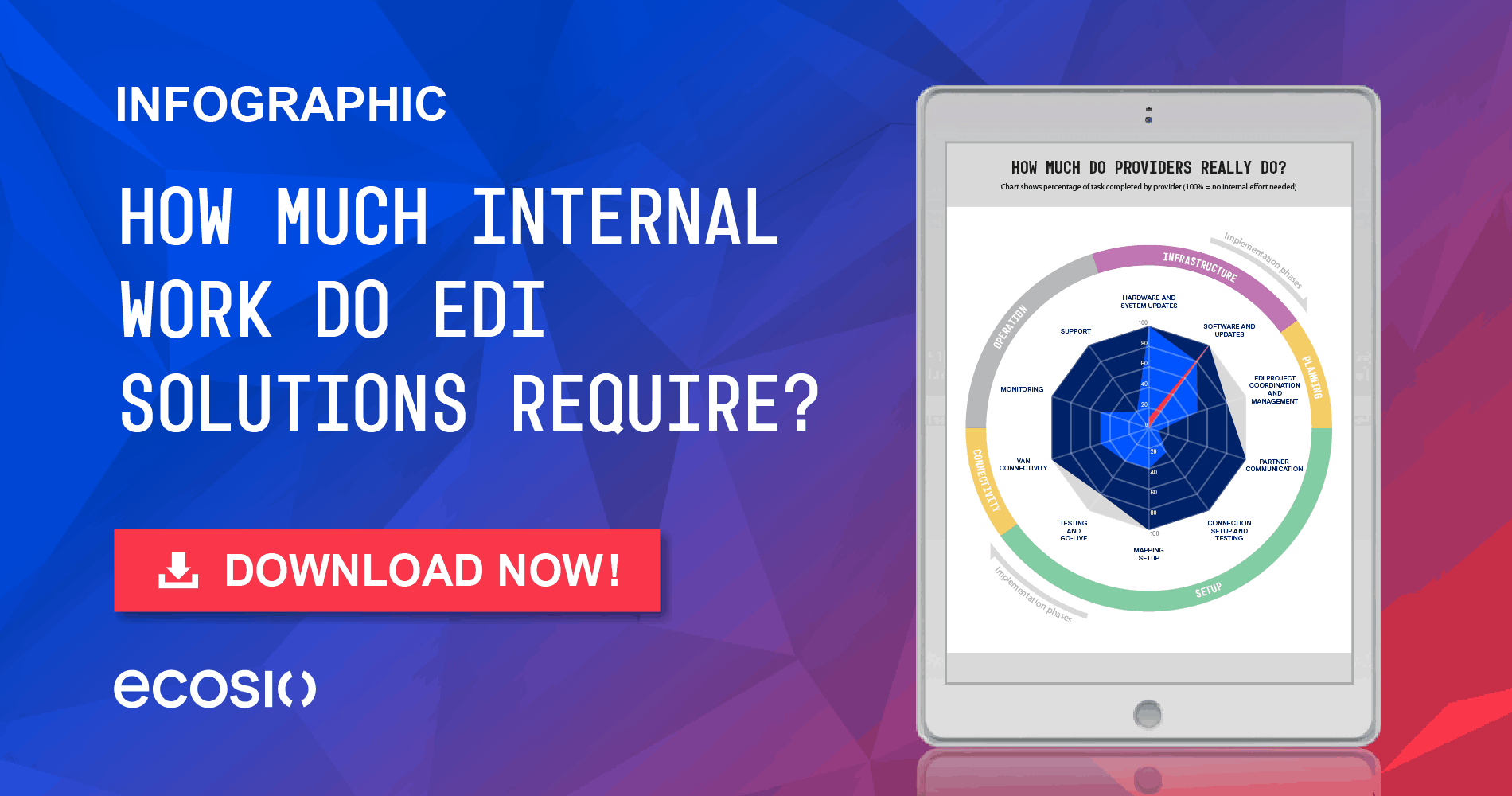
A fully managed / full service EDI solution, such as that offered by ecosio, is one in which the EDI provider handles all EDI tasks, from technical setup and message testing etc. right through to ongoing operational tasks such as message monitoring and error handling. It is for this reason that full service EDI providers are known as fully managed EDI providers – they manage everything for you! Just how much of the work required to set up and run a successful EDI solution is handled by a fully managed EDI provider compared to other providers can be seen in our helpful infographic on this subject here.
Fully managed EDI solutions also typically offer much better support and more flexibility than other EDI solutions, and may even be able to offer better data transparency too. Crucially these qualities allow businesses to avoid the common issues listed above.
The table below illustrates the considerable differences between the three types of solution over the life cycle of an EDI project:
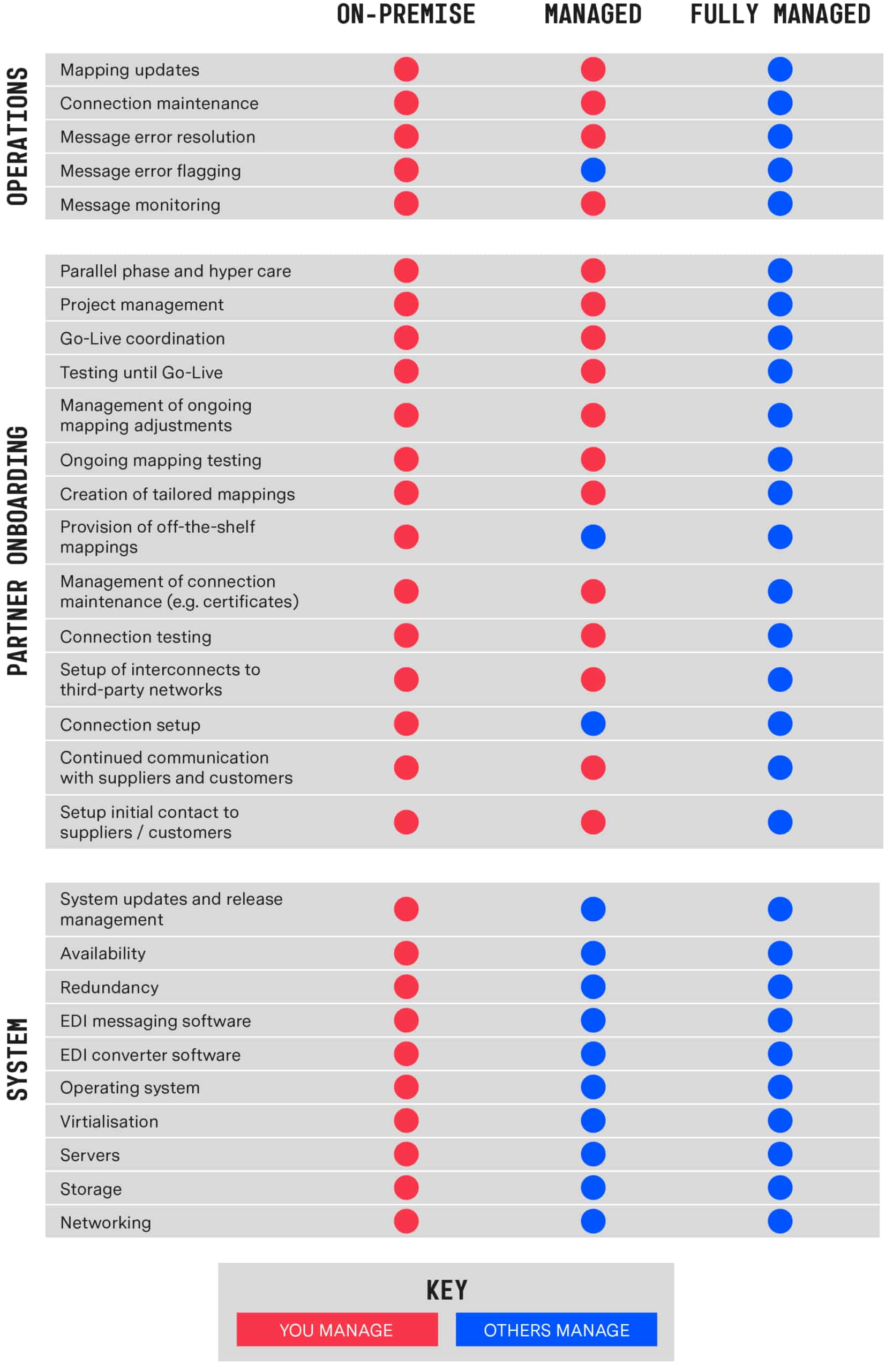
The three key areas where managed EDI differs from fully managed EDI
While, as the table above clearly illustrates, there are many ways in which managed and fully managed EDI solutions differ in terms of what the provider is able to do, there are three main differences that it is worth exploring in more detail…
1) Partner onboarding
Partner onboarding is arguably the area where there is the biggest disparity between fully managed EDI solutions and those that claim to offer managed EDI. As those who have onboarded EDI partners before will know, the process can take a frustratingly long time if a proactive approach is not taken.
…with ‘managed EDI’ solutions
Unfortunately, it is common for ‘managed’ solution providers to complete only the basic initial mapping and pass the responsibility for testing the connection to their customer. In this scenario, the purchaser of the EDI solution has to chase their partners for whatever data or documents are required. As well as being a time-consuming exercise, when issues are discovered that require mapping to be adjusted, the solution purchaser then has to act as a middleman between their partner and their EDI solution provider. In turn, this further increases the time of the project and the likelihood of errors and oversights occurring.
It is important during this phase to test all possible message exchanges, including all variations of a document (e.g. invoices with and without VAT). However, as many supply chain organisations are unaware of what thorough testing involves, their testing is often far from comprehensive. Having received no help during the testing phase from their ‘managed’ solution provider, businesses in this situation are then likely to experience many errors following go-live. Depending on the number of partners and exchanges involved, this can be extremely expensive to fix!
…with fully managed EDI solutions
With a fully managed EDI solution such as ecosio’s, virtually all of the internal effort is removed. These solutions will provide businesses with a dedicated integration engineer whose job it is to chase down information from partners and ensure that testing is conducted as thoroughly as possible, preventing issues further down the line. Not only does this have a dramatic impact on the time in which partner onboardings can be completed, as EDI integration engineers have a wealth of testing experience, clients can be sure that their connections will be extremely reliable before going live.
For a comprehensive rundown of the steps involved in supplier EDI onboarding, read our article “Supplier EDI Onboarding – The Seven Key Steps” on this.
2) Message monitoring
While establishing connections may be the most technical aspect of implementing an EDI solution, effort is also required to ensure the solution is operating correctly from day to day.
…with ‘managed EDI’ solutions
With the average ‘managed’ EDI solution day-to-day message monitoring is handled exclusively by the client. This involves regular checking to ensure no messages are stuck and that there are no errors with incoming or outgoing documents.
…with fully managed EDI solutions
With a fully managed EDI solution the pressure of checking message statuses and delivery / error notifications is removed. Instead, your provider will oversee the smooth running of the system, which should include setting up automated alerts and flags for different occurrences.
Further, providers offering a comprehensive service may also be able to offer clients a depth of data visibility simply not possible in less complete solutions. For example, as it is directly integrated into clients’ systems via API, ecosio cloud-based EDI solution (our Integration Hub) provides users with unparallelled data visibility, allowing users to see information on every stage of message exchange. What’s more, this information is all visible within their existing ERP user interface!
3) Support + error handling
No matter how much care is taken during system setup to avoid errors, the nebulous nature of EDI standards, formats and protocols is such that they are inevitable from time to time. With this in mind, and given the hugely detrimental impact errors can have on profits and partner relationships, it is important to have reliable processes in place to deal with errors when they occur. This includes not only error identification, but also resolution.
…with ‘managed EDI’ solutions
With most ‘managed’ EDI services, the provider’s error handling is reactive at best. Generally the responsibility for identifying errors lies solely with the solution purchaser. It is then the purchaser’s responsibility to notify their provider of the issue and chase until it has been resolved.
As the level of support offered by ‘managed’ solution providers varies, however, this can be a frustrating process. Despite the business critical nature of EDI, customers often find it difficult to get through to someone with sufficient knowledge of the situation to help them resolve the issue. In some cases the ‘support’ offered by providers is simply a generic support email address, with customers left in the dark as to when they can expect to hear back.
…with fully managed EDI solutions
With fully managed solutions error handling and support is proactive, not reactive. A good solution should be able to spot errors quickly and instantly start the process of resolving them. Ideally this process should be so smooth that errors can be resolved before they are even noticed by anyone else.
For example, if an incoming order fails, there is no need for the client to spot this and notify their provider. Instead, as they are responsible for monitoring message flow, the provider should spot this and contact the sender directly to ensure the necessary amendments are made to enable the message to be sent successfully. Nothing is required from the client!
When it comes to support, fully managed solutions also offer far higher quality. Clients should have a dedicated integration engineer who they can contact who understands their business and knows their partners, and is therefore well positioned to resolve any issues quickly.
The benefits of fully managed EDI
From a business perspective, the most compelling benefits of fully managed EDI can be usefully condensed into four categories…
1) Fully managed EDI saves you time
While all EDI is capable of saving users time through minimising manual processes and increasing data accuracy, fully managed EDI enables businesses to multiply these savings further by…
- Allowing internal teams to focus on core competencies, as all EDI tasks are handled by your solution provider
- Reducing time required for partner onboardings through external project management and use of intelligent tooling such as automated testing
- Shortening error resolution time through deep ERP integration and full-text search across all EDI messages, which enables delivery errors to be spotted quickly
- Freeing up internal teams from EDI onboarding and support tasks, allowing them to concentrate on more value-adding activities
2) Fully managed EDI saves you money
Arguably the clearest and most convincing benefit of fully managed EDI is its capacity to save businesses money. Fully managed / full service EDI enables users to…
- Reduce the total cost of ownership (TCO) of B2B processing, as EDI is offered as a scalable service on a pay-per-use-basis
- Experience flexible, cost-efficient growth, as new features and connection types can be added in modular fashion without prohibitive “price cliffs”
- Minimise cost-intensive manual tasks by getting EDI connections to a working state faster, since onboarding tasks are handled by specialised external teams
Note: While on-premise and partially managed EDI solutions may initially appear cheaper, when CAPEX, OPEX and other indirect costs are all taken into account, fully managed / full service EDI almost always offers superior value.
3) Fully managed EDI reduces your operational risk
In addition to helping businesses save money, fully managed / full service EDI providers such as ecosio also serve to reduce risk by…
- Ensuring the highest possible level of availability through the operation of multiple redundant servers
- Ensuring your solution is always cutting-edge through regular, automatic installation of software/security updates
- Making sure your solution’s success isn’t dependent on individuals, as message exchange is overseen by dedicated experts
- Detecting potential message delivery errors and resolving them as quickly as possible thanks to continuous monitoring
As a result, businesses that opt for a fully managed EDI solution need not worry about issues such as damaged partner relationships, fines, deterioration of solution efficiency or catastrophic data loss. Fully managed EDI ensures that no matter what, your electronic processes stay up and running.
4) Fully managed EDI increases your competitive advantage
As well as making life easier for internal teams, fully managed / full service EDI also places businesses using such solutions at a distinct advantage compared to their partners. This is due to the fact that fully managed EDI helps you…
- Focus on your core business while supporting EDI tasks are taken care of by a specialised service provider
- Stay competitive in the long-run, as fully managed solutions can easily be adapted to suit changing requirements (e.g. introducing a Web EDI platform or fulfilling country-specific e-invoice requirements)
- Boost business relationships, as partners’ EDI requirements can be met faster and more accurately
What’s more, fully managed EDI also boosts the attractiveness of the business in question to prospective partners, with benefits such as fast onboarding and round-the-clock message monitoring/error resolution, likely to be particularly appealing.
Why fully managed EDI is the future of B2B integration
Given the benefits of fully managed EDI it’s no wonder that more and more businesses are adopting this approach. In fact, fully managed EDI is set to become the new norm in the coming years.
Far from being replaced by new technologies such as API (as has been wrongly predicted by many over the years), EDI is now more crucial than ever to business processes. While large industry players demand ever more detailed data from suppliers, many businesses are also looking to extend B2B message exchange automation across as much of their supply chain as possible, with Web EDI platforms now allowing even the smallest suppliers to send documents via EDI. In many countries, too, the use of EDI – particularly e-invoicing – is now being actively encouraged and even mandated by governments. Meanwhile the Covid-19 crisis prompted many businesses to step up B2B integration efforts in order to improve supply chain sustainability.
As the scope and popularity of EDI has grown, however, so has the effort and expertise required to set up and operate a successful EDI solution. As a result, while handling EDI in-house may still be possible for those businesses with a wealth of internal EDI expertise, for most organisations a full service approach via the cloud offers a more logical and futureproof solution.
Just as we no longer have to think about how our phone calls are connected to the person on the other end (thanks to our network providers sorting this for us), so modern businesses are recognising that they no longer have to concern themselves with the technical intricacies of EDI document formats and protocols. By offering businesses security, flexibility and (perhaps most notably) the freedom to focus on what they do best, full service EDI is undoubtedly the future of B2B integration.
For more info on what the future of EDI might hold, see our article on the five top trends in EDI here. Alternatively, a more detailed exploration of how EDI is likely to evolve in the coming years can be found here.
Conclusion
As you should now recognise, managed and fully managed EDI are by no means the same. Whilst not all managed solutions offer the same exact services and some offer more than others, none can compete with fully managed solutions in terms of the extent to which they relieve pressure on internal teams.
Unfortunately, as providers often veil the limited nature of the service they provide, many businesses find themselves stuck in contracts they can’t get out of with solutions that require more resources and expertise to maintain than are available. Given that EDI contracts are usually fairly long, this commonly results in either the business in question having to pay over the odds for additional support from their provider or external consultants, or struggling to handle complicated processes in-house.
To avoid these situations it is extremely important to select a provider whose services fit your requirements. With a better understanding of the differences between managed and fully managed EDI, hopefully you are now more aware of what questions to ask prospective providers to establish the extent of their offering and make the right choice.
Looking to experience the benefits of EDI with minimal internal effort?
Efficient EDI is essential for ambitious supply chain organisations. However, integrating, running and maintaining a successful solution takes time and expertise. As these are commodities that few supply chain organisations have at their disposal, at ecosio we offer a fully managed service.
Over the years we’ve connected thousands of companies and understand exactly what effective EDI involves. With a single connection to our powerful Integration Hub, our partners benefit from unparallelled end-to-end data visibility. Meanwhile, our experienced integration engineers and EDI experts oversee every connection so you don’t have to.
In short, we take care of all your EDI needs, from mapping and testing to message monitoring and error resolution… and everything in between, leaving you to concentrate on whatever it is your business does best.
Discover more about our updated product, ecosio.flow.
For more information, contact us today!
Der Beitrag Managed vs fully managed EDI – What’s the difference? erschien zuerst auf ecosio.
]]>Der Beitrag The Real Cost of EDI: Considerations When Selecting a Solution erschien zuerst auf ecosio.
]]>With limited experience of EDI and faced with a choice between multiple different solutions, it is understandable that many people use the price of the solution as a key selection criterion. However, as we shall explore in this article, when it comes to EDI solutions, focusing principally on price is unwise. In fact, opting for a cheaper package that is less well suited to your current and future needs will almost always end up costing your business more than implementing a more comprehensive solution.
Implemented correctly, EDI solutions can bring substantial long term cost savings and hugely reduce internal effort and associated complications. By opting for a substandard solution, however, many of the key benefits of efficient EDI (and attendant savings) are negated.
To see exactly where savings are lost, let’s look at some of the common areas where EDI solution buyers typically experience problems.
Mapping / Routing
As mapping and routing is the bread and butter of EDI providers and something that everyone considering EDI requires, EDI users understandably do not expect to be charged extortionate amounts to test connections, to send/receive a new document type or to exchange messages via a new communication channel.
Unfortunately, however, this is exactly the situation many businesses face once tied into a contract. By failing to check exactly how much work their contract obliges their provider to do or what functionality their package contains, customers run the risk of encountering large license fees or activation charges. Despite the fact that activation of new functionalities (e.g. exchanging via AS2) often requires no effort on the part of the EDI software vendor, something as simple as gaining an license key to activate a new function can cost thousands of pounds! Obviously this quickly eradicates whatever savings a business intended to achieve by selecting the cheaper solution.
A common example of such a situation can be found below:
- A supplier is faced with an immediate request to enable the receipt of purchase orders and the transmission of invoices over EDI. Due to their contract volume, this customer is very important and therefore needs to be satisfied or will otherwise look for a different supplier.
- The supplier tries to fulfill this need with the least amount of effort involved and with little time left. The decision process therefore does not involve a true internal discussion of the real needs and capabilities of internal teams such as current IT backend systems, the sales department, logistics etc.
- Due to this, often the lowest bidder wins the race. Issues are not identified before the solution is purchased, resulting in more problems down the line when a unfitting EDI solution needs to be implemented
- As a result, EDI stakeholders are unhappy about the speed and quality of the implementation, encounter problems with its capability and ease of use and are faced with additional charges to bring the EDI solution closer to the real needs.
Partner onboarding
Like mapping and routing, partner onboarding is an essential part of EDI for growing businesses. Predictably, therefore, it is another key area where solution buyers become frustrated with substandard service from EDI software vendors.
As anyone who has had to onboard partners themselves will recognise, onboarding requires a huge amount of effort. In addition to sorting the technical details (e.g. setting up test connections etc.), liaising with partners to get the necessary connection information can be a very time-consuming process.
With a fully comprehensive EDI software vendor this process is handled by the solution provider. Ideally, a dedicated project manager will be assigned to oversee the connection process. This involves chasing partners for relevant details, validating information and overseeing document implementation. In addition to removing all internal effort, this drastically improves the speed of connections.
By contrast, some EDI software vendors offer remarkably little help when it comes to partner connections. Whilst they may claim to provide assistance with onboarding, the contract may only specify that they are obliged to send a single email requesting relevant requirements from your prospective partner, for example. Solution buyers therefore experience neither fast, nor hassle-free connections and are left having to chase both their partners and their EDI software vendor to achieve results. Obviously, as with extortionate costs for unlocking new mapping/routing capabilities, this can quickly erase whatever savings were made by selecting a cheaper solution.
Maintenance and updates
As EDI is constantly evolving, it is necessary to implement regular updates to keep a system functioning at optimum level. Updates can relate to many different things, such as document standards, EDI protocols or e-invoicing regulations.
For example…
- In recent years there was a switch from OFTP1 to OFTP2 connections in the automotive industry. This involved all existing connections between thousands of suppliers and their OEM customers and other suppliers requiring work. Due to the changes involved in this many EDI solutions needed additional licenses or adapters to meet the requirements of OFTP2. Further, additional security options such as encryption and message signature meant that EDI users needed to be trained and capable of understanding the principles behind the communication protocol to correctly setup and troubleshoot OFTP2 connections.
- Similar efforts and effects need to be assumed for changes in e-Invoicing for governments, such as with FatturaPA in Italy. As the systems are still relatively new they are subject to a significant amount of changes, on both the technology side and the regulation side. They may include smaller changes such as a renewed certificate, but can also affect business processes and regulations.
Therefore an experienced integration partner that knows about the business level as well as the technological implications should be selected.
The larger a business’s partner network, the more updates have to be implemented, the more work is required to do so, and the higher the risk of failing to make the changes.
With the best fully managed EDI solutions such updates are implemented as required with zero effort needed from the customer. Cheaper and less comprehensive packages, on the other hand, will not include updates. Customers then face a choice between attempting to fix issues in-house (and running the risk of making costly mistakes while doing so), or paying for their service provider or an external consultant to update their system.
Further, by selecting a substandard solution which does not offer ongoing maintenance and automatic implementation of updates businesses may not even be aware of new and potentially crucial updates. Over time this can cause a significant reduction in process efficiency and security. Businesses in this situation also run the risk of experiencing sudden errors across a large proportion of their supply chain, which can be extremely expensive to rectify.
Error handling
As costly as issues relating to mapping, routing, partner onboarding and maintenance can be, arguably the area where EDI solution buyers experience the most frustration with non-comprehensive EDI software vendors is error fixing.
Although many solutions claim to offer support, the quality of this support differs hugely from one provider to the next. Whilst a fully comprehensive EDI provider may offer 24/7 support, cheaper providers’ support will be limited. Often ‘support’ is limited to a single phone number or email address, via which it is typically extremely difficult and time-consuming simply to get through to anybody, let alone the right person.
Unfortunately, many businesses neglect to investigate the quality of their chosen provider’s support prior to signing a contract. When errors then occur, valuable time is lost trying to fix the issue. Further, the longer it takes to resolve the issue, the more likely it is to escalate or for similar issues to appear elsewhere in your supply chain, a scenario that can easily result in spiralling costs.
How to secure a good value contract with an EDI software vendor
1 – Conduct a thorough requirement analysis
Possibly the single most useful step you can take before starting the process of selecting your EDI supplier is to conduct a thorough requirement analysis. Though this takes some time, it is well worth the effort and will ensure you don’t get stuck in the wrong contract. Some key questions to ask during this stage might be:
- Do we have sufficient EDI knowledge in-house to operate an on-premise system?
- Are we able to develop effective testing processes to ensure the security of new connections?
- What functionality are we likely to need in the future?
- Are internal teams capable of protecting data security by staying on top of updates?
- Do we need a provider that can respond quickly to resolve errors?
- Is simplifying partner onboarding a priority?
2 – Don’t underestimate the effort required to setup and operate effective EDI
Although fully automated EDI hugely reduces the amount of manual effort required to exchange business documents, there are still many processes even after setup, such as error handling and message monitoring, that require management by someone to keep your system running smoothly.
A common error made by those selecting an EDI software vendor is to focus on the capabilities of the software, without considering who will be in charge of making sure things function correctly. Ultimately, even if you purchase the most incredible software, if you don’t know how to use it effectively or don’t have sufficient internal resources, you won’t see any benefit. Businesses in this situation are therefore forced to hire the required resources, change their EDI solution altogether or enlist the help of another third party supplier in the form of an EDI consultant (and in so doing commit to another contract).
With a comprehensive EDI solution these problems do not arise. Whilst operating an EDI solution in-house makes sense for those businesses with sufficient internal resources/knowledge and for whom EDI is a central part of the business, this is not the case for others. By far the most sensible option for businesses new to EDI or without EDI experience in-house is to opt for a fully managed solution. As opposed to the hands-off approach of other providers, a fully managed EDI solution provider will handle everything from the initial setup to ongoing operation, virtually eliminating the need for internal involvement. In addition to offering much better value, this approach ensures optimal system performance and frees up time for internal teams, allowing businesses to focus on what they do best.
A detailed breakdown of the differences between different EDI provider solutions can be found in our infographic on this topic.
3 – Consider future needs
Choosing a flexible solution is one of the best ways to ensure you achieve value over the course of your EDI contract. From a change in the amount of monthly messages you send, to needing the ability to send information in different formats and via different communication protocols, your EDI needs can easily shift over time. It is essential, therefore, that you select a solution that is able to help your business as you grow and requirements change. Sadly too few businesses consider this and are forced to pay through the nose to achieve simple functionality as their needs evolve.
Don’t let that be your business! By considering future needs and choosing a flexible, comprehensive EDI solution you can ensure that your business avoids surprise fees and continues to benefit from efficient, hassle-free EDI for the duration of your contract.
4 – Make sure you know what your package does and doesn’t include
Though it sounds obvious, clarifying exactly what your package includes can save you a huge amount in the long run. If a provider seems to be offering the same service for considerably less, this is very unlikely to be the case! By failing to identify the difference between the two before making your decision you are likely to pay for it later.
A concise list of five things to consider when selecting a vendor can be found in our article “5 Key Components to Consider When Selecting an EDI Vendor”.
Can ecosio’s comprehensive EDI solution help you?
For more information on ecosio’s unique, fully managed EDI solution and to find out how we could help your business to benefit from efficient B2B document exchange with minimal internal effort, contact us today.
Der Beitrag The Real Cost of EDI: Considerations When Selecting a Solution erschien zuerst auf ecosio.
]]>Der Beitrag EDI with Iceland – What You Need to Know erschien zuerst auf ecosio.
]]>Iceland at a glance
- Founded in 1970
- Over 800 UK locations
- Stores in 3 continents (Europe, Africa and South America)
- Over 20,000 employees
Three key aspects to doing EDI with Iceland
Before being able to trade EDI messages with Iceland, suppliers must understand Iceland’s onboarding process, the document formats they prefer and what exchange protocol they use.
Iceland’s supplier onboarding process
- Your in-house team (or EDI partner) will make contact with Iceland’s EDI team to set up the EDI connection.
- After setting up the necessary EDI mappings, Iceland will exchange test EDI documents with you via a test connection. It is important during this stage to make sure that all relevant types of document and delivery are tested.
- After successful completion of the test phase the connection will go live and you will be able to exchange EDI messages with Iceland for real.
What standards and document types does Iceland use?
Although Iceland previously used the TRADACOMS standard, they now exchange orders and invoices over EDIFACT. Iceland’s preferred document types for suppliers to use are EDIFACT ORDERS D96A and INVOICE D96A.
Starting EDI with Iceland
The first step in connecting to Iceland is setting up an exchange channel using an EDI protocol.
With their EDI provider, suppliers should establish two connections: a test connection and a productive connection. To be able to trade EDI messages with Iceland suppliers have to be able to communicate with OpenText’s Business Network. Thankfully, as ecosio’s Integration Hub offers integration with Business Network, one connection to ecosio can satisfy all document exchange requirements.
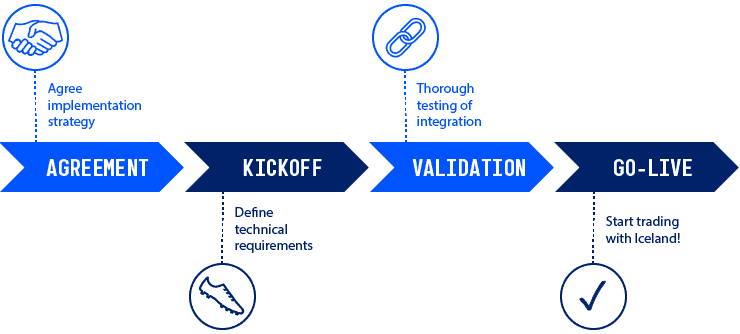
Connection timeline
As no two companies have the same requirements, it is difficult to say how long setting up a connection will take exactly. This depends principally on the mapping and routing that needs to be done.
The simplest and fastest way to establish a secure and reliable connection to Iceland is to use a service provider that offers a dedicated project manager to take ownership of the process.
Below is a diagram of the steps involved.
How ecosio can help
Ecosio has a wealth of experience in facilitating EDI connections to large retailers. Our EDI experts will ensure you benefit from an efficient and reliable connection as quickly as possible.
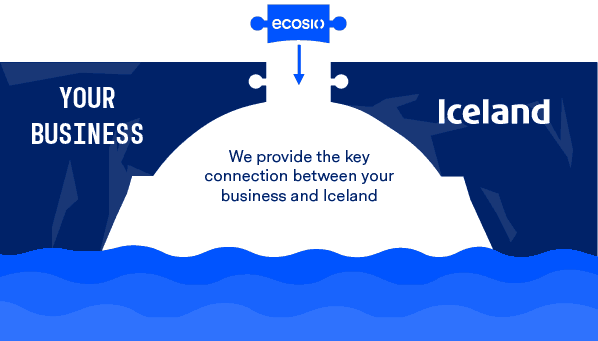
Our one-of-a-kind Integration Hub supports all EDI formats and protocols. As a result, a single connection to ecosio will enable your business to trade EDI messages with Iceland (and other retailers) with minimum effort.
Unlike other solutions, ecosio’s EDI solution is embedded directly in your ERP system as a native feature. This deep integration allows for important processes to be accessed via your existing user interface and allows for useful end-to-end message visibility.
Benefits at a glance
- All EDI requirements met via a single connection to ecosio’s Integration Hub
- No existing EDI knowledge required
- Simple and fast partner onboarding
- End-to-end data visibility
Do you have any questions?
If you have any questions about doing EDI with Iceland feel free to contact us, we’d love to help!
Please also see our other articles for the EDI requirements of similar retailers including ASDA, Boots, M&S, Morrisons, Ocado, Sainsbury’s, Tesco and Waitrose.
Der Beitrag EDI with Iceland – What You Need to Know erschien zuerst auf ecosio.
]]>Der Beitrag Waitrose EDI – Where to Start erschien zuerst auf ecosio.
]]>Waitrose at a glance
- Founded in 1904
- Around 350 UK locations today
- Export food to over 50 countries worldwide
- Annual revenue of over £5 billion
Waitrose EDI – three key things to understand
In order to start EDI with Waitrose, suppliers must first understand Waitrose’s onboarding process, what document formats they use and what their preferred exchange protocol is.
Waitrose’s supplier onboarding process
- Waitrose will supply prospective suppliers with document format guides and an EDI questionnaire.
- Suppliers return questionnaire, confirm start date and verify product master data.
- A test connection is established via testbox.
- Test invoices are sent to Waitrose. It is a requirement to send EDI invoices within a maximum of 3 months. A charge will be levied for any paper invoices received after that date.
- Feedback is received from Waitrose and adjustments made if necessary until invoices are transmitted correctly.
- Parallel phase starts. Both EDI invoices (with test qualifiers) and paper copies are transmitted to Waitrose.
- After a successful parallel phase, the connection is put live and you are officially a Waitrose EDI partner.
What EDI standards and document types does Waitrose use?
Waitrose exchanges invoices [INVFIL] and orders [ORDHDR] via the TRADACOMS standard.
Setting up EDI with Waitrose
Before being able to exchange EDI documents with Waitrose, an exchange channel using an EDI protocol must exist.
With its EDI provider, Waitrose will establish two connections: one test and one productive.
Specifically, suppliers require a connection to OpenText’s Business Network to exchange automated messages with Waitrose. As ecosio’s cloud-based EDI solution (our Integration Hub) already offers integration with Business Network, all document exchange requirements will be satisfied via a single connection between ecosio and your ERP system.
Connection timeline
As the amount of mapping and routing required will differ from one supplier to the next, it is tough to say exactly how long it will take to set up a connection, though, as mentioned earlier, Waitrose will charge any suppliers unable to set up EDI within three months.
The easiest and most efficient way to set up a connection to Waitrose is to use an expert managed service provider that is able to offer a dedicated project manager to oversee the process.
Below is a summary of the steps involved in the connection process.
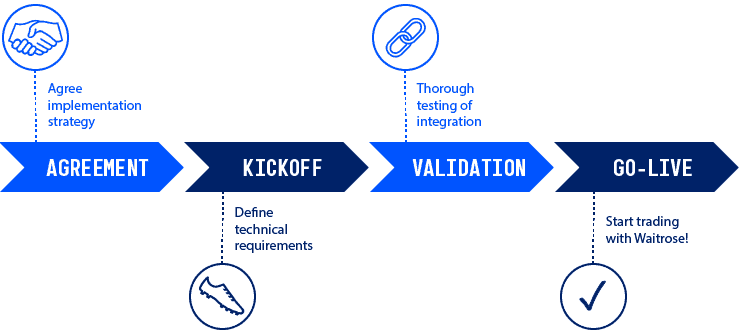
How ecosio can help
Ecosio has years of experience connecting suppliers to large retailers including Waitrose. We can make sure an efficient and reliable connection is established quickly and with minimum fuss.
Our unique Integration Hub supports all secure EDI protocols and formats, meaning one connection to ecosio will allow you to trade messages with Waitrose (and other retailers) in the correct format and over the correct protocol with minimum effort.
Unlike other providers’ solutions, ecosio’s is embedded directly in the user’s ERP system as a native feature. As a result, important processes are integrated into the existing user interface, producing useful end-to-end message visibility.
Benefits at a glance
- All testing, mapping and routing achieved via a single connection to ecosio’s cloud-based EDI solution (our Integration Hub)
- Zero internal EDI knowledge needed
- Hassle-free partner onboarding
- Unparalleled end-to-end data visibility thanks to deep ERP integration
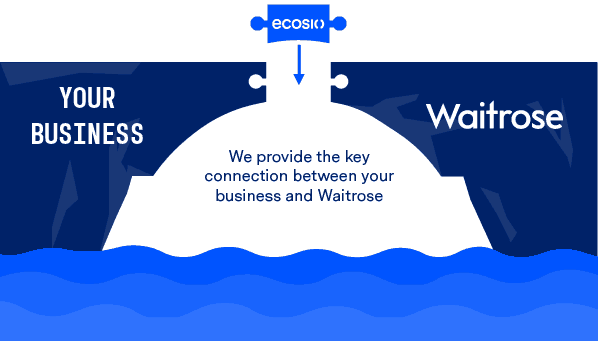
Do you have any questions?
If you have any additional questions about EDI with Waitrose feel free to contact us, we’d love to help!
Please also see our other articles for the EDI requirements of similar retailers including ASDA, Boots, Iceland, M&S, Morrisons, Ocado, Sainsbury’s, Tesco.
Der Beitrag Waitrose EDI – Where to Start erschien zuerst auf ecosio.
]]>Der Beitrag Web-Based EDI vs Fully Automated EDI: What’s the Difference? erschien zuerst auf ecosio.
]]>Unfortunately, despite being well aware of the issues with web-based EDI, many businesses neglect to consider moving to a fully automated solution as they are either unaware of the substantial benefits of doing so or believe migration will be extremely complicated.
Admittedly, identifying the benefits of moving from a web-based to a fully automated EDI solution, and when best to do so, can be tricky, with different providers all saying different things. To help elucidate, this article explores the real difference between web-based and fully automated EDI, providing you with a clear picture so you can make the right decision for your business moving forward.
Starting out – web-based EDI
For many businesses, the first interaction with EDI comes as a result of a large retail customer requiring EDI capability from their trading partners. In order to enable their suppliers to trade with them efficiently, these larger customers will generally provide access to a web-based EDI portal.
Naturally, as supply chain businesses grow, so do their trading partner networks. As such, in time many smaller and mid-sized suppliers quickly find themselves having to manage B2B data exchange via multiple web-based EDI portals. This in turn can compromise growth, efficiency and profits, as exchanging commerce critical information becomes increasingly complicated and resource-heavy.
Where most businesses go wrong
Unfamiliar with the key differences between web-based EDI and fully automated solutions, many organisations purchase their own web-based EDI package in order to simplify document exchange by removing the need to access multiple customer portals. However, while this consolidation admittedly saves some time, it fails to combat the main business problem that EDI was developed to fix – time-consuming and error-prone manual data entry.
As illustrated in the diagram below, although the communication between your web-based EDI platform and your partners may be automated, seamless integration between your EDI portal and your ERP system is not possible. This means that all information must be manually transferred. In essence you’re paying to do business with those customers who require EDI, without experiencing any of the benefits of EDI yourself.

How does fully automated EDI differ from web-based EDI?
The key difference between web-based and fully automated EDI is the fact that the latter allows your business partners’ ERP system effectively to talk directly to your own, bypassing the need for human intervention. Individual documents are then automatically available in your ERP system and can be searched for and edited in your existing user interface.

By removing the need for manual data entry, both error rate and pressure on internal teams are greatly reduced.
“What are the cost implications?”
Although Web EDI offers suppliers the benefit of being able to expand their partner networks to include larger retailers, in terms of the cost-effectiveness of processing documents, web-based EDI is virtually the same as traditional paper/PDF communication.
As illustrated in the figure below, the only real saving of moving from paper-based document exchange to Web EDI is printing costs. On the other hand, moving from web-based EDI to fully automated EDI drastically reduces the number of steps to process a document. Thanks to seamless integration in the user’s ERP system, fully automated EDI requires only two steps for successful end-to-end exchange: generation and transmission.
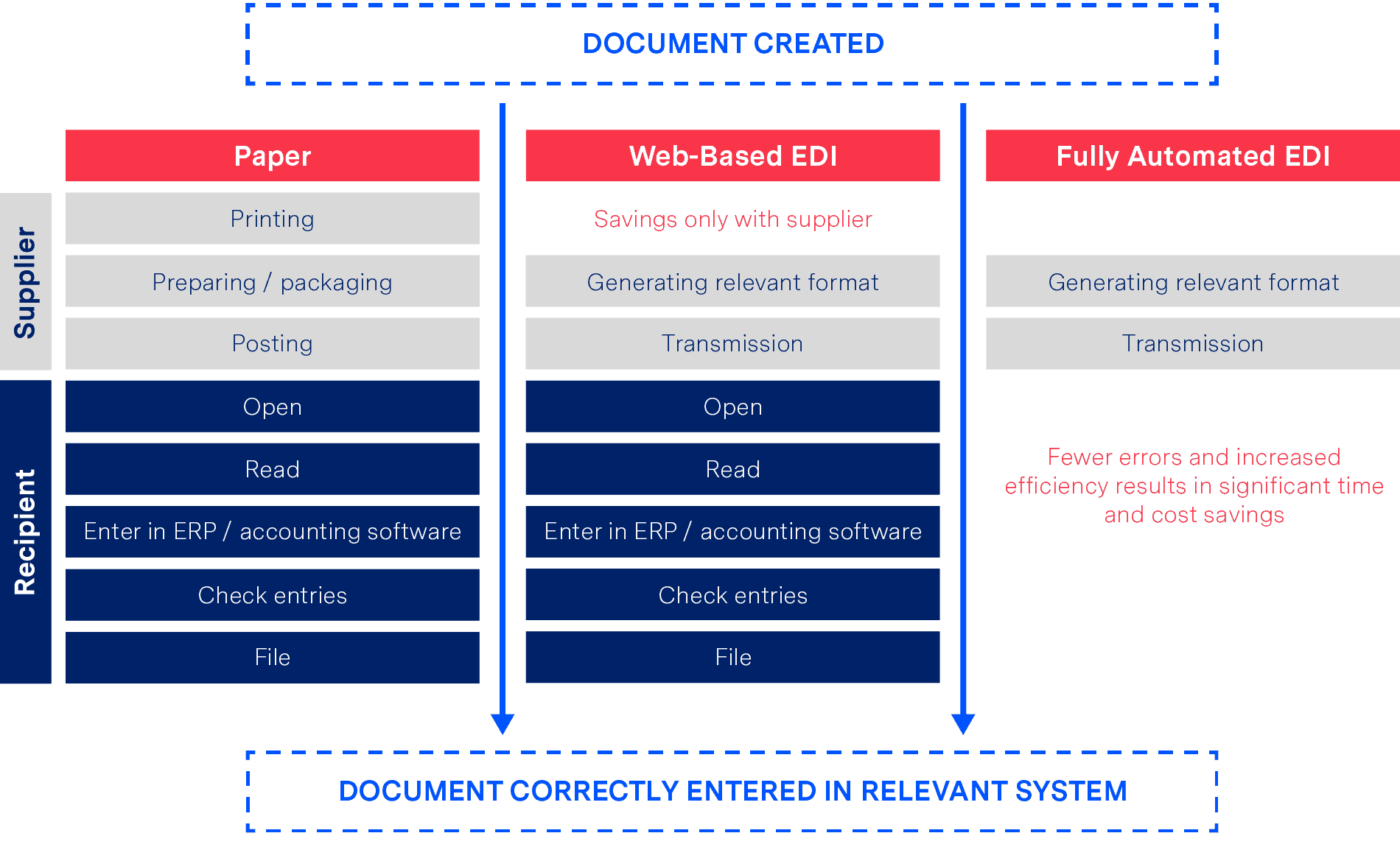
While estimating the cost benefits of this process improvement is complicated, based on numerous reports from IBM, GS1 and others, the expected savings of moving to a fully automated system can be calculated at around 64%. This figure factors in FTE costs, opportunity costs of more value-adding activities, errors, delays and postage/fax fees (if relevant).
As we look at in our blog post on the topic, however, perhaps the biggest factor when it comes to achieving cost savings is making the right EDI supplier choice.
How is this process improvement achieved?
The key factor behind this streamlining of B2B document exchange is deep ERP integration.
Opting for a managed EDI solution offering deep integration (as opposed to relying on customers’ web-based EDI portals) means that when it comes to monitoring, accessing, troubleshooting or modifying messages, you can do it all directly in your ERP system. This allows businesses to self serve – avoiding delays and relieving pressure on in-house resources.
Unlike many other providers, ecosio offers deep ERP integration, creating a seamless UI experience thanks to our unique and powerful API. With several connectors capable of creating a fast link between ecosio and any ERP system, achieving unparalleled message status visibility is a simple process.
Differences at a glance
| Web EDI | Fully automated EDI |
|
|
“So when should I make the switch?”
In general, a classic EDI solution is always preferable to a Web EDI solution, because only with classic, managed EDI can the full automation potential of electronic data exchange be realised. However, in practice the transition to a fully automated system usually comes after a period of using web-based EDI portals.
As shown in the figure below, the use of web-based EDI becomes uneconomical beyond a certain volume of documents (and increasingly so as document volume increases over time).
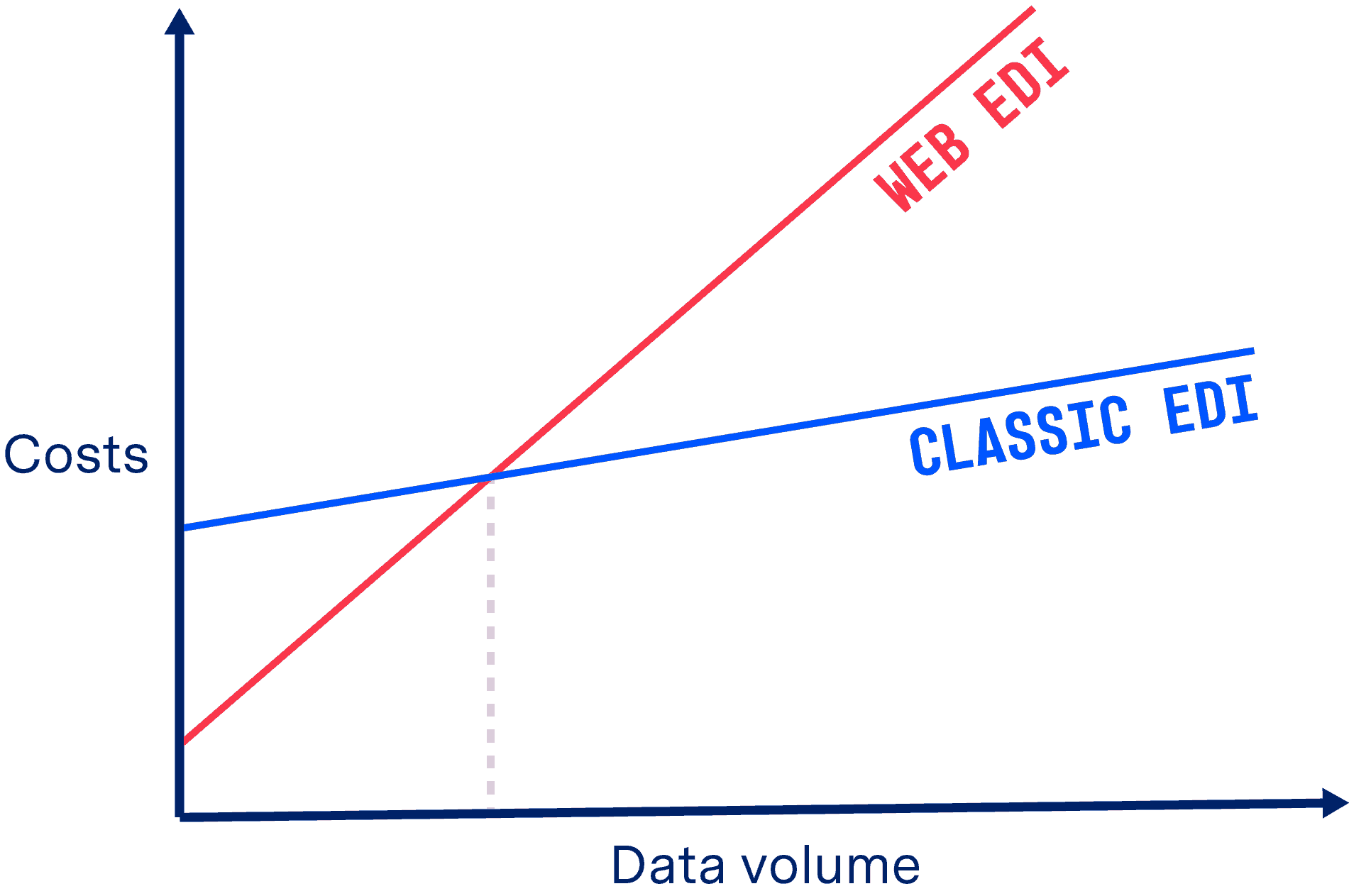
Want to learn more?
Discover more about our updated Web EDI product, ecosio.flow.
If you are a supplier looking to move from your customers’ web-based EDI portals to experiencing the benefits of fully automated EDI yourself, get in touch today. We’re happy to answer any questions you have!
Der Beitrag Web-Based EDI vs Fully Automated EDI: What’s the Difference? erschien zuerst auf ecosio.
]]>Der Beitrag 5 Key Components to Consider When Selecting an EDI Vendor erschien zuerst auf ecosio.
]]>For those approaching migration or implementation projects, this article should help to ensure you don’t experience negative consequences in the future due to lack of foresight in certain areas. We have distilled successful EDI implementation into 5 key components – planning, infrastructure, set-up, connectivity and operation – each of which we will explore in more detail below. To achieve a successful, efficient and future-proof solution all 5 of these components should be considered. How effectively you consider and execute on these 5 key components determines the extent to which you will realise cost savings and accelerated delivery speed.
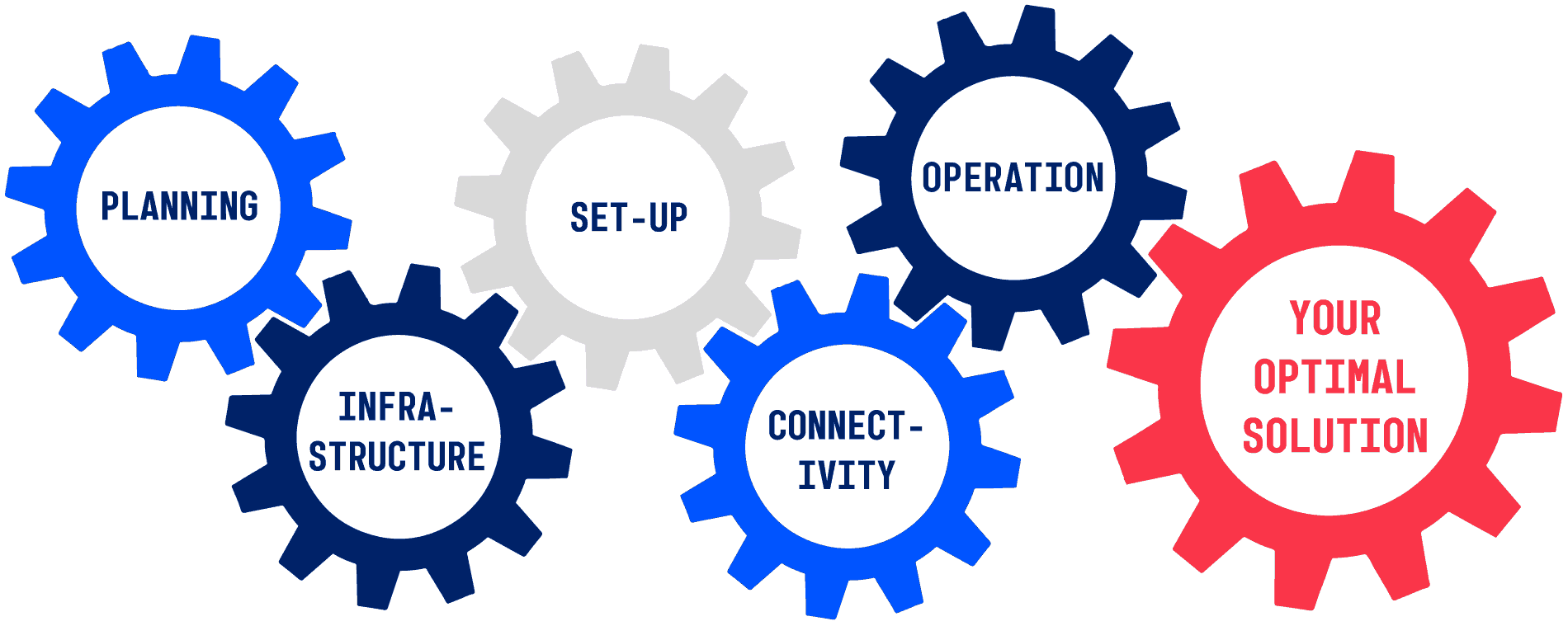
1) Planning
As with any significant project, planning is essential to eventual success. After all, in order to achieve the best solution for you, it makes sense that you first identify what an optimal EDI system might look like in practice according to your specific context.
Though you may not have EDI expertise, you know your partner trading cycle (and business goals) better than anyone external, which is why we recommend that an experienced internal stakeholder is involved in this stage and supports you throughout. Ideally the planning stage should be led by an internal team with support from an experienced EDI vendor, who will be able to suggest improvements and cost-saving optimisations you may not have been aware of.
2) Infrastructure
The next key thing to consider is the type of infrastructure you want to use. Do you want to move to a cloud-based managed service or do you think you have sufficient internal expertise and resources to handle EDI on your own, for example? If the latter, are you aware of the extent to which this choice will impact your company’s capacity for future growth? Very few businesses’ EDI needs remain constant for a long time, and implementation of a flexible system can ensure you are not held back by your data exchange processes in the months and years to come.
3) Set-up
Third is looking into the practicalities of how the system will be constructed. Who will build the mappings and conduct thorough testing? Understanding who will do the heavy lifting here is key, as having to handle much of this internally can be extremely time-consuming. While EDI solutions may appear similar to the untrained eye, they often differ greatly when it comes to how hands-on they are during the set-up phase. Given that the success of the testing and implementation phases will dictate the efficiency and reliability of your system going forward, it’s important to select an EDI vendor that meets your specific needs.
For a detailed look at what an implementation project looks like, our article “What Exactly Does an EDI Implementation Project Involve?” on this topic.
4) Connectivity
Fourth is identifying how you will communicate with and connect to your trading partners. Again this will determine how to allocate resources and responsibility as this can be the most time-intensive part of the EDI onboarding process, especially if you have a lack of in-house EDI expertise. Often the work required for this component is underestimated, with many companies experiencing drawn-out supplier onboarding times as a result. However, by allocating sufficient internal resources or opting for an EDI vendor that is able to manage the entire onboarding process, from first contact to go-live, expansion of (and communication with) your trading partner cycle can be quick and easy.
5) Operation
Finally, once your EDI solution has been set up and your current partners onboarded, your systems still need to be monitored and maintained to make sure that messages are being sent and received correctly. Given the potentially expensive knock-on effects of supply chain data exchange issues, from delays and chargebacks to lost orders and damaged supplier relationships, the importance of having a system in place to catch and resolve issues quickly cannot be overstated.
For a detailed breakdown of how much work is done by different EDI providers, download our infographic on this topic.
How ecosio can help
Unlike other EDI vendors, whose packages in reality place great burden on internal teams, because they only partly cover the above components, ecosio provides value at each of the 5 steps mentioned above. Through our comprehensive service, which includes building and testing all required mapping and routing, providing a dedicated project manager to streamline partner onboardings, and round the clock monitoring, we ensure that minimal internal effort is required to achieve an optimal solution. In short, our EDI experts take care of everything so you can focus on what you do best! This way, we not only save you time and money, but also stress.
At ecosio we are experts at helping companies to optimise their B2B data exchange. Whether you are looking to consolidate complex existing processes into one unified cloud-based system, or are interested in implementing an EDI solution for the first time, our flexible Integration Hub and managed, modular services offer the perfect answer to your problems.
Deeper, faster, smarter, cleaner.
Find out more
For more information on ecosio’s services and to find out how we can help your business in particular, click here to arrange a call with one of our experts today.
Der Beitrag 5 Key Components to Consider When Selecting an EDI Vendor erschien zuerst auf ecosio.
]]>