Der Beitrag Electronic Data Interchange (EDI) with the Help of VDA Standards erschien zuerst auf ecosio.
]]>The Association of the Automotive Industry was founded in 1901 and is an interest group of the German automotive industry and its suppliers. The headquarters are located in Berlin.

VDA Headquarters in Berlin (Source: Wikimedia Commons
The VDA is publicly known through the Internationale Automobilausstellung (IAA, International Automotive Exhibition), since they operate as their organiser. In addition to the representation of interests, VDA also undertakes standardisation tasks, with recommendations for logistical processes in the automotive sector to be adopted. Those recommendations established themselves throughout the years as the de facto standard of the German automotive industry.
The development of the VDA standards
Already in 1977, before even UN/CEFACT started to develop the EDIFACT standards, the Verband der deutschen Automobilindustrie began, defining EDI message standards, which were dedicated to the automotive industry and its suppliers. In contrast to EDIFACT or ANSI ASC X12, no segments or separators are used, but instead elements with constant length, called the fixed length format are used. Every data element has a defined length, within which the information can be transmitted. If the information is shorter than the defined length, the rest is filled out with blank spaces.

Numbering of the VDA messages
Each VDA message type has a unique number, almost like a description. Message type 4905 describes for example a delivery forecast. At the end of this article you will find a list of the different VDA standards.
Current development
The current fixed length VDA standards are gradually being replaced by EDIFACT document types. Therefore, the VDA association releases recommendations, on how EDIFACT messages can represent VDA document types. Nevertheless, the current VDA message types are still very frequently used in the automotive industry and one can expect this to still be the case in the coming years.
How are VDA standards being used?
Depending on the car manufacturer, different VDA standards can be used. The following scenario, depicted with a delivery forecast and despatch advice, as well as the paper documents which go with it, come up very frequently. This example is of a pump manufacturer, who sends goods to a car manufacturer.
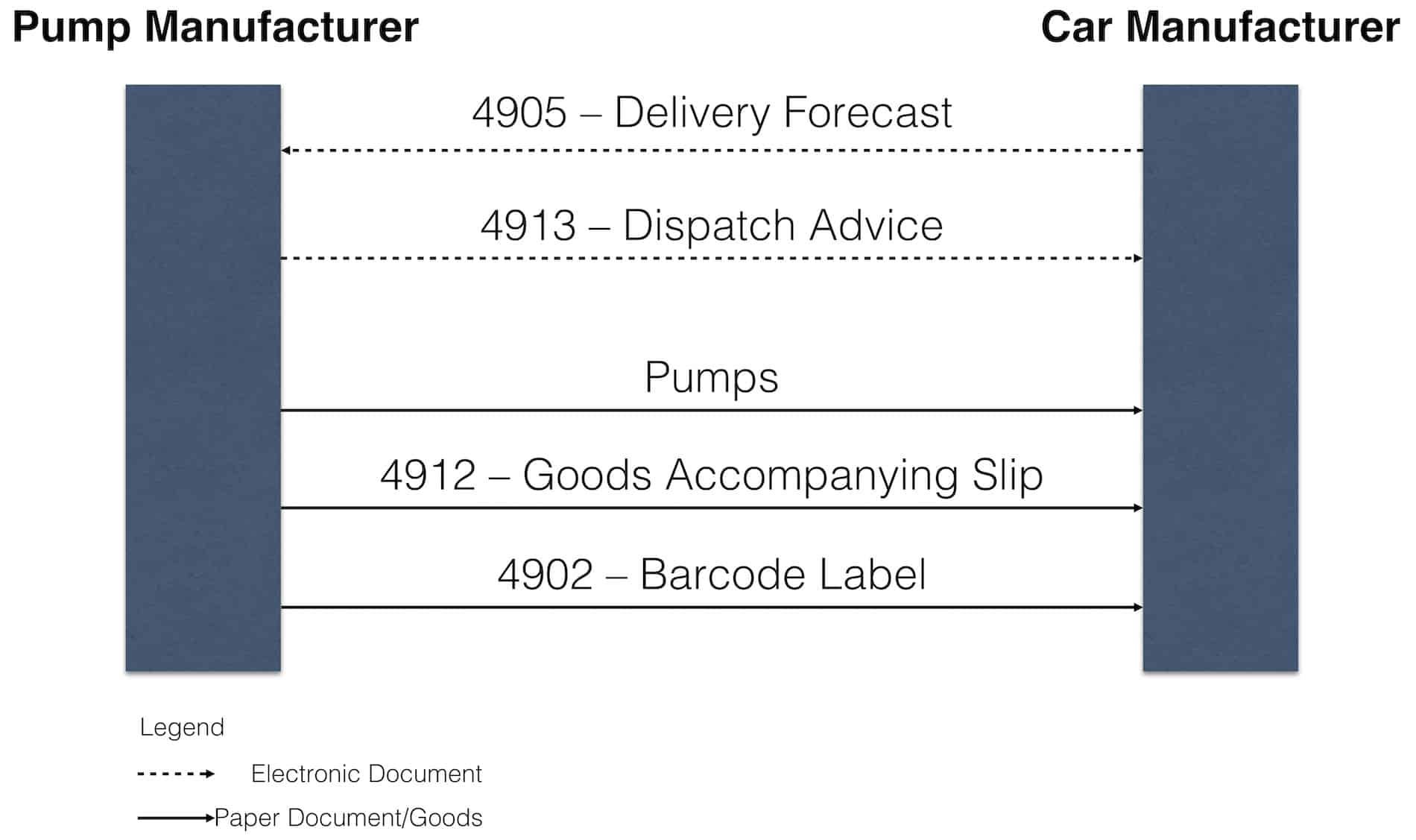
An Example of the Use of VDA Standards
The car manufacturer forecasts the deliveries to the pump manufacturer with the help of a 4905 message. The pump manufacturer prepares the goods accordingly and confirms the delivery with a 4913 message. Next step is to ship the pumps, together with two paper documents: a barcode label 4902 together with the goods, which can be scanned with a barcode scanner and a paper-based goods slip 4912.
Are you looking to use VDA standards?
The use of VDA standards is now required by more and more car manufacturers and their pre-suppliers. However, the implementation of the corresponding electronic document types and the paper documents which go with it, including the correct barcodes, is not so simple. We are more than happy to help you with any questions you might have about VDA.
List of VDA standards
The list below gives you a (non-exhaustive) overview of the important standards, which the VDA association adopted (as of February 2015).
| Nr. | Description | First Publication |
|---|---|---|
| 4900 | Transmission of ODETTE messages; EDIFACT payload | Jan 91 |
| 4901 | Enquiries/offer | Oct 77 |
| 4902 | Transport label (barcode enabled) | Sep 94 |
| 4903 | Microfilm | Apr 82 |
| 4904 | Delivery forecast | May 83 |
| 4905 | Transmission of call off | Apr 96 |
| 4905/2 | Transmission of call off based on ODETTE-DELINS Version 3 | Jan 91 |
| 4907 | Transmission of remittance advice | Aug 93 |
| 4911 | Transmission of price data | Jan 89 |
| 4912 | DFÜ goods slip | Jan 91 |
| 4913 | Transmission of delivery notes and transport data | Mar 96 |
| 4914 | File Transfer Protocol (FTP) – contains 4914/1 and 4914/2 | Mar 88 |
| 4915 | Transmission of detailed call off (JIT) | Apr 96 |
| 4916 | Transmission of call off just-in-sequence | May 91 |
| 4918 | Transmission of vehicle identification and transport data | Apr 87 |
| 4919 | Transmission of vehicle arrival and departure notification; process description | Apr 87 |
| 4920 | Transmission of forwarding instructions (sender/supplier to shipper) | Apr 89 |
| 4921 | Transmission of delivery data (shipper to client/goods receiver) | Apr 89 |
| 4922 | Form for the shipment of goods between the supplier, shipper and client – shipping request | Jun 10 |
| 4923 | Transmission of enquiries | Jan 92 |
| 4924 | Transmission of offer/quotation | Jan 92 |
| 4926 | Transmission of acknowledgment of order | Sep 93 |
| 4927 | Transmission of equipment statement and equipment movement | Feb 97 |
| 4928 | Checklist for production partners (system suppliers) with just in time delivery in the information processing area; first publication | Aug 96 |
| 4929 | AVIEXP: EDI for delivery notes and transport data; VDA guideline of the ODETTE subset AVIEXP V5R1 for UN/EDIFACT message DESADV D96A | Feb 98 |
| 4930 | Transmission of inventory and stock movement information with external warehousing | Apr 93 |
| 4931 | Packaging data sheet | Apr 93 |
| 4932 | INVOIC: EDI for invoices and credit notes data; VDA recommendation to ODETTE subset V5R1 for UN/EDIFACT message INVOIC D97A | May 99 |
| 4933 | Standardised transport note/ shipping readiness advice (including labels) | Jul 14 |
| 4936 | Web EDI (part I) for the deployment of call off data, the logging and shipment of delivery notes (shipment, transport and delivery slip data), printing of the goods slip, and deployment of the credit note data. | Nov 01 |
| 4937 | Automated responses for delivery notes part 0: process description and general information | Mar 09 |
| 4937 P1 | Automated responses for delivery notes part 1: syntax and service report (EDIFACT CONTRL) | Mar 09 |
| 4937 P2 | Automated responses for delivery notes part 2: application error and confirmation message (EDIFACT APERAK) | Mar 09 |
| 4937 P3 | Automated responses for delivery notes part 3: receiving advice notice (EDIFACT RECADV) | Mar 09 |
| 4938 P1 | Process framework for the exchange of electronic invoices with the use of EDIFACT without digital signature | Apr 12 |
| 4938 P2 | Global INVOIC application manual – data structure (incl. labels) | Jun 14 |
| 4938 P3 | Electronic invoicing process with small and medium sized businesses in the automotive industry (incl. labels) | Dec 13 |
| 4938 P4 | Freight invoice – data structure for the exchange of invoice data for transport services. | Dec 13 |
| 4939 | Transport and shipping slips | Dec 07 |
| 4940 | Checklist for the deployment of ODETTE messages | Aug 93 |
| 4941-1 | Part 1: Packaging account overview | Feb 06 |
| 4941-2 | Part 2: Packaging inventory report | Feb 06 |
| 4941-3 | Part 3: Packaging inventory discrepancy | Feb 06 |
| 4942-4 | Part 4: Packaging inventory correction | Feb 06 |
| 4942-5 | Part 5: Packaging inventory delimitation | Feb 06 |
| 4943 | Packaging batch report | Feb 06 |
| 4944 | Packaging transport request | Feb 06 |
| 4945 | Packaging transport status | Feb 06 |
| 4946 | Packaging request acknowledgment | Feb 06 |
| 4947 P1 | Part 1: Packaging movement notice | Feb 06 |
| 4947 P2 | Part 2: Packaging receiving confirmation | Feb 06 |
| 4948 P0 | Bypass/drop ship part 0: Process description and general information | Oct 06 |
| 4948 P1 | Bypass/drop ship part 1: order | Oct 06 |
| 4948 P2 | Bypass/drop ship part 2: order response | Oct 06 |
| 4948 P3 | Bypass/drop ship part 3: delivery notice | Oct 06 |
| 4949 | Proposition about the standardisation of the communication for the exception handling of the supply chain in aftermarket | May 07 |
| 4970 | Transport preview for finished vehicles | Jun 99 |
| 4971 | Pick up order for finished vehicles | Mar 00 |
| 4972 | Dispatch notice from plant/base for finished vehicles | Mar 00 |
| 4973 | Vehicle entry for finished vehicles | Mar 00 |
| 4974 | Vehicle exit for finished vehicles | Mar 00 |
| 4975 | Change/information notice for finished vehicles | Feb 00 |
| 4976 | Change/information confirmation for finished vehicles | Mar 00 |
| 4977 | Damage report for finished vehicles | Mar 00 |
| 4978 | Repair start/end notice for finished vehicles | Mar 00 |
| 4979 | Shipping readiness notice for finished vehicles | Mar 00 |
| 4980 | Loading instructions for finished vehicles | Mar 00 |
| 4981 | Usage of portal agents in the portal applications of the automotive industry | Oct 11 |
| 4982 | Data exchange between the companies of the automotive industry and the logistic service providers to fulfil the requirements of the import control system ICS of the European Union. | Dec 11 |
| 4983 | Transmission of attachments and signatures with EDIFACT messages (including labels) | Mar 12 |
| 4984 | Transmission of delivery forecasts (incl. labels) | Jun 14 |
| 4985 | Transmission of JIT call offs (incl. labels) | Jan 13 |
| 4986 | Transmission of production synchronous (JIS) call offs | Jun 14 |
| 4987 | Transmission of delivery notes (incl. labels) | Jul 14 |
| 4988 | Transmission of remittance advice with EDI (incl. labels) | Dec 13 |
| 4989 | Transmission of arrival confirmation | Dec 13 |
| 4990 | Inventory and stock movement report | Feb 15 |
| 4991 | Transmission of shipping notes (incl. labels) | Apr 14 |
| 4993 | Activity fields for portal managers | Feb 15 |
| 4999 | Glossary | Mar 15 |
Questions?
Electronic Data Interchange (EDI) with the Help of VDA Standards? Feel free to contact us, we would love to help you!
Der Beitrag Electronic Data Interchange (EDI) with the Help of VDA Standards erschien zuerst auf ecosio.
]]>Der Beitrag What is a Tier supplier? erschien zuerst auf ecosio.
]]>- Suppliers are categorised as Tier 1, Tier 2, Tier 3, Tier-n based on their distance from the OEM, reflecting the sub-supplier structure
- In the automotive industry, OEMs source modules from specialist suppliers, who assemble components from other suppliers, with individual parts supplied on the third tier
- Close links between OEMs and tier suppliers require fast and effective communication of required quantities to ensure the supply of modules, components and parts, particularly in just-in-time and just-in-sequence processes, supported by electronic data interchange
Structure of a supply pyramid
A supply pyramid describes the structure of a supply chain with the end product producer at the top. The end product producer is referred to as an OEM, which stands for Original Equipment Manufacturer. The suppliers of modules and systems are directly underneath the OEM. These suppliers are supplied by component suppliers who in turn buy their goods from parts suppliers.
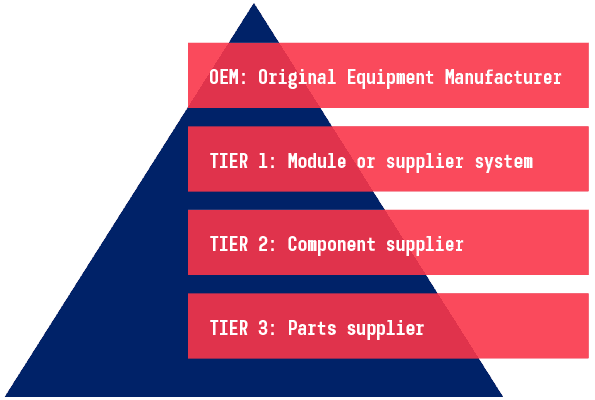
Suppliers are referred to as Tier 1, Tier 2, Tier 3, Tier-n suppliers, depending on their distance from the OEM. This reflects the sub-supplier structure.

Tier supplier structure visualised – an example from the automotive industry
The automotive industry is characterized by complex and closely interlocked logistics chains. Instead of producing all their components in-house, automotive manufacturers procure the individual modules from specialist suppliers. These suppliers will in turn assemble components supplied by specialised component suppliers. The suppliers of individual parts are found on the third tier.
These boundaries are not always so clearly defined. A supplier may thus be both Tier 1 and Tier 2 – for example a business might deliver antenna modules to both OEMs and Tier 1 suppliers.
The following diagram illustrates an example of an automobile supply chain:
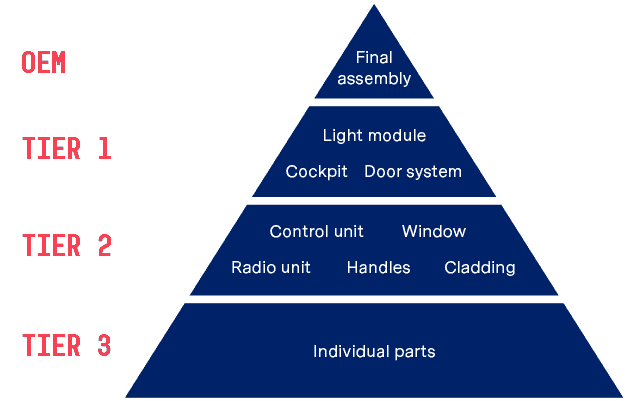
Supply pyramid in the automotive industry
Challenges along the supply chain
Close links between OEMs and their individual tier suppliers pose special challenges to smooth process operation. The horizontal integration of many different suppliers and their own suppliers will, for instance, demand that required quantities are communicated fast and effectively if the supply of modules, components and individual parts is to be ensured. This is a critical factor in success especially with just-in-time and just-in-sequence processes. Electronic data interchange is used to ensure communication, whilst the concepts of delivery schedule and just-in-time deliveries may for instance be deployed. Standardisation organizations such as ODETTE and VDA have already developed many useful standards to allow efficient operation of automobile supply processes.
Apart from logistics messages such as delivery schedule, despatch advice, etc., continuous digital engineering is essential. This will, for instance, include the exchange of construction data such as CAD (Computer-aided design) drawings and the like.
Any questions?
If you have questions about logistics in the automotive industry or would like to learn more about implementing an EDI based process please contact us – we look forward to hearing from you!
You can also find more useful information on this and other relevant topics in our extensive resource centre and blog.
Der Beitrag What is a Tier supplier? erschien zuerst auf ecosio.
]]>Der Beitrag VDA 4938 – New standard for electronic invoices in the automotive industry erschien zuerst auf ecosio.
]]>The German Association of the Automotive Industry (VDA) has for many years been publishing standards for processes found in the automotive and associated industries. VDA is the acronym of the association’s German name Verband der Deutschen Automobilindustrie.
VDA has also, in addition to standards for logistics such as delivery call-offs, JIT delivery schedules, despatch advices, etc., published standards for electronic invoicing. The two familiar standards are VDA 4906 (EDI for invoices) and VDA 4908 (EDI for credit notes). Both standards are outdated today. VDA 4906 was passed in May 1993 and VDA 4908 in May 1996. The use of these standards is no longer recommended and the new e-invoicing standard VDA 4938 should be used instead.

VDA 4938 – a standard for electronic invoicing
VDA developed the VDA 4938 standard to meet current statutory and fiscal requirements for the automotive industry. The objective of VDA 4938 is a uniform design of electronic invoices and credit notes to allow the electronic exchange of information between companies using EDI (OEMs and tier suppliers etc.).
The VDA 4938 standard has four different parts, as listed below.
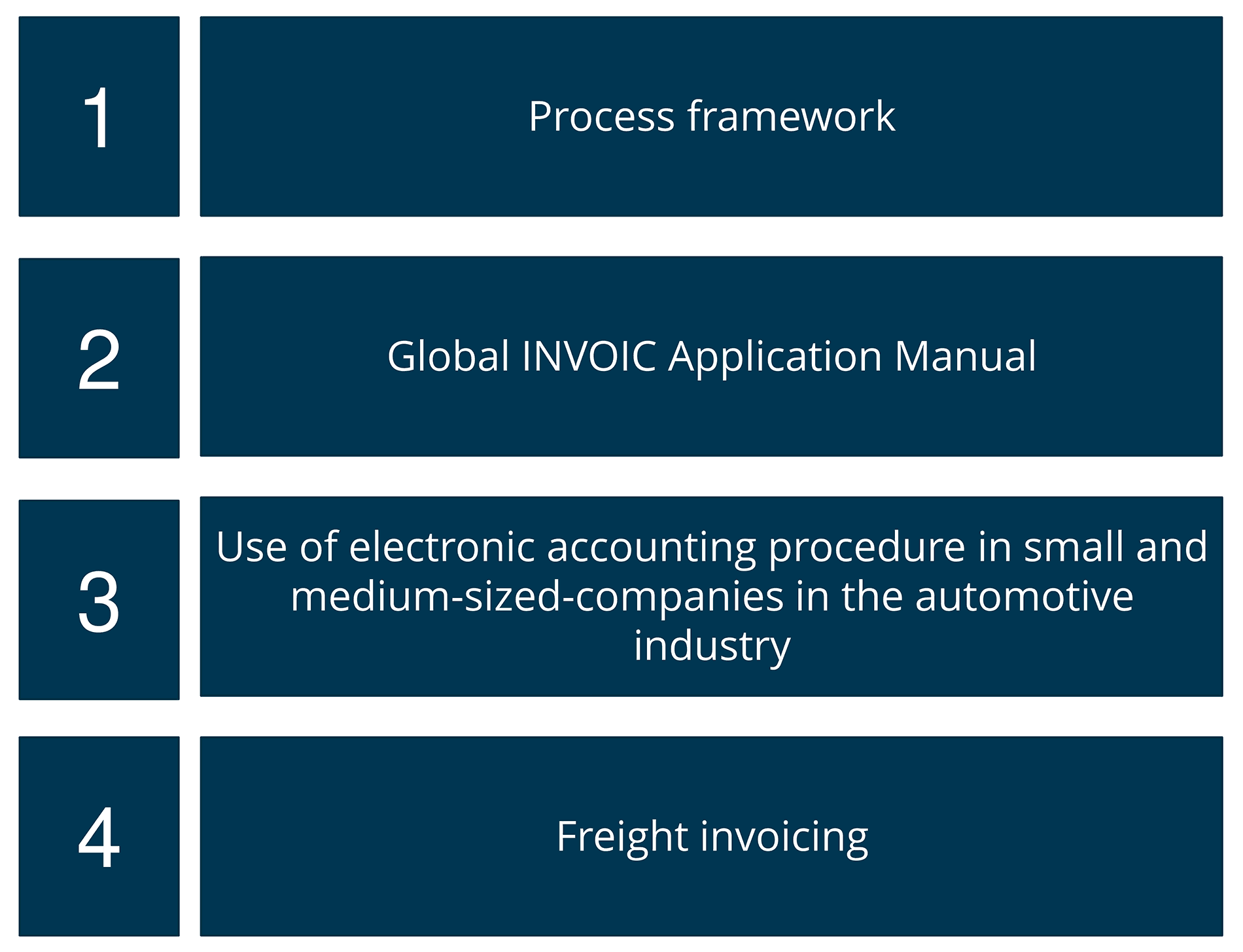
Overview of the VDA 4938 family of standards
The individual documents are available under the following links (in German):
- 4938 T1 – Process framework for the exchange of electronic accounting documents, using EDIFACT without digital signatures
- 4938 T2 – V 2.2 Global INVOIC Application Manual
- 4938 T3 – Use of electronic accounting procedures for small and medium-sized companies in the automotive industry
- 4938 T4 – Freight invoicing
Part 1 deals with the process framework for electronic invoicing. This includes a process recommendation, technical guidelines, and guidelines for the involvement of service providers. Agreement templates and checklists for VDA 4938 users are also included.
Part 2 contains the EDI definition, the so-called EDIFACT Message Implementation Guideline – MIG for short, based on EDIFACT INVOIC D07A.
Part 3 contains the invoicing specification developed by auto-gration, an EU-funded project aimed at supporting small and medium-sized enterprises in their participation in global automotive industry supply chains. The result of this project is an XML specification for electronic invoicing, now included as Part 3 of VDA 4938.
Part 4 contains specifications for the display of freight invoices based on EDIFACT INVOIC D13A.
Any questions?
You have further questions in regard to VDA standards, or would you like to introduce a VDA 4938 based solution? Please do contact us or use our chat — we’re more than happy to help!
Der Beitrag VDA 4938 – New standard for electronic invoices in the automotive industry erschien zuerst auf ecosio.
]]>Der Beitrag The essential details of the VDA 4905 call off message erschien zuerst auf ecosio.
]]>VDA standards are maintained by the German Association of the Automotive Industry and represent one of the important families of standards used by that industry. VDA is the acronym of Verband der deutschen Automobilindustrie.
Standard definitions are given for a variety of applications, referring not only to the structure of electronic documents, but also specifying, for instance, labels and shipping documentation.
VDA 4905 delivery call-off
Delivery call-offs represent a key means of communication in the automotive industry, since tightly linked processes involving customers, suppliers, and upstream suppliers demand that changing supply chain dates and requirements must continuously be communicated “back up the chain”.
The principle is illustrated in the diagram below.
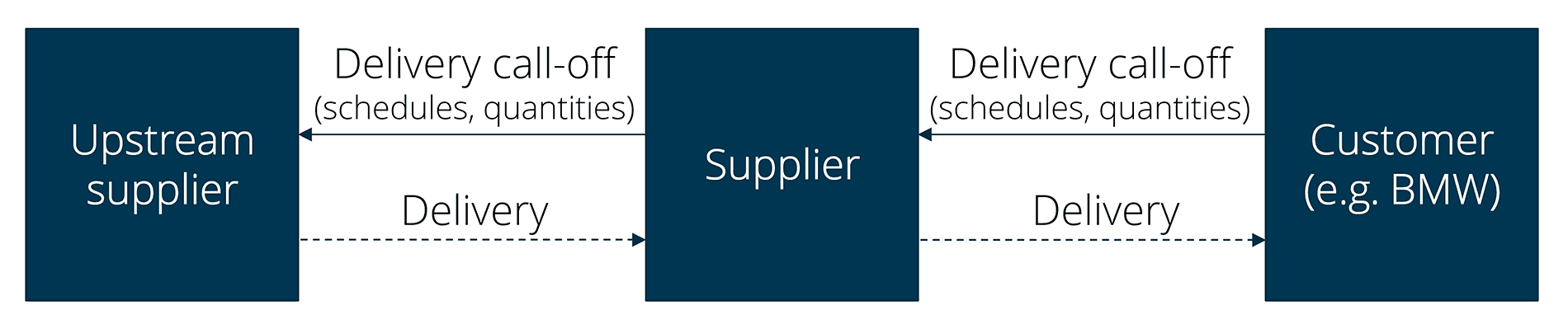
VDA 4905 delivery call-off principle
A new delivery call-off will fully override the previous delivery call-offs. Current requirements can therefore always be communicated back to the previous link in the logistics chain and up-to-date requirements are availabe to all business partners involved.
Learn how to resolve the key issues facing IT decision makers today
VDA 4905 delivery call-off structure
Similar to many other VDA standards, VDA 4905 delivery call-offs have a fixed dataset length of 128 characters. Adding a line break after every dataset will produce a sequence of rows. Each row starts with a three-character record type.
The diagram below illustrates the structure of a VDA 4905 message. The first three digits define the record type. M means, that the dataset is mandatory. K means, that the dataset is optional. M derives from the German muss, meaning must. K derives from the German kann, meaning can.
The last character indicates how often the dataset is allowed to be repeated, where n stands for as often as needed and 1..n for at least 1 to n times.
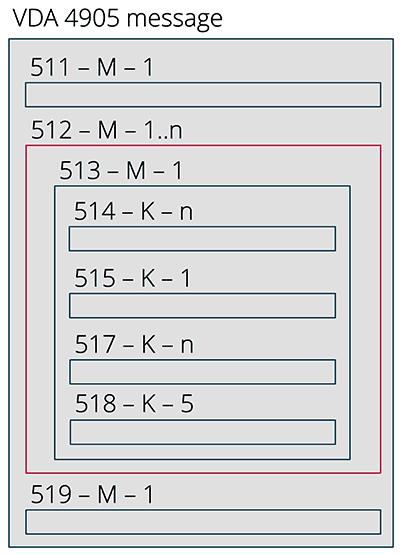
Structure of a VDA 4905 delivery call-off
The nested structure also indicates datasets, that can be repeated after a first dataset. The diagram shows, that transmission of delivery call-off data starts with record type 511 and will always end with record type 519.
A transmission must always contain record type 512 with the corresponding subordinate record types for every sorting parameter combination. In the VDA context, the sorting parameter combination includes the following parameters:
- Customer factory
- Customer material number
- Order number
- Unloading point
If, for instance, material number number a and number b and customer factory factory x and factory y are given and a call-off is required for both material numbers and both factories, the result will be as follows:
- 1 x 511
- 1 x 512 plus sub-record types (
material number ainfactory x) - 1 x 512 plus sub-record types (
material number ainfactory y) - 1 x 512 plus sub-record types (
material number binfactory x) - 1 x 512 plus sub-record types (
material number binfactory y) - 1 x 519
Differences compared to EDIFACT
The VDA standard has several special features compared to EDIFACT, which we briefly discuss below.
Sequential numbering
EDIFACT file transmissions are clearly identified by interchange references (provided in the UNB segment). Interchange references are issued by the sender and are numbered sequentially ascending. Using the interchange reference an EDIFACT transmission is easy to trace. In addition the message creation date and time in the UNB segment help with correctly identifying a transmission. Thus, wrong messages may, for instance, be traced and re-transmitted without a problem.
VDA has a different approach. A new transmission number and an old transmission number are transmitted for each transmission. New and old transmission numbers are unique references for the current and previous transmissions, respectively. No sequential numbering of the transmitted numbers is therefore required. Transmissions may furthermore be numbered differently, for instance in accordance with technical areas (e.g., orders for regular products as opposed to orders for spare parts).
Customer and supplier identification
It is customary in the trade that parties interchanging data (supplier, customer, invoice recipient, place of delivery, etc.) are identified by Global Location Numbers – GLN.
The automotive sector instead uses numbers that were exchanged bilaterally in advance. These may, for instance, include customer number, supplier number, customer’s factory number and unloading point.
Product identification
It is also customary in the trade that exchanged products are identified by a Global Trade Identification Number (GTIN). The GTIN is a number the producer assigns to his products. A consumer will recognise the GTIN as the number under the bar code, which can be found on almost all products in a supermarket shelf.
The automotive sector generally uses material numbers instead of GTINs. The supplier maintains his own list of individual customer material numbers, enabling him to assign them to his internal material numbers.
Cumulative quantity received
The cumulative quantity received comprises all negative or positive deliveries recorded by the customer, from a specific point in time. The quantity in transit will be the difference between cumulative delivery quantity by the supplier and cumulative quantity received at the customer.
The customer may also reset the cumulative quantity to 0 by sending a reset date in a delivery call-off. This date will then apply to all the parts of the supplier. Thus, the first call-off transmission after the reset shall contain all parts of the supplier relevant to the specific customer, allowing to start a new sequence.
Record type version numbers
Within the framework of VDA messaging (including VDA 4905) it is possible to assign version numbers to individual record types. EDIFACT does not provide for such version control on the record type level –- the only comparison would be EDIFACT directory version control -– e.g. EDIFACT EANCOM D96A vs. EDIFACT EANCOM D01B.
A common standard for all?
“The entire automotive industry relies on the VDA standard. Good news for all suppliers –- all companies in the automotive industry will be able to receive delivery call-offs using the same standard.”
Not quite, unfortunately…
Similar to EDIFACT, where the global EDIFACT standard (used in its pure form only by a few) has many subsets that are specific to certain industries and companies, the VDA also has versions that are specific to some companies.
This means, for instance, that German OEMs may have slightly different requirements under the VDA standard, that upstream suppliers will need to take into account.
More questions about VDA?
More questions on the topic of delivery call-off or other VDA standards? Please do contact us or use our chat — we’re more than happy to help!
Der Beitrag The essential details of the VDA 4905 call off message erschien zuerst auf ecosio.
]]>