Der Beitrag ecosio to Host SAP/EDI Workshop at UKISUG Connect 2021 erschien zuerst auf ecosio.
]]>What is UKISUG Connect?
UKISUG stands for the UK and Ireland SAP User Group. UKISUG Connect is this group’s large annual conference. At the conference SAP customers, consultants, employees and partners from across the UK & Ireland come together to discuss relevant topics, listen to expert talks and collaborate.

About UKISUG Connect 2021
This year’s event will welcome over 500 SAP customers, 200 SAP experts and 70 exhibitors. Delegates will be able to choose from 80+ sessions across the conference’s three days, as well as enjoy the many opportunities to network. The full schedule can be found here.
At this year’s event ecosio will be exhibiting and will therefore be available throughout the conference to answer any SAP or EDI-related questions.
At the 2021 event ecosio will also be running a workshop, entitled “Electronic Data Interchange (EDI) and e-Invoicing with SAP ERP and SAP S/4HANA – Technical Foundations and Best Practices”.
What ecosio’s workshop will cover
In ecosio’s workshop SAP expert Philipp Liegl will explore how a cost-effective, efficient and sustainable EDI solution can be implemented in SAP systems, detailing several positive steps you can take to ensure your SAP/EDI project is a success – no matter what the target SAP system is or whether it’s yours or a client’s.
Thanks to the number of different SAP systems and EDI integration options out there, identifying which solution makes the most sense for your specific situation can be difficult. Available solutions are numerous, including local EDI converters, SAP PI/PO, SAP Integration Suite with its Cloud Integration component, and fully managed solutions from external service providers. This session will help you identify which of these represents the best option.
Attendees will discover how to access full EDI functionality via their SAP system’s existing user interface and turn their SAP into their own EDI control centre with a seamlessly integrated and customisable solution. They will also learn what the different options for EDI and e-invoicing integration in SAP are, how to reduce the strain on in-house resources and the secrets to long term EDI success.
Interested in attending?
Registration for the event is still open and tickets can be purchased here.
We look forward to seeing you there!
Der Beitrag ecosio to Host SAP/EDI Workshop at UKISUG Connect 2021 erschien zuerst auf ecosio.
]]>Der Beitrag SAP® EDI Project Roles – A Breakdown erschien zuerst auf ecosio.
]]>Given the many different SAP systems available and the myriad ways in which EDI capability can be achieved, however, it can be difficult to know exactly how to go about integrating a new solution. To help, in this article we provide an overview of the different roles involved in a successful SAP EDI project and which tasks are handled by each role.
For the purposes of this article we will look specifically at the roles required to integrate fully managed EDI, as this constitutes the most comprehensive EDI solution available to SAP users – and crucially requires the least internal effort from you. In this approach to EDI integration in SAP, the roles and responsibilities are typically spread across four key players: your EDI provider (ecosio in this example), your business, your SAP consultancy and your partners (e.g. customers/suppliers/relevant governmental agencies)…
Your EDI Provider (ecosio)
Thanks to ecosio’s fully managed approach, it is ecosio, rather than your internal team, that handles the vast majority of EDI tasks (click here for a more detailed breakdown of the amount of internal effort required to setup and operate different EDI solutions).
ecosio’s team of EDI and SAP experts manages the EDI SAP integration process from setup and testing to maintenance and error handling. This way you are able to experience all the benefits of EDI with none of the hassle.
A key part of the success of the ecosio approach is the nature of the two roles involved…
1) Integration Engineer

Every ecosio customer is assigned a dedicated Integration Engineer. This ecosio Integration Engineer is your very own EDI hero and acts as a single point of contact for all things EDI.
As well as being an expert in EDI protocols and formats, they also understand the underlying IDoc structure and the correct data representation. More importantly, they know your company, are familiar with your needs and are easy to get hold of. Contrary to many other EDI support personnel, our Integration Engineers really care about every EDI message exchanged!
Their key responsibilities include (but are not limited to)…
- Managing the SAP EDI integration/migration process end-to-end
- Liaising directly with relevant parties so you don’t have to
- Handling industry-specific EDI issues within SAP
- Proactively identifying and resolving errors to ensure ongoing success
Main contacts: Your internal project manager, the ecosio Onboarding and Operations team, your SAP consultancy project manager, your partners’ EDI contact people
2) Onboarding and Operations Team

Working alongside and supporting your Integration Engineer is ecosio’s Onboarding and Operations team. The job of this team is to provide your ecosio Integration Engineer with support in regard to onboarding, document mappings, connection testing and any other EDI tasks whenever needed. Significantly, there is no need for your organisation to liaise with this team directly, as everything is handled via your Integration Engineer.
Main contacts: ecosio Integration Engineer, SAP consultancy project manager, your partners’ EDI contact people
Your Business
With ecosio’s fully managed EDI solution, there are three different EDI roles that must be filled by individuals in your business:
1) Project Manager

The first and most important role is that of the project manager. They are essential as they understand your business and what you want to achieve better than anyone.
Their responsibilities include…
- Developing the project strategy in line with your ecosio Integration Engineer
- Ensuring your project stays on time and on budget
- Collecting feedback from internal users
- Communicating regularly with your ecosio Integration Engineer and alerting them to any issues or changes in strategy (e.g. a change in the agreed order of partner onboarding)
Main contacts: ecosio Integration Engineer, key users, business users
2) Key Users

These users have the most comprehensive understanding of SAP/EDI. They are responsible for providing feedback during the mapping/testing phase and checking that messages are coming through as desired. They should also alert the project manager if any issues or opportunities for optimisation are spotted. Key users may also be used to help train business users.
Main contacts: Internal project manager, business users
3) Business Users

A business user is simply an employee who uses the final product. Their responsibilities are limited to using the product correctly and alerting the project manager should they spot any issues.
Main contacts: Internal project manager, key users
SAP Consultancy
When it comes to your SAP consultancy, there are four related roles:
1) Project Manager

The SAP consultancy project manager oversees all work done in relation to your project by that organisation. Their main task is to liaise with the ecosio Integration Engineer and pass any relevant information on to colleagues to ensure any SAP ERP issues are resolved as fast as possible. Their focus should be keeping your SAP system working and ensuring your project stays on time and on budget.
Main contacts: ecosio Integration Engineer, SD/MM/FI consultant, ABAP programmer, SAP basis administrator
2) SD/MM/FI Consultant

The SD/MM/FI consultant manages the necessary adjustments to your SAP system to enable seamless integration of your new EDI solution. This involves testing and carrying out acceptance. SD/MM/FI consultants are experts when it comes to SAP problem solving.
Main contacts: SAP consultancy project manager, ABAP programmer
3) ABAP Programmer

The ABAP programmer’s role is to realise custom code when the normal SAP means aren’t sufficient. Effectively, they step in when the SD/MM/FI consultant is unable to fix an issue.
Main contacts: SAP consultancy project manager, SD/MM/FI consultant
4) SAP Basis Administrator
The SAP basis administrator is like the SAP mechanic. They oversee SAP system operation and fix any issues relating to memory / processor use, network, etc.
Main contact: SAP consultancy project manager
Your Partners (Customers / Suppliers / Governmental Agencies)
For other partners, there is only one relevant EDI project role:
EDI Contact Person

This individual acts as the sole contact point for your ecosio Integration Engineer, who will liaise with them directly during onboarding to get them connected. Your ecosio Integration Engineer may also need to contact them post go-live to fix any subsequent message exchange issues.
Main contact: ecosio Integration Engineer
About ecosio and Connections That Work
At ecosio we are experts in providing EDI Connections That Work and have helped hundreds of businesses to experience the benefits of automated document exchange in SAP®.
Our expert Integration Engineers and Onboarding and Operations team takes care of everything from setup and testing to maintenance and error handling. With our solution virtually zero internal effort is required for you to experience successful EDI in SAP®.
To find out how you can experience streamlined, future-proof EDI in your SAP system, get in touch today. We are always happy to answer any questions you may have!
Want this information as a handy one-page infographic?
To help you visualise SAP EDI project roles, we’ve condensed the information in this article into a helpful, printable infographic.
Der Beitrag SAP® EDI Project Roles – A Breakdown erschien zuerst auf ecosio.
]]>Der Beitrag Alternative Solutions for EDI Data Exchange with SAP PI erschien zuerst auf ecosio.
]]>SAP PI (Process Integration) is a software component offered by SAP, which allows data exchange between an SAP and an internal or external system. Therefore SAP PI is the SAP Exchange Infrastructure (SAP XI) successor. Technically speaking, SAP PI is part of SAP Netweaver, the technical platform on which the SAP ERP system runs.
The picture below illustrates the basic idea behind SAP PI using a typical EDI situation.
SAP PI can also be used to integrate internal systems (e.g. CRM system, HR systems, etc.), however, this aspect will not be discussed in this article.
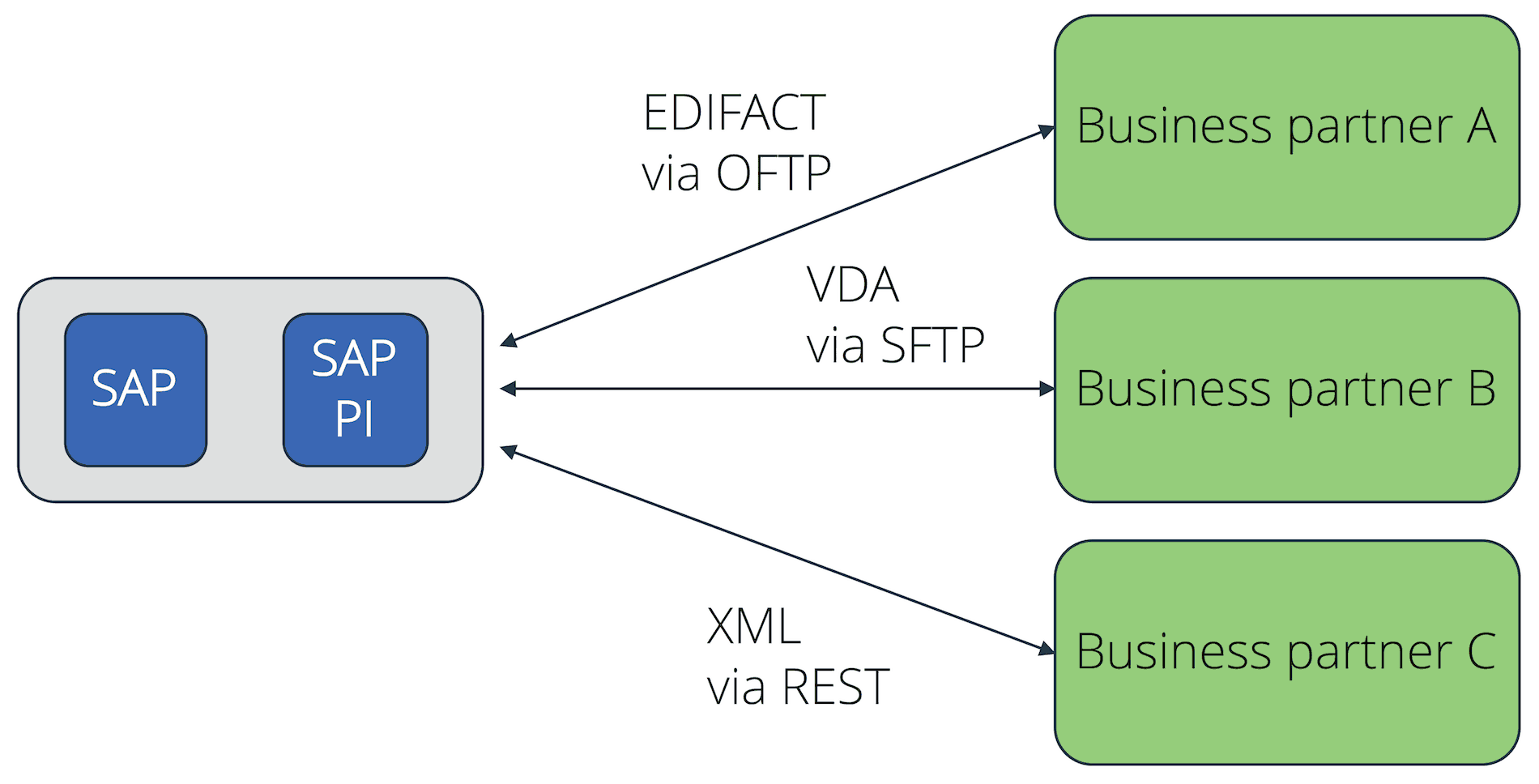
Ground Principles of SAP PI in a EDI Scenario
The core functions of SAP PI are:
- Connectivity
- Mapping
- Routing
The connectivity function allows SAP PI to offer a variety of adaptors for the various message transport protocols. This includes several protocols, which are needed for the electronic data interchange with external partners, such as AS2, X.400, OFTP, SFTP, RESTful Web Services, etc.
With the support of the relevant maps, SAP PI is also able to translate files from an internal SAP format (e.g. IDoc) to an external EDI format such as EDIFACT, XML, ANSI X.12, etc. The maps can be created using a graphic editor and deployed based on XSLT or with the help of an ABAP program.
The routing will then help to deliver the messages to different receivers, based on the information present within the file.

Challenges EDI businesses face with SAP PI
One of the main challenges when creating an EDI connection based on SAP PI is the complexity of the software. As a figure of speech, instead of being handed a hammer and nails, one needs to make do with a very comprehensive and complex toolset. Therefore a lot of know-how is needed to configure and operate SAP PI, which requires qualified employees. As EDI does not go home at 5pm, but is a 24/7 matter, the responsible employees constantly need to be available in the business for maintenance and to ensure a smooth EDI process.
Below is an outline of the many other challenges a company might encounter in its day-to-day operations.
Connection parameter maintenance
Despite the common belief, EDI connections are not entirely maintenance free. Connections using digital certificates (e.g. AS2 or OFTP2) need to have their certificates changed regularly, in unison with the partners in order to avoid connection disruptions. One could for example expect a medium-sized company in the production industry to have a few hundred clients or suppliers who are connected via EDI. For SAP PI, this implies the maintenance of a few hundred different connections. In most cases, the number of connections is considerably higher.
When new connections need to be established, this often does not go completely smoothly. For example, AS2 allows a number of settings, which are not necessarily uniformly implemented by all business partners. Therefore the set up of a new AS2 connection requires an adequate level of detailed technical know-how. The same can be said about OFTP2 or other protocols.
Difficulties when integrating exotic protocols
Even though SAP PI supports multiple EDI protocols, there are always connections for which standard protocols will not work. An example is the Peppol network, used to deliver electronic documents within Europe. Should a company want to implement this protocol in their SAP PI, they must create their own adaptors, which would require experienced employees or an external service provider.
Maintenance of mapping tables
Having document mappings created in-house for SAP PI requires detailed know-how of the EDI standards used. Depending on the number and type of clients and suppliers, a lot of different standards and formats have to be used. Pure IDoc know-how, which many SAP trained employees have, is not enough here.
However, the effort in regard to document mappings is not only in the initial creation of the mapping tables, but also in the consistent maintenance of the existing ones. This will also require trained employees, who can apply the necessary adjustments to the mappings when changes are needed.
In addition to the technical implementation of mappings, the professional evaluation of information in document standards is also important. For example, companies in the automotive industry have their own standards (e.g. VDA). However, there can be variations in how the different automotive manufacturers apply those standards.
Due to the large number of carried out projects and implemented mappings, this domain knowledge naturally exists with an EDI service provider. Therefore, should a company wish to create each connection in SAP by itself, employees would first have to go through the tedious process of learning this knowledge. It might even prove impossible at times, as the information is not available on the manufacturer’s website, but is only known by certain contact persons in the company. Part of the challenge is to know who those contact persons are.
Constant monitoring of the EDI data flow
Another important complication when connecting with SAP PI is the constant monitoring of the EDI data flow. EDI connections might not need much maintenance, but they still need to be constantly monitored. The need for constant monitoring is due to the fact that EDI takes place in a network. Within a network, nodes may fail at any time without warning, or nodes may not behave as expected.
During a network outage, the connection to a partner can be interrupted, thus preventing the delivery of receipt confirmations (e.g. MDN for AS2 or EERP for OFTP2). In this case one would have to personally contact their business partners to find out if they received the messages correctly. To do this, one would first need to find and align the message IDs, which is time consuming.
Even though EDI is a system-to-system type of communication, there are still people in front of each system, who may enter potentially incorrect data. This would cause message maps to fail, and would need to be corrected manually. This is another case where highly trained professionals are needed, as they would need to quickly solve this issue.
X.400 cost topic
When using a paid third party network for the message exchange, such as X.400, the costs can be quite high. A single business typically gets poor conditions from these providers, as the data volumes are too low. A central service provider is able to procure large data volumes at a better price than a single business unit.
Conclusion
SAP PI offers a wide range of functionality and flexibility. However, the configuration, operation, and maintenance require the employment of adequate staff, which needs to be taken into consideration when planning the total cost of ownership. The same applies when using a local EDI converter.
Alternatives based on EPO connectors
An alternative to creating in house EDI connections based on SAP PI is the use of a managed EDI solution. Below is an example of an EDI connection based on ecosio.EDI and the EPO connector.
One connection for all
The main difference to EDI connections with SAP PI is the concept of one connection for all. The following diagram illustrates how instead of having x different connections to one’s business partners, a company can only have one connection to a central EDI provider, ecosio in this case.
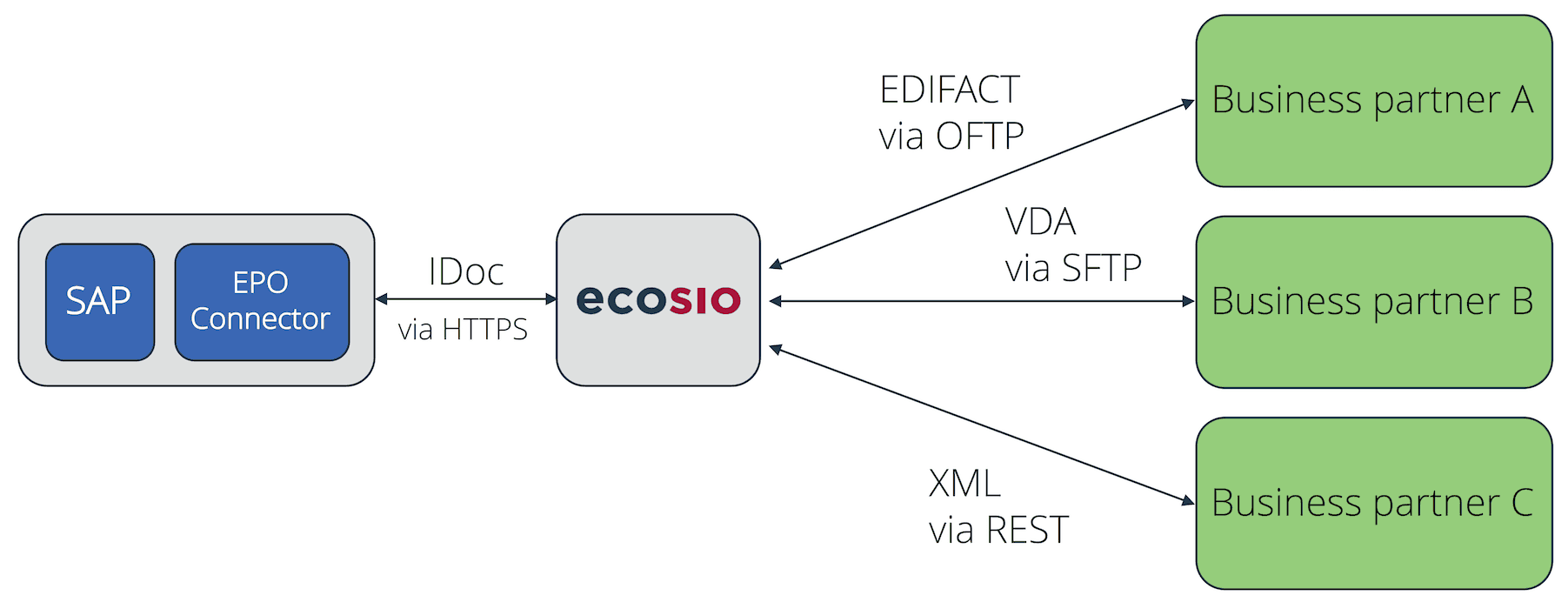
EDI Connection Using EPO Connector
The EDI provider takes over all tasks centrally – tasks which would be carried out in an in house solution with SAP PI. This includes the set up and maintenance of the EDI connections, setting up and maintaining document mappings, the correct routing of messagess, and the ongoing monitoring of the data flow.
Instead of maintaining x different connections and mappings in SAP, the SAP native document exchange format IDoc is used. Incoming IDocs are delivered to the EPO Connector by ecosio, and appear in SAP, directly in transaction BD87. The EPO connector will automatically accept outbound IDocs and deliver them to ecosio, who then converts them into the correct final format and delivers them to the receiver.
The only task that is left to the SAP system is to monitor transaction BD87, to get an overview of the inbound and outbound IDoc. The illustration below shows this overview.
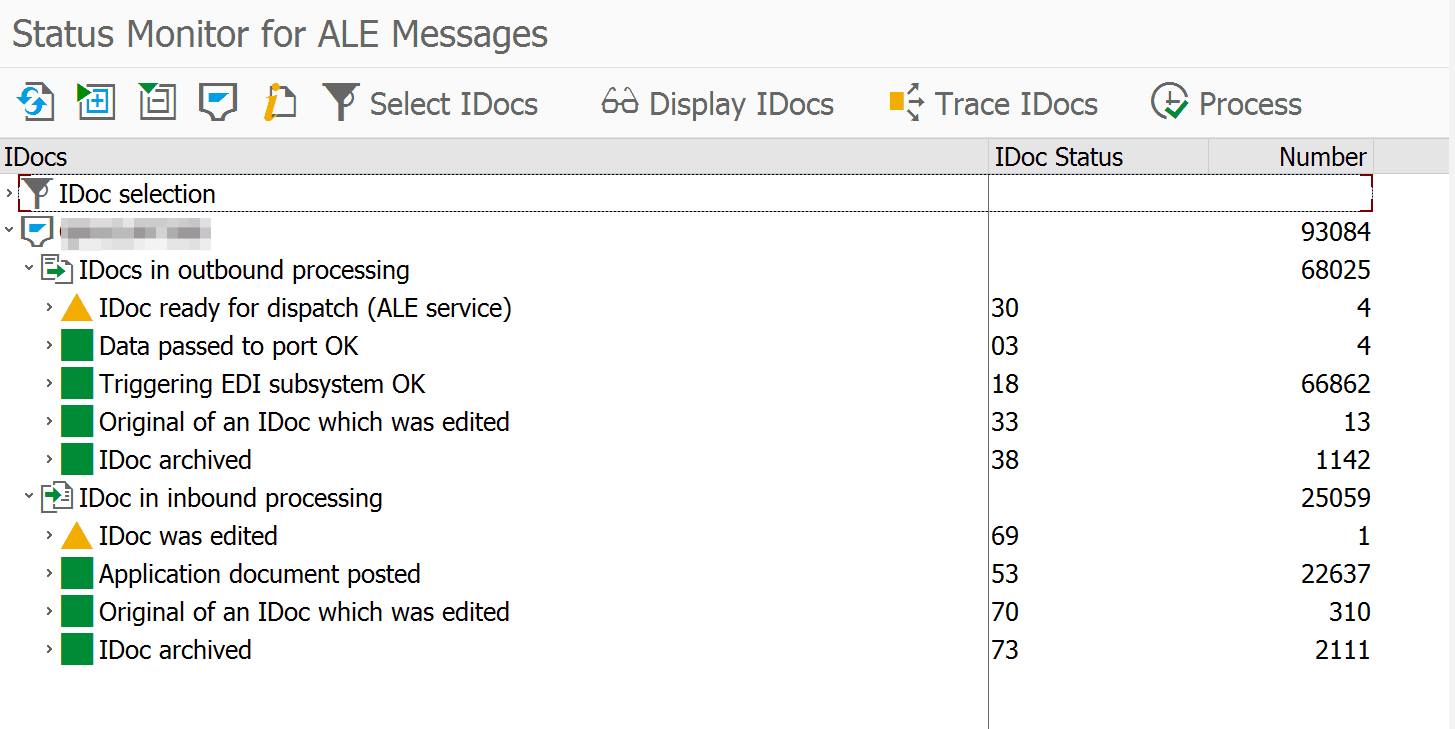
IDoc Overview of Transaction BD87
© 2020. SAP SE or an SAP affiliate company. All rights reserved. Used with permission of SAP SE.
Should a more detailed tracking of an inbound or outbound message be needed, the ecosio.Monitor can be used for this purpose as well. It provides an overview of all sent and received messages, and informs users about the delivery status of messages. With a sent message for example, it is possible to see if the receiver actually received the message (e.g. Daimler or BMW).
In order to view the ecosio.Monitor, it is not necessary to leave the SAP. On the contrary, the ecosio.Monitor can be opened directly in SAP with one click on the EDI message ID in the IDoc viewing page, as demonstrated below. A login using a single-sign-on solution is performed in the background. Thus, the user does not have to enter any login credentials for the ecosio.Monitor.
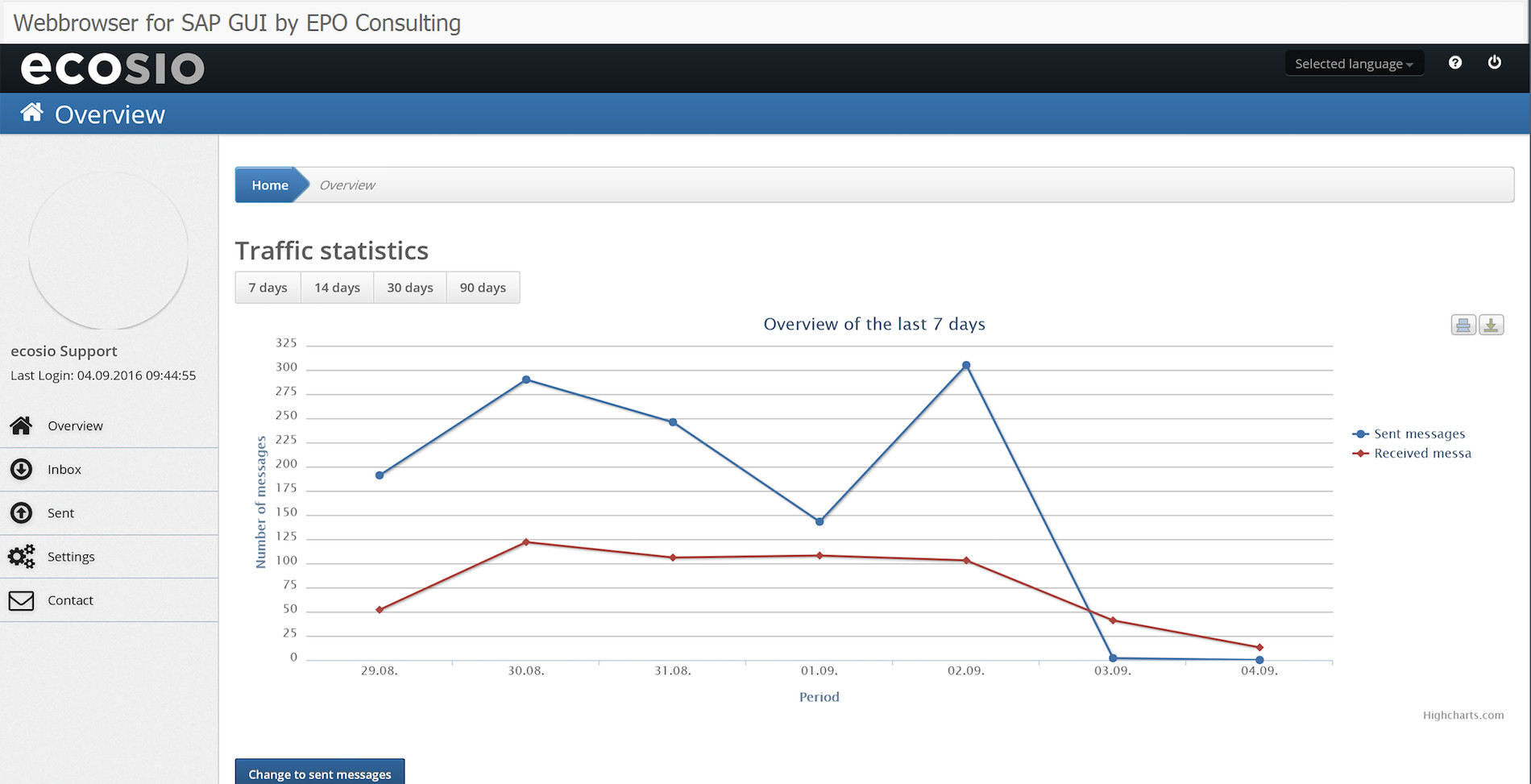
ecosio.Monitor directly accessible in SAP
In the ecosio Integration Hub SAP users can view the delivery state of a specific message, or check other sent or received messages.
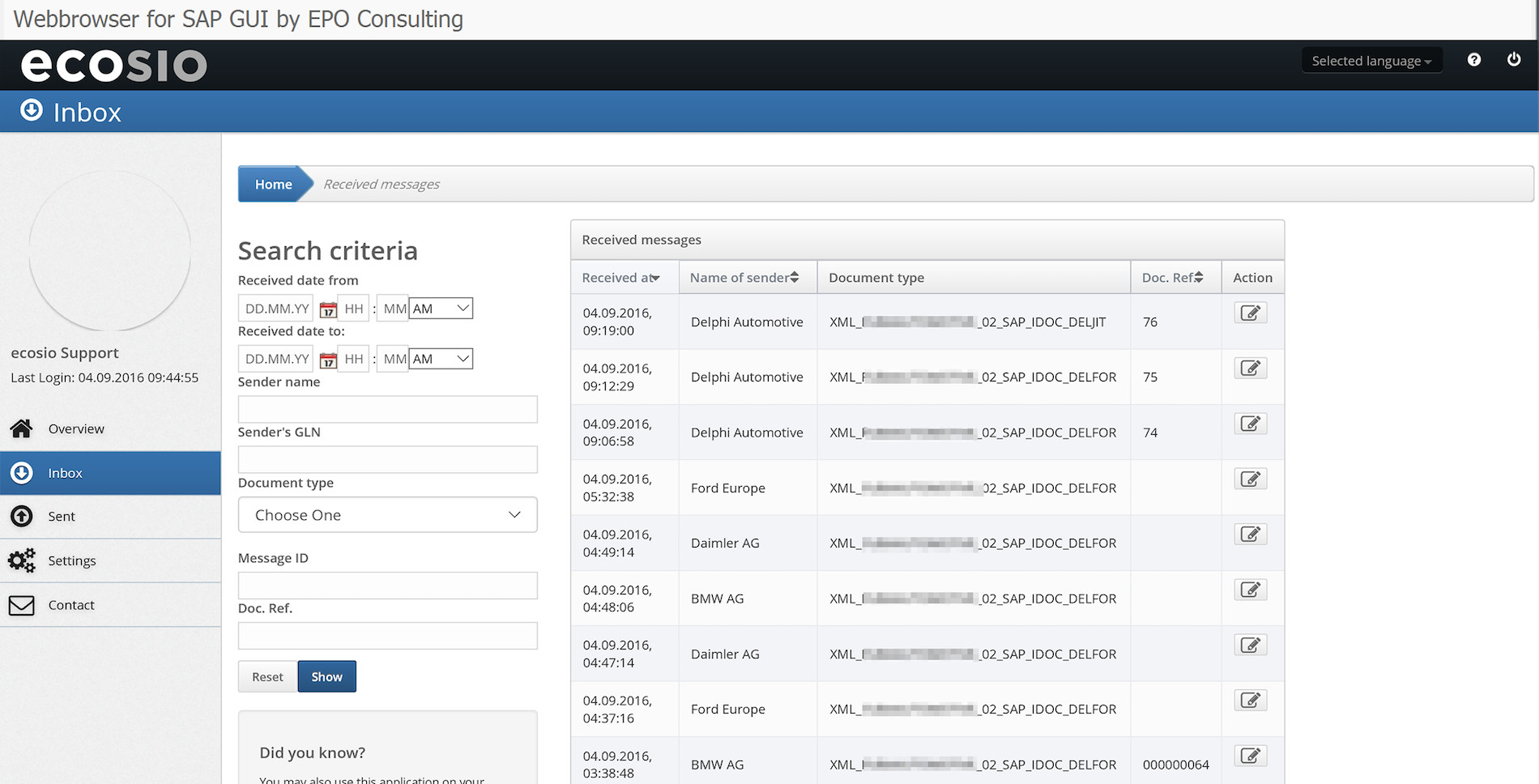
Detailed View of Messages in ecosio.Monitor
Ongoing monitoring by external professionals
If a company chooses ecosio to take care of its EDI processes, the ecosio operations team constantly monitors all of the EDI data flow. Should there be issues with the delivery of messages from and to business partners, the operations team will sort this out with their EDI contact person and the message delivery will resume as soon as the issue is resolved.
Since the operations team’s main task is to monitor EDI connections and solve issues, the phone numbers and email addresses of all EDI contacts of the different companies are stored. The team even knows some of the EDI contact persons personally, which reduces the communication effort and increases the speed at which issues are being solved.
24/7 Connection monitoring
EDI processes are time sensitive, especially in logistics. DESADVs (Dispatch Advice) need to be sent on time, DELJIT (delivery just in time) and production synchronous forecasts must be received on time etc. Therefore a connection breakdown would be disastrous, as it would prevent reaching SLAs and can lead to penalties on the business partner’s side.
All connections to and from ecosio are monitored 24/7. If a connection stops, an alerting mechanism kicks in, allowing the operations team to counteract quickly.
Set Up of any connection protocol
Thanks to their full focus on EDI topics, an EDI provider such as ecosio can implement even the more exotic protocols, Peppol being one example of these. From an SAP point of view, this means that no expensive or complicated special adaptors are needed for SAP PI data exchange.
Summary
SAP PI offers SAP users a wide range of possibilities and functions to create connections to internal and external systems. Especially when considering the total cost of ownership, an outsourced EDI solution with an external EDI service provider is cheaper than an in-house EDI solution.
Do you have any questions?
Do you still have questions about SAP PI data exchange or EDI with a SAP ERP system? Feel free to contact us, we would love to help you!
SAP ERP and SAP S/4HANA are the trademarks or registered trademarks of SAP SE or its affiliates in Germany and in several other countries.
Der Beitrag Alternative Solutions for EDI Data Exchange with SAP PI erschien zuerst auf ecosio.
]]>Der Beitrag Alternative Solutions for EDI in SAP PI and SAP PO erschien zuerst auf ecosio.
]]>- Managing EDI with SAP PI or SAP PO internally yourself
- Installing a local EDI converter and connecting to SAP PI or SAP PO
- Outsourcing to a fully managed EDI service provider
We will show you which EDI functionalities you can implement in your company with the respective solution and which questions decision-makers can use to help themselves in choosing the right solution.
EDI and B2B integration with SAP PI or SAP PO – What do I need to know?
SAP Process Integration (SAP PI) is a comprehensive software component that enables data exchange between the SAP system and internal and external systems. SAP PI uses various Java-based routing and integration mechanisms as well as various adapters that can be used to implement transport protocols and format conversions.
SAP Process Orchestration (PO) is an SAP PI installation variant (with different license models) that has been enhanced to include functionality in the area of “business process modeling and implementation”. In addition to the classic SAP PI capabilities of message routing, mapping and connectivity, PO also includes parts of SAP Business Process Management and SAP Business Rules Management.
In terms of EDI, the core technical functionalities of SAP PI and SAP PO are:
- Connectivity
- Mapping
- Routing
Under Connectivity, SAP PI offers a range of adapters that can be used to convert various message transport protocols. These include many protocols that are required for electronic message exchange with external partners, such as AS2, X.400, OFTP2, SFTP, RESTful Web Services, and so on. Mappings can be used to implement translations between SAP internal formats (for example, IDoc) and external EDI formats such as EDIFACT, XML, ANSI ASC X.12, and so on. Mappings can be converted using a graphical editor, based on XSLT, or using a Java program. Routing controls message delivery to different recipients based on information in the message.
All three solutions presented in the same way are based on these core functionalities of SAP PI or SAP PO, but differ essentially in the following factors in EDI operation or in the following questions that the decision-maker can ask himself:
- How much internal EDI capacity (i.e. personnel & EDI expertise) can I use for mapping, routing, 24/7 monitoring, troubleshooting and maintenance of the connections? Do I want to manage EDI completely internally or do I want to relieve my internal teams and outsource EDI?
- Which technical requirements does my EDI solution have to meet? Which document types, protocols, formats and legal requirements regarding electronic invoicing (e.g. XRechnung in Germany or FatturaPA in Italy) do I need for my B2B network?
- What EDI capabilities does my B2B network require? Do I need access to Value Added Networks (VANs)? Do I want or need to connect to Peppol? Do I have suppliers without EDI capabilities that I still want to connect to automated message exchange (with Web EDI?)
- How flexible or scalable do I want to design my EDI solution? Can I rely on a rigid implementation in the long term or do I want to become more resilient and future-proof with regard to the technical requirements?
If you know the answer to all these questions for your company, you will be able to make the right choice for your business. Keeping the questions in mind, we will now look at the three technical approaches for an EDI implementation in SAP PI and SAP PO.
1. Managing EDI with SAP PI or SAP PO internally
SAP PI and SAP PO are extremely complex and extensive software components that allow for internal implementation of some EDI functionalities. According to the point-to-point principle, automated EDI connections to individual partners can be established by appropriately qualified personnel.
However, one of the main challenges during implementation is precisely the complexity of the software. One does not get the proverbial hammer and nail in the hand, but a very extensive toolset. For the independent configuration and the ongoing operation of EDI connections via SAP PI or SAP PO, highly qualified employees with corresponding EDI expertise are therefore required. If smooth EDI operation is to be guaranteed 24/7, these employees must be available on a continuing basis.
Furthermore, not all required EDI functionalities (current and future) may be supported or require the use of additional solutions, as shown in the graphic:
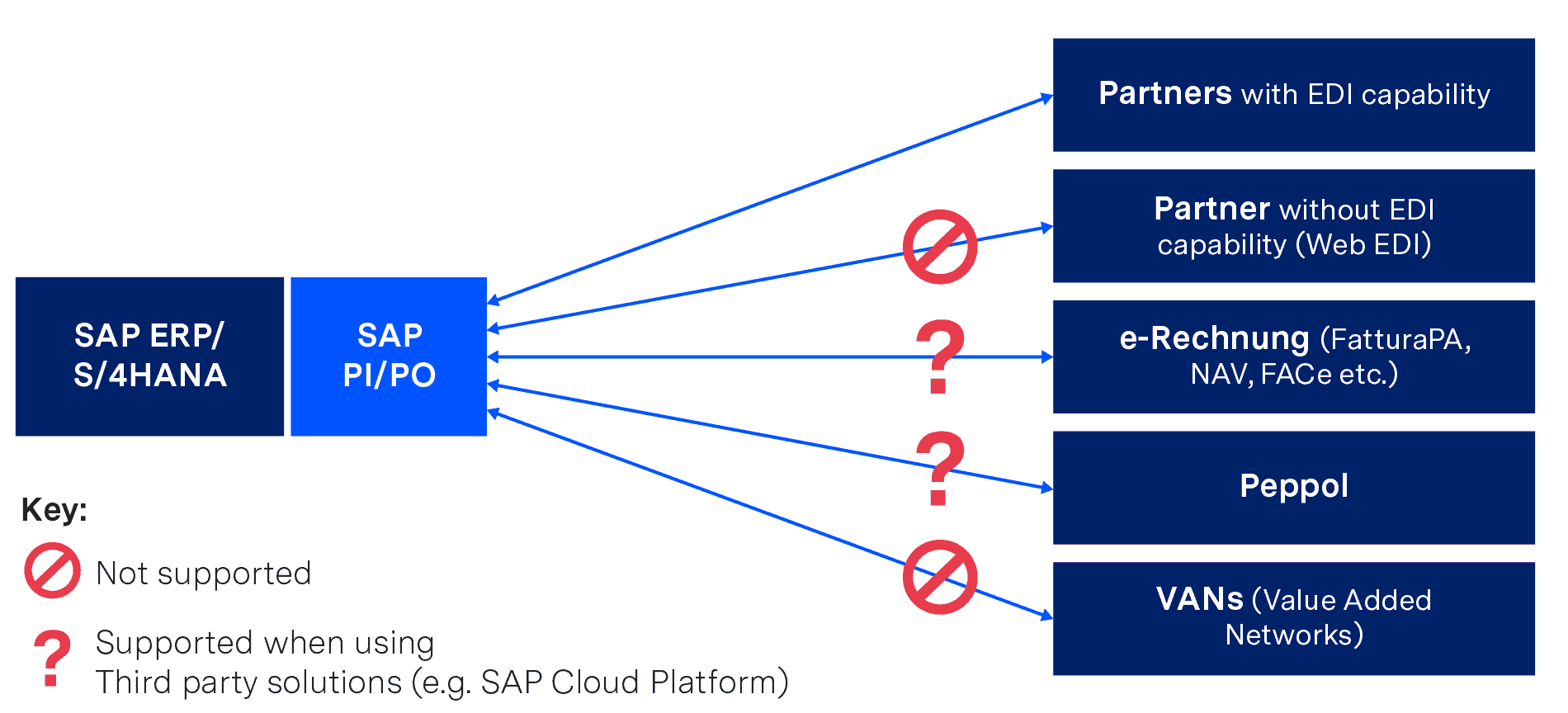
If you want to implement EDI internally purely with SAP PI or SAP PO, you will therefore have to do without some functions (or implement them as a third-party solution), but you will also need highly qualified personnel, EDI know-how and sufficient resources to cope with:
- Mapping and routing of all necessary connections
- Ongoing maintenance of the connection parameters and regular renewal of certificates
- Ongoing maintenance of mapping tables and industry internal practical knowledge about the implementation of special formats (e.g. VDA)
- Ongoing coordination with the B2B partners and procurement of all necessary information (especially in the onboarding process)
- 24/7 monitoring and troubleshooting
Incidentally, those who only want to work with SAP PI have to accept a major restriction – this only allows flat file formats via SFTP/SOAP/REST/HTTP protocols. If you want to use “classic” EDI formats (such as EDIFACT or ANSI ASC X12) and protocols (such as AS2 or X.400), you must have either a special package from a third-party manufacturer or the “B2B Add-on” from SAP – but this is only available with the SAP PO license (even if no other SAP PO functions are required).
The issue of X.400 costs should also be mentioned. If messages have to be transmitted to third-party networks that are subject to charges, these costs can be quite high. As an individual company, often only poor rates are available due to the relatively small amount of data being exchanged.
Internal implementation of EDI with SAP PI and SAP PO offers you a very high degree of functionality and flexibility. However, configuration, operation and maintenance also require the use of appropriate resources, which must be included in the total cost of ownership analysis. These costs must also be taken into account when using a local EDI converter, the option we present next…
2. Installing a local EDI converter and connecting to SAP PI or SAP PO
Another possibility is the acquisition and operation of a local EDI converter, which is connected to SAP PI or SAP PO. This is a software to be installed locally that converts documents from SAP internal IDoc format to partner format and vice versa.
Converter solutions are individually adaptable, but are potentially cost-intensive due to individually payable license costs for various functionalities, formats and upgrades in combination with long-term maintenance contracts. For example, support for protocols such as X.400 or services such as VAN connectivity must be purchased separately.
Local converter solutions must also be operated completely by internal teams, just as in the previous solution (implementing and operating EDI in SAP PI or SAP PO internally). This includes particularly time-consuming processes such as mapping, testing and 24/7 monitoring. This again requires appropriately trained employees.
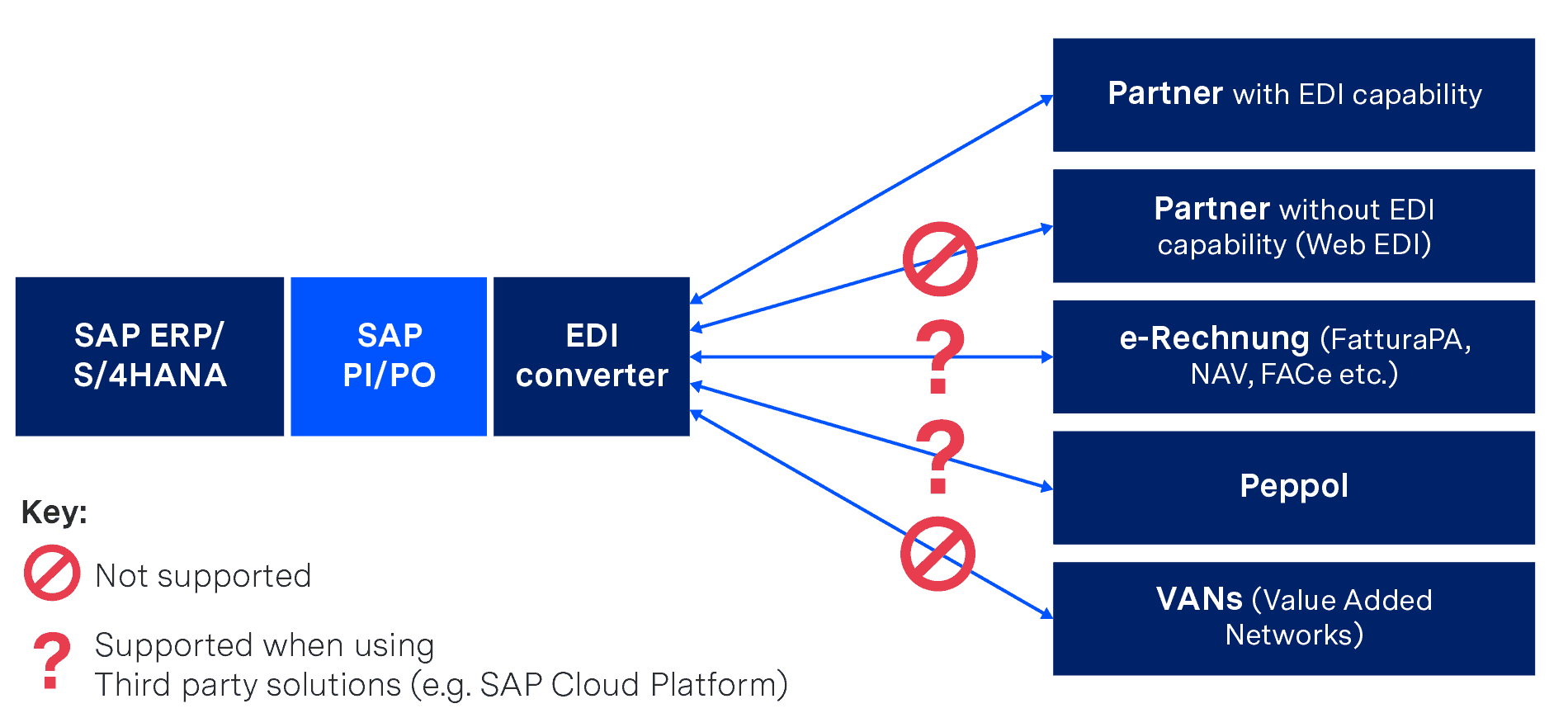
SAP PI/PO with local EDI converter
It should also be considered that both the software itself and the individual mappings age. In other words, over time new releases of the converter will be published, which do not necessarily allow an upgrade from the existing version and mappings. This results in corresponding migration projects that have to be realised internally or with the help of an external consulting company.
3. Outsourcing to a fully managed EDI service provider
Fully managed EDI is a cloud-based EDI solution where a company is connected to a specialised EDI service provider via a single connection. This service provider then takes over all EDI functions and processes, depending on your company’s requirements.
If your company uses SAP PI or SAP PO, all you need for a successful connection to ecosio as your EDI service provider is the snap ecosio Bridge for SAP and its turnkey integration flows in SAP PI or SAP PO, which was especially created by SNAP Consulting.
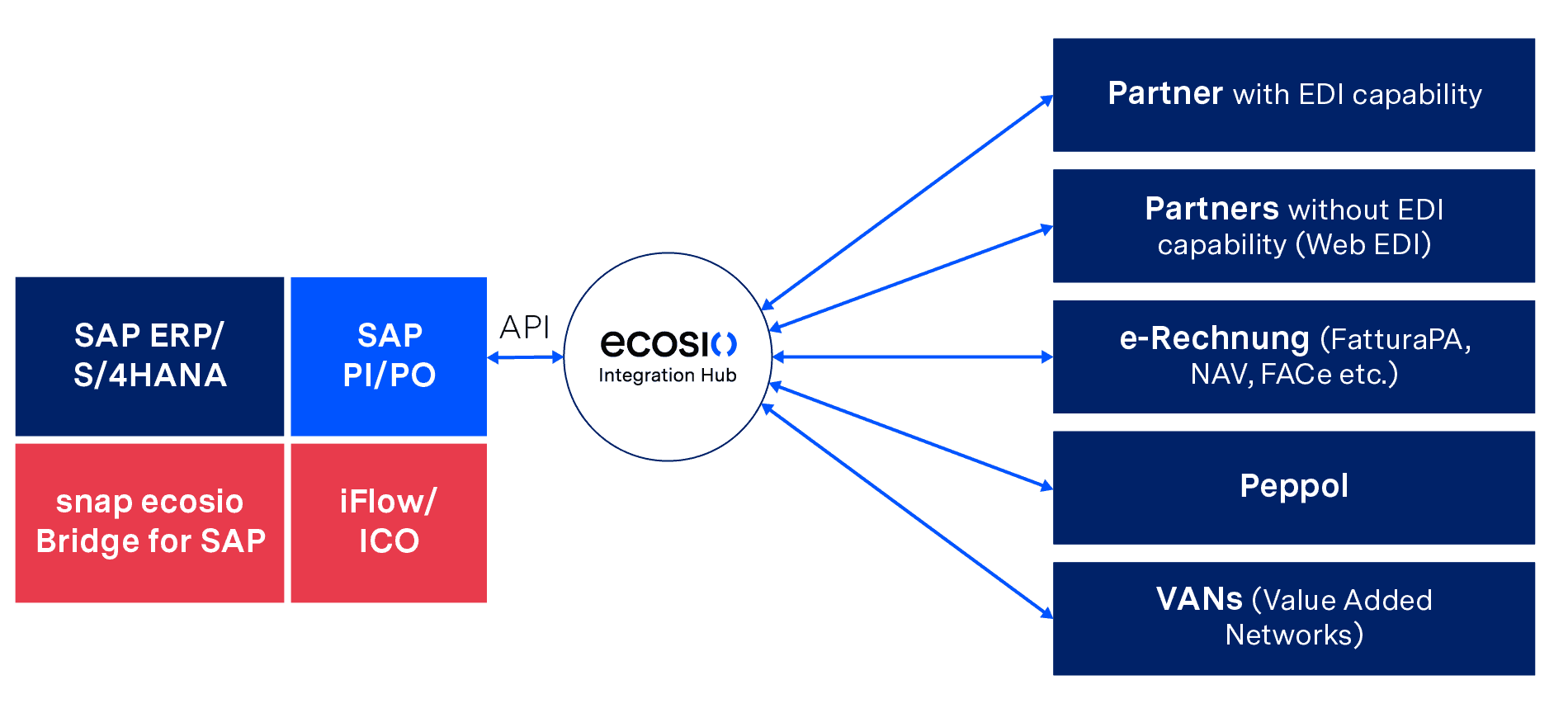
Deep EDI Integration in SAP with snap ecosio Bridge for SAP and iFlow/ICO
In this solution the EDI service provider creates and ensures all technically desired EDI prerequisites, such as routing via various protocols, VANs and Peppol or conversion into all common and necessary formats, including legal requirements in the field of e-invoicing. Further, operation, 24/7 monitoring and partner onboarding (including partner communication) are also handled by the service provider.
The deep integration of the EDI functionalities into the SAP system also enables your business department to:
- Jump to the original EDI message for incoming messages, directly in SAP – without need for an extra login
- Jump to the generated EDI message for outgoing messages – again without extra login
- Track the EDI message status directly in SAP by changing the IDoc status of sent EDI messages to status 40 or 41 – depending on whether the recipient received the message or not
- Conduct a full text search of all messages and documents
- Benefit from automatic alerts/notification if messages are incorrect or could not be delivered
Updates, the ongoing certification of protocols and new SAP versions (such as SAP S/4HANA) are easily adopted and supported. Fully managed EDI offers companies the possibility to use all EDI functions without an expiration date – providing maximum EDI efficiency with minimum internal effort.
Summary
You now know the three possible technical approaches for implementing EDI on the basis of SAP PI or SAP PO and which criteria and questions you should use to select the most suitable one for your company. Essentially, you need to assess how much capacity you have internally to cope with implementing and operating an EDI solution.
Independent EDI implementation or the use of a local EDI converter enables a company to send and receive EDI messages, but requires a high level of internal effort, and highly qualified personnel. In addition, some functionalities may have to be purchased externally.
Outsourcing to a fully managed EDI service provider offers you all the EDI functionalities available with SAP PI and SAP PO but in a flexible and freely scalable way. The entire effort, from mapping and routing to monitoring and troubleshooting, is taken over by the EDI service provider, relieving internal teams.
Want more information?
Discover more about our updated product, ecosio.flow.
Do you still have questions about SAP PI data exchange or EDI with an SAP ERP system? Feel free to contact us, we would love to help you!
SAP ERP and SAP S/4HANA are the trademarks or registered trademarks of SAP SE or its affiliates in Germany and in several other countries.
Der Beitrag Alternative Solutions for EDI in SAP PI and SAP PO erschien zuerst auf ecosio.
]]>Der Beitrag What SAP ERP or SAP S/4HANA version are you using? erschien zuerst auf ecosio.
]]>- Open SAP GUI → “Status” → zoom into SAP System data to check your installed version
- SAP ERP 6.0 (Business Suite 7) versions are shown via SAP_BASIS and SAP_APPL values
- SAP S/4HANA versions use a YYMM format (e.g. 1909 = September 2019), visible via the S4CORE component
- Knowing your version is key for EDI integration and upgrade planning
How to find your SAP version number
To find out which SAP ERP or SAP S/4HANA system you are using, open the SAP GUI and select “Status” in the menu.

SAP Menu
© 2020. SAP SE or an SAP affiliate company. All rights reserved. Used with permission of SAP SE.
Then click on the zoom button in the SAP System data section.
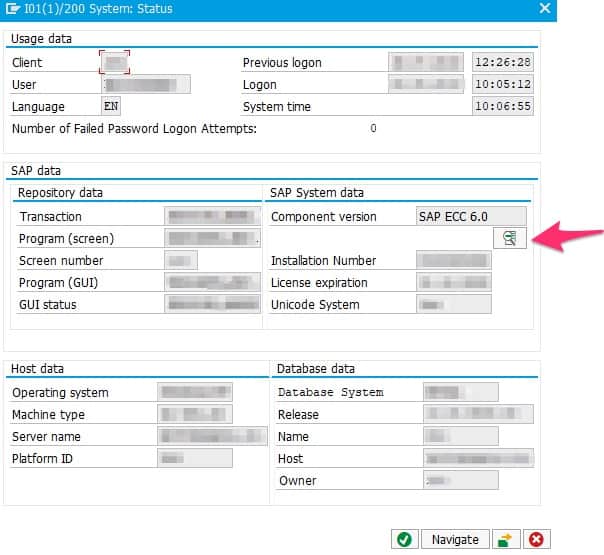
SAP Details
© 2020. SAP SE or an SAP affiliate company. All rights reserved. Used with permission of SAP SE.
Depending on the SAP version and depending on whether you run SAP Business Suite 7 or SAP S/4HANA, details may be shown in different ways.
SAP Business Suite 7
SAP ERP 6.0 is the central core component of SAP Business Suite 7 and the predecessor of SAP S/4HANA. Over the years new capabilities have been added to SAP ERP 6.0, which are called Enhancement Packages (or EHP in short). The latest EHP is EHP 8.0, which was released in 2016. The following screenshot has been taken from SAP Business Suite 7. The Installed Product Versions tab gives an overview of the currently used product versions.
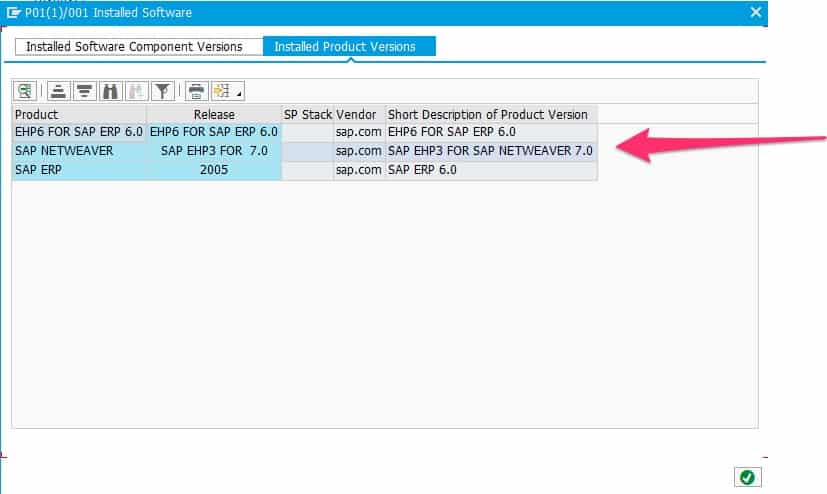
SAP product versions
© 2020. SAP SE or an SAP affiliate company. All rights reserved. Used with permission of SAP SE.
Where no tab exists, the version may be obtained by inspection of the two SAP_BASIS and SAP_APPL types. SAP_BASIS indicates the version of the underlying NetWeaver server and SAP_APPL the version of the used SAP ERP 6.0 component.
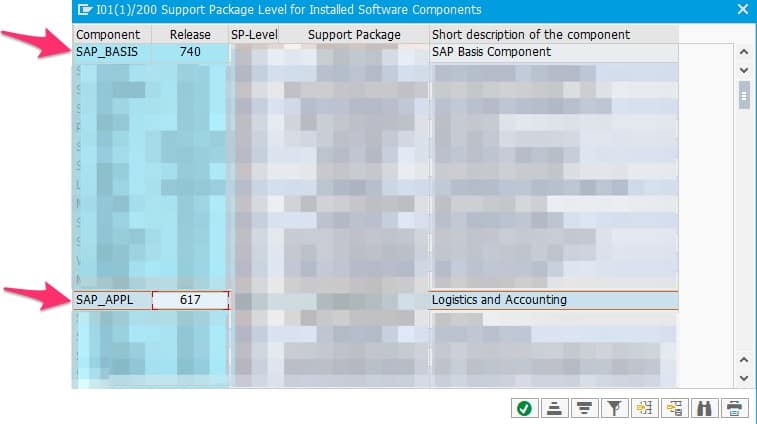
SAP product details
© 2020. SAP SE or an SAP affiliate company. All rights reserved. Used with permission of SAP SE.
A SAP_BASIS type 740 indicates a SAP NetWeaver Server Version 7.4, SAP_BASIS 750 would indicate SAP NetWeaver Server Version 7.5 and SAP_BASIS 702 would indicate SAP NetWeaver 7.0 with Enhancement Package 2. Thus, the first two digits of SAP_BASIS indicate the SAP NetWeaver version and the last digit the NetWeaver enhancement package (if applicable).
A SAP_APPL type 617 indicates a SAP ERP 6.0 with EHP7. A middle digit 1 indicates that the system is enabled for HANA databases. A SAP_APPL 605 indicates a SAP ERP 6.0 with EHP 5. Since the middle digit is 0, the system is not enabled for HANA.
SAP S/4HANA
SAP S/4HANA is short for SAP Business Suite 4 HANA and is the newest ERP system of SAP. In SAP S/4HANA versions are named after the year and the month they were released (YYMM). Users of Microsoft Windows will find that naming convention quite familiar, as the same concept is used there.
Thus, an SAP S/4HANA system version 1909 indicates the release date of September 2019.
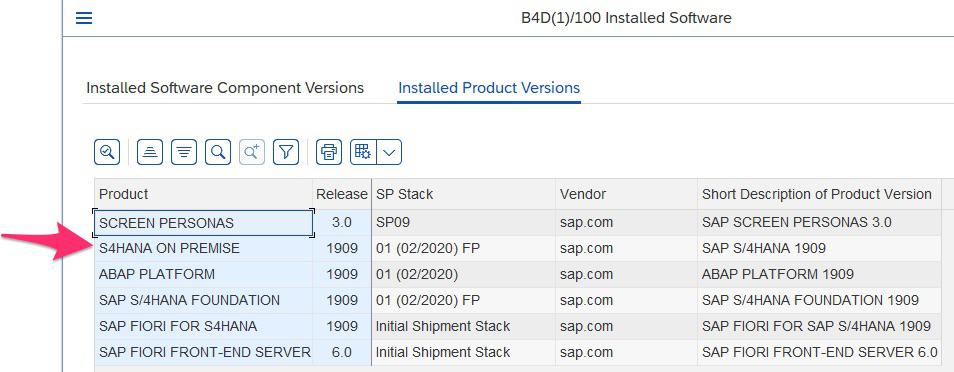
S/4HANA systems have a dedicated component called S4CORE (common questions regarding this component can be found in the SAP Community). The S4CORE version also indicates the used S/4HANA version.
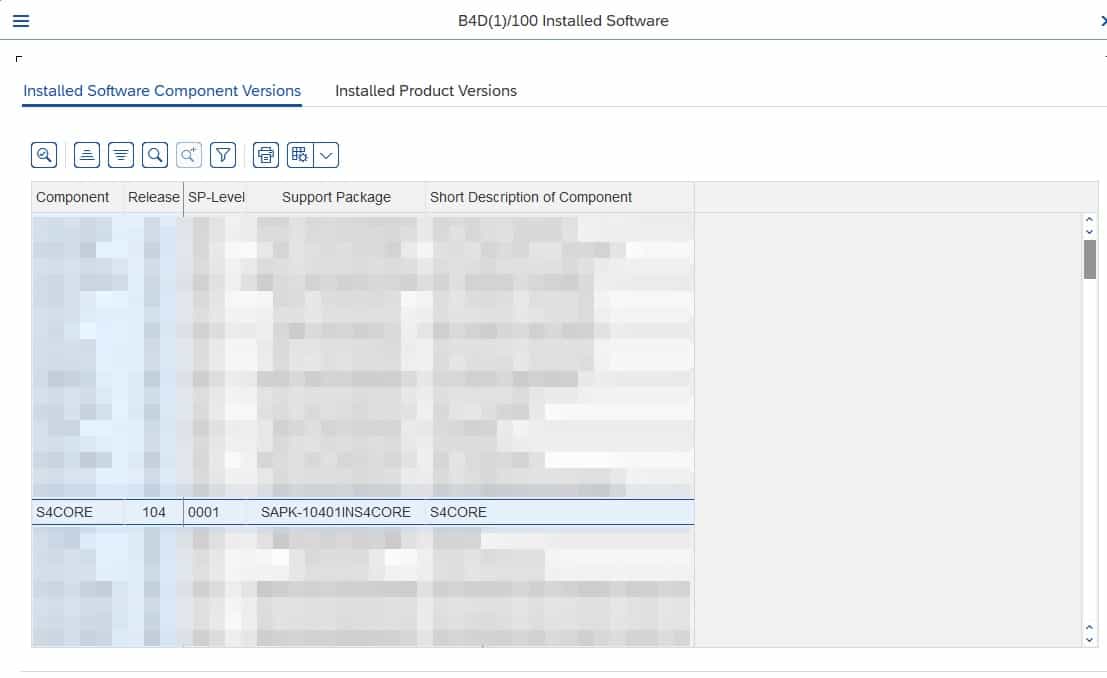
© 2020. SAP SE or an SAP affiliate company. All rights reserved. Used with permission of SAP SE.
S4CORE 102 means you are running an SAP S/4HANA 1709, S4CORE 103 means 1809, S4CORE 104 means 1909, etc.
Any questions about SAP ERP?
Got any questions about SAP and electronic data interchange (EDI)? Please contact us – we look forward to assisting you! You can also chat directly with one of our experts online.
SAP ERP and SAP S/4HANA are the trademarks or registered trademarks of SAP SE or its affiliates in Germany and in several other countries.
Der Beitrag What SAP ERP or SAP S/4HANA version are you using? erschien zuerst auf ecosio.
]]>