Der Beitrag The 7 EDI Documents Typically Found in a Trading Partner Cycle erschien zuerst auf ecosio.
]]>The exchange of business documents is part of a procurement process between suppliers and buyers, whether in retail, automotive or other production industries transacting goods and services on a regular basis. The following figure represents the typical flow of the seven most common EDI documents between a buyer and seller in a trading partner cycle, which I will explain further below.
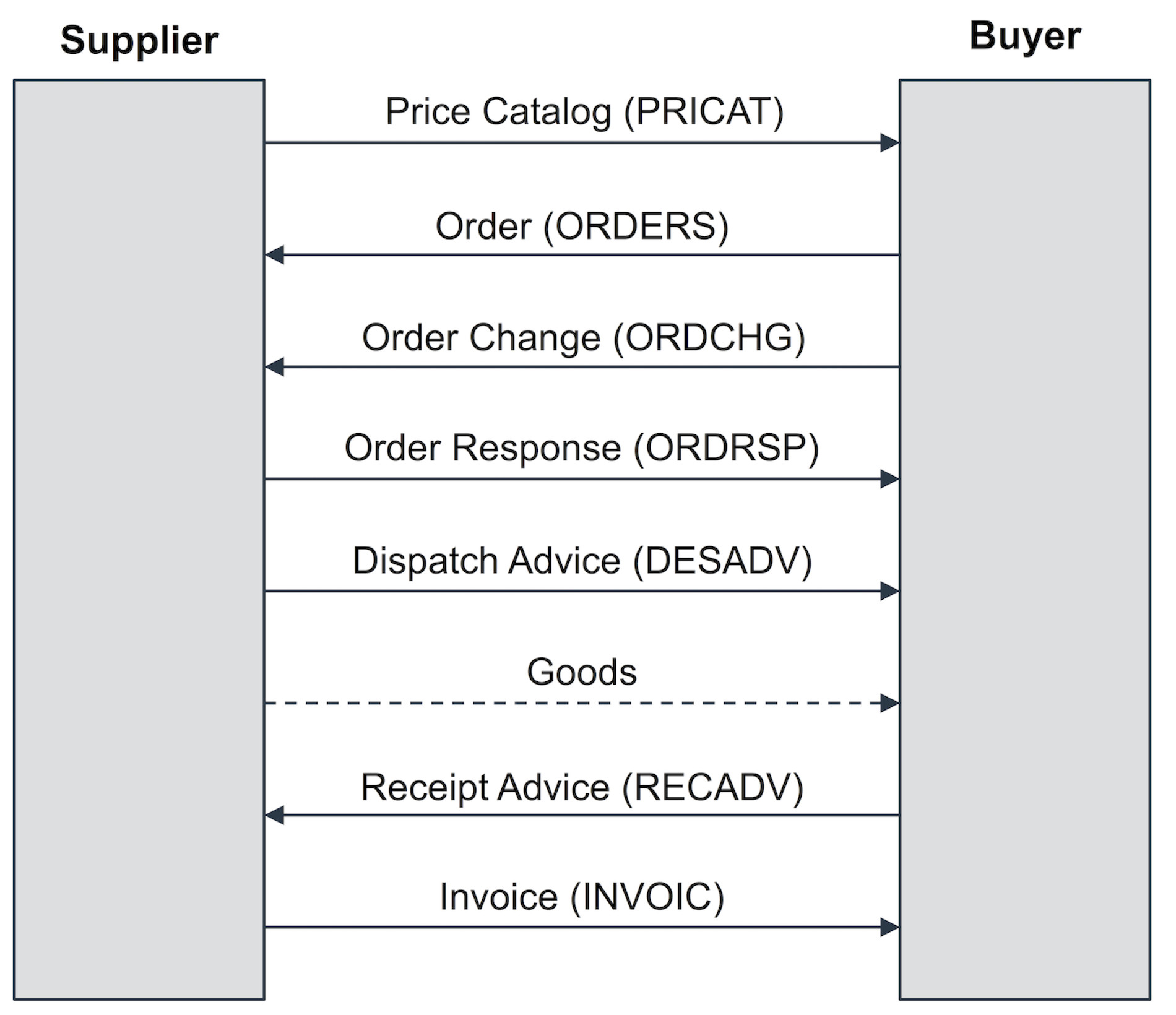
buyer and seller in a trading partner cycle
Price Catalog (PRICAT)
The first step of the exchange process between trading partners, is the price catalog and is required when the supplier provides the buyer with a current list of its products, product details, as well as price information. This process is commonly referred to as the product master data exchange, however, is not that common in modern trading partner cycles.
Purchase Order (ORDERS)
Once a buyer decides on the parameters of purchase from its supplier, the buyer must send a purchase order in order to receive those good. As such, this document is a necessary EDI transaction used by a customer, e.g. Sainsbury’s or Skanska, to place an order with one of its suppliers, e.g. Nestle or Tata Steel. This will contain the same information included in a traditional paper purchase order (PO), such as specific items and quantities to be produced, pricing and applicable discounts and shipping details. With EDI, the message includes coded information about the buyer, supplier, delivery point, products, etc. This means that unique identifiers such as global location numbers (GLNs) or global trade identification numbers (GTINs) are used for the identification of the involved trading partners and their goods. GLNs and GTINs are mostly found in retail and wholesale – manufacturing and the automotive industry often build on supplier’s or customer’s article numbers for material identification. In regard to partner identification bilaterally agreed IDs (e.g. JLR for Jaguar Landrover) or DUNS numbers are often used.
The benefit of using purchase orders via EDI allows businesses to avoid data entry errors associated with manually entering data into your system. It also reduces time delays and speeds up the process of sending and receiving documents, as well as, eliminating duplicates.
Order Change (ORDCHG)
A buyer may wish to request to change the quantity of goods ordered or the requested delivery date by emitting an order change message, indicating to the supplier a change of the initial purchase order.
Order Response (ORDRSP)
The supplier may acknowledge a received order message or a received order change message using an order response message. The order response can also be used as an Order Confirmation so as to recap and confirm what was in the purchase order. The supplier is essentially telling the customer that the order was received and they will take the job. It closes the loop and confirms the order electronically, without a follow up call or fax. The document can also indicate that the purchase order was accepted or rejected. It can even indicate any changes in pricing or quantity, alert the customer of product availability (in stock or backorder) and provide ship and delivery dates.
An automatic update of confirming an order or response will prevent confusion or mistakes when the invoice is sent later down the line. Time and money is saved by not having to follow up manually and check.
Dispatch Advice (DESADV)
A supplier notifies the buyer of the shipped good the buyer can expect to receive. Using the dispatch advice message, the supplier provides the buyer with information about the shipment including number of pallets, pallet identification numbers such as serial shipping container codes (SSCC), net and gross weight, identification of the transport vehicle such as license plate number of the truck, etc.
The benefit of this is that the buyer may coordinate the arrival and processing of the goods-to-arrive, e.g., in case of cross-docking-scenarios, frozen goods, etc. Furthermore, the buyer may verify the completeness of the shipment by comparing the received goods with the information provided in the previously received dispatch advice message.
Receipt Advice (RECADV)
After the goods have been received by the buyer, the buyer may emit a receipt advice message, confirming the amount of received goods. The amount of confirmed goods in the receipt advice may be different from the amount communicated by the supplier in the dispatch advice. Reasons for such a deviation may for instance be damaged goods the buyer refuses to accept or a wrong number of goods shipped by the supplier.
Invoice (INVOIC)
An outbound EDI document that replaces the traditional paper invoice. This document basically says that your order is complete and has shipped, so now we are billing you. Invoice details typically include goods provided, shipping particulars and payment terms. If your EDI is embedded, the invoice data is usually translated directly out of your accounts receivable module into the EDI document and subsequently into the accounts payable module of the customer.
Questions about the trading partner cycle of document types?
If you’d like more help with gathering your requirements from your supply chain, you can reach out – we’d be happy to help. or check out our chat.
Der Beitrag The 7 EDI Documents Typically Found in a Trading Partner Cycle erschien zuerst auf ecosio.
]]>Der Beitrag How Can I Apply for a GLN / GTIN / SSCC? erschien zuerst auf ecosio.
]]>Before we discuss how to apply for a GLN / GTIN or SSCC, let’s first look at the GS1 system…
GS1 is a global standardization organization with the goal of simplifying value creation processes by developing global standards. GS1 is funded by the fees that organizations pay to participate in the GS1 system. The developed standards revolve around the following four main areas:

GS1 identification numbers fall under the Identify category and are used for global, non-conflicting and unique identification. GLNs – Global Location Numbers are used to uniquely identify companies and divisions. GTINs (Global Trade Identification Numbers) are used to uniquely identify products and services and SSCCs (Serial Shipping Container Code) for the unique identification of carriers.
The basis for all numbers in the GS1 identification number system is a GS1 base number. Based on the GS1 base number, the other numbers such as GLN, GTIN or SSCC can then be formed.
Learn how fully managed EDI could help to boost your business
How to apply for a GLN number
GLNs are awarded by the country offices of GS1. To apply for a GLN, please contact your country organization.
Do you have any questions?
Do you still have questions about applying for a GLN / GTIN / SSCC? Feel free to contact us, we would love to help you!
Der Beitrag How Can I Apply for a GLN / GTIN / SSCC? erschien zuerst auf ecosio.
]]>Der Beitrag What is a GTIN? erschien zuerst auf ecosio.
]]>GTIN is the abbreviation for Global Trade Identification Number. As with GLN, the acronym already contains the term “number”, so we’re just speaking about GTIN instead of GTIN number.
In many cases, the old term EAN (European Article Number) is still used today.
What do I need a GTIN for?
A GTIN is used the unique identification of products and services without any overlapping between two items. Thus, a GTIN guarantees the global uniqueness of a product or service identification. Let’s take a supermarket for example. Identifying specific products by only using their names is not suitable for the following reasons:
- Different products can have the same or a similar name
- The same product can be referred to by different names from different supply chain participants. The manufacturer of a product could name it
Milk skimmed 1lwhereas the logistics company would call itProducer xyz Milk skimmed 1land the offering supermarket usesExtra skimmed milk 1l. Without having a strict and unique identification key, such as a GTIN, the integration of supply chains can be very challenging, as misunderstandings in communication tend to happen more often than not. - Names are generally bad for the identification of products in EDI transactions. IT professionals prefer using unique identifiers that allow for an unambiguous and non-overlapping identification. In the context of databases, one would refer to these as primary keys.
GTINs are a huge help as they allow the unique identification of products throughout multiple companies and different countries.
Especially as a small or medium sized business, one gets confronted with GLN and GTIN when trying to implement EDI with a (typically larger) trading partner. In the course of exchanging invoices, advance shipping notices, orders etc. with these partners, GTINs will be used for the identification of products and services.

How is a GTIN structured and what is the link to a GLN?
In one of our latest blog posts we have already looked at the usage of Global Location Numbers – GLN for the unique identification of companies. There is a direct link between a company’s GLN and the GTINs it is using.
To create a GTIN, a company needs to be in possession of a GS1 company prefix. The assigned company prefix forms the base for the creation of all GS1 identifiers like GLN, GTIN and SSCC numbers. Once again, the following picture shows the structure of a GLN (GS1 prefix number 9012345) as well as the example GLN 9012345000004.

Based on the GS1 company prefix, it is possible to create multiple GTINs. Depending on the purchased GS1 prefix license, the company can create up to 100,000 GTINs.
The GTIN is generated by using the GS1 company prefix number, following with the item reference and ending with a checksum. The first three digits of the GS1 company prefix is the GS1 country code which can be used to acquire the country where the GS1 company prefix was assigned in.
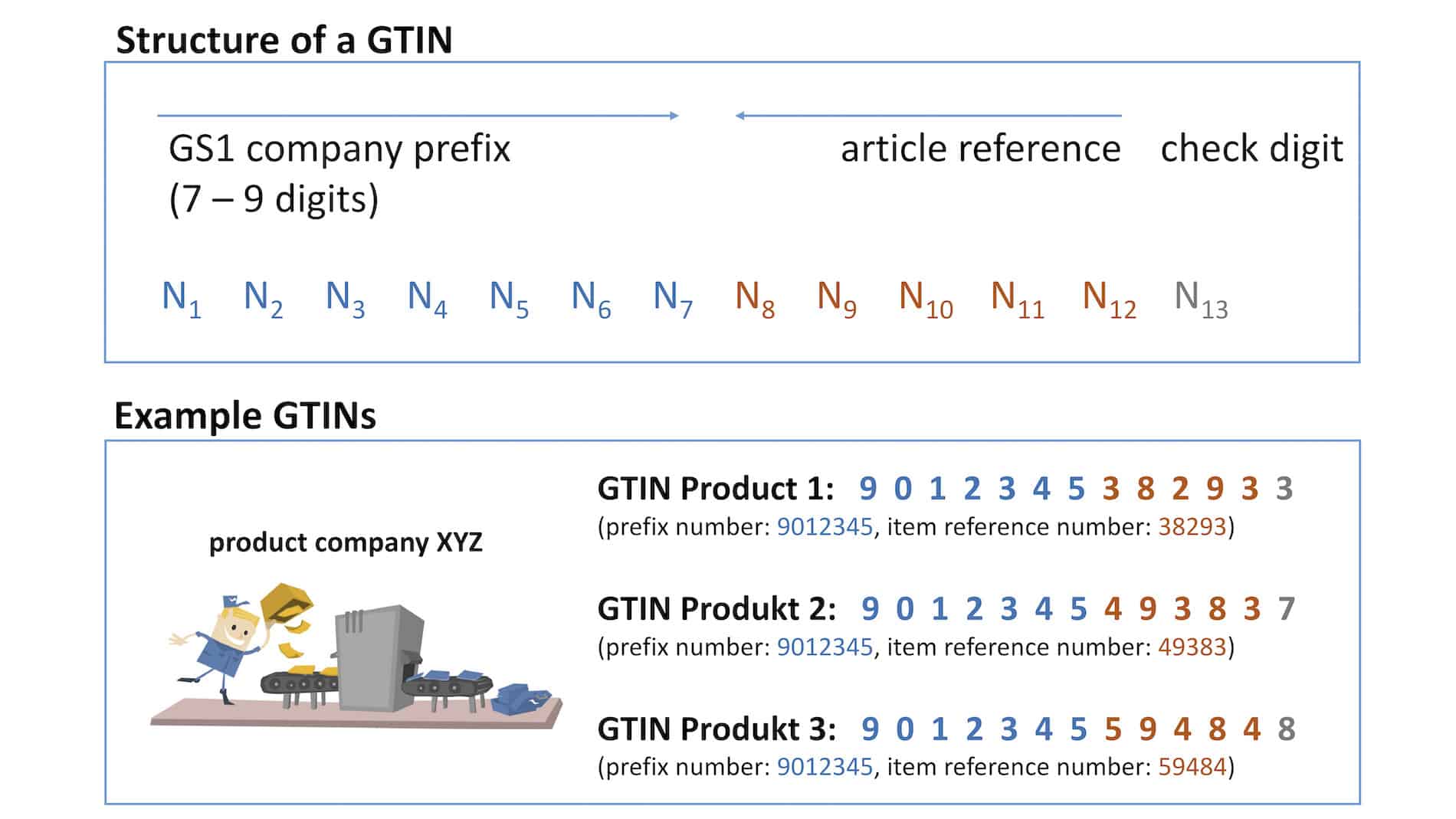
The image above shows the structure of a 13-digit GTIN. Apart from the 13-digit GTIN, there are also 8, 12 and 14-digit GTINs. The difference between the GTIN classes is also explained on the GS1 website.
Is there a connection between the barcode of a product and its GTIN?
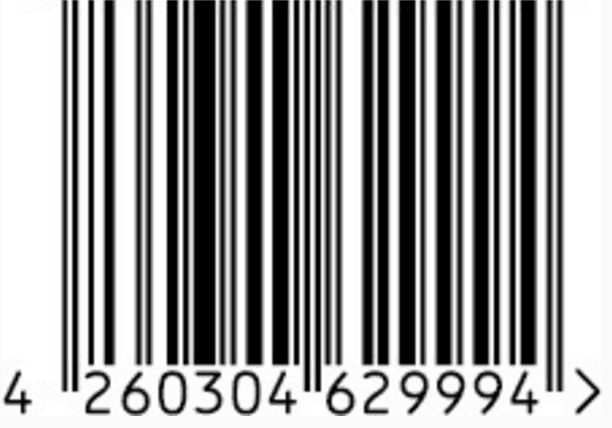
Whenever possible, the GTIN will be attached to the product via a barcode label. This label contains the GTIN in a coded form, allowing it to be read automatically. The scanning is typically done using a barcode reader, similar to the way items are scanned at the checkout till in a supermarket. The following image shows an example barcode with its attached GTIN as found on regular products.
Can the GTIN be used to identify the associated company?
Like with a GLN, it is not possible to identify the related company by looking at the GTIN only. To find out who the GTIN belongs to, one must use the directories of the appropriate GS1 organization or ask the company directly, which GTINs are in use. The GS1 directories are called GEPIR (Global Electronic Party Information Register).
Please note: There are companies who don’t publish a full set of their GLNs and GTINs in the GEPIR directories.
Which requirements are needed to be able to use a GTIN?
Let us summarize the necessary requirements a company needs to satisfy to make use of a GTIN:
- A GS1 company prefix, which is used as the base for GTINs. Depending on number of GTINs needed, there are multiple prefix classes one can choose from. For further details please refer to the following blog post on the topic of GLNs.
- Internal article numbers are needed for the article reference in the GTIN (see illustration above).
- Checksum for the created GTIN base numbers. (GS1 company prefix + article reference)
- An implementation of the GTINs in the internal IT systems as well as an EDI connection to the trading partners, such as customers and suppliers.
Do you have any questions?
Do you still have questions about GTINs? Feel free to contact us, we would love to help you!
Der Beitrag What is a GTIN? erschien zuerst auf ecosio.
]]>Der Beitrag Overview of the EDIFACT EANCOM format erschien zuerst auf ecosio.
]]>EDIFACT stands for Electronic Data Interchange for Administration, Commerce and Transport and has been in constant development by the United Nations since 1986. This standard is known under the name UN/EDIFACT. Whilst working on standardising the UN/EDIFACT format, numerous requirements from all industries needed consideration. However, although this may have helped broaden the UN/EDIFACT standard and make it more flexible, it also complicated its actual use.
A simple invoice may, for instance, include many optional elements and different identifiers may be used for the identification of the involved companies and products, etc. Before they can create an actual EDIFACT invoice, the sender and receiver need to agree on the subset of segments they will be invoked when exchanging files. If it were the case, that both parties always needed to agree on a specific subset, this would inevitably lead to a huge and unnecessary number of different subsets, and therefore reduce the benefits of EDI through the time needed to make the subsets compliant.
It is therefore advisable to agree on certain standard EDIFACT-subsets. These EDIFACT subsets are derived from the EDIFACT standard and were tailored to suit a specific user group. Mandatory elements are defined according to the EDIFACT subset and additional specifications laid down (e.g. identifiers to use, date formats, code lists, etc.).
These subsets apply to whole industries (e.g. paper, steel or consumer goods industry), including at the corporate level.
The diagram below illustrates the subset approach.
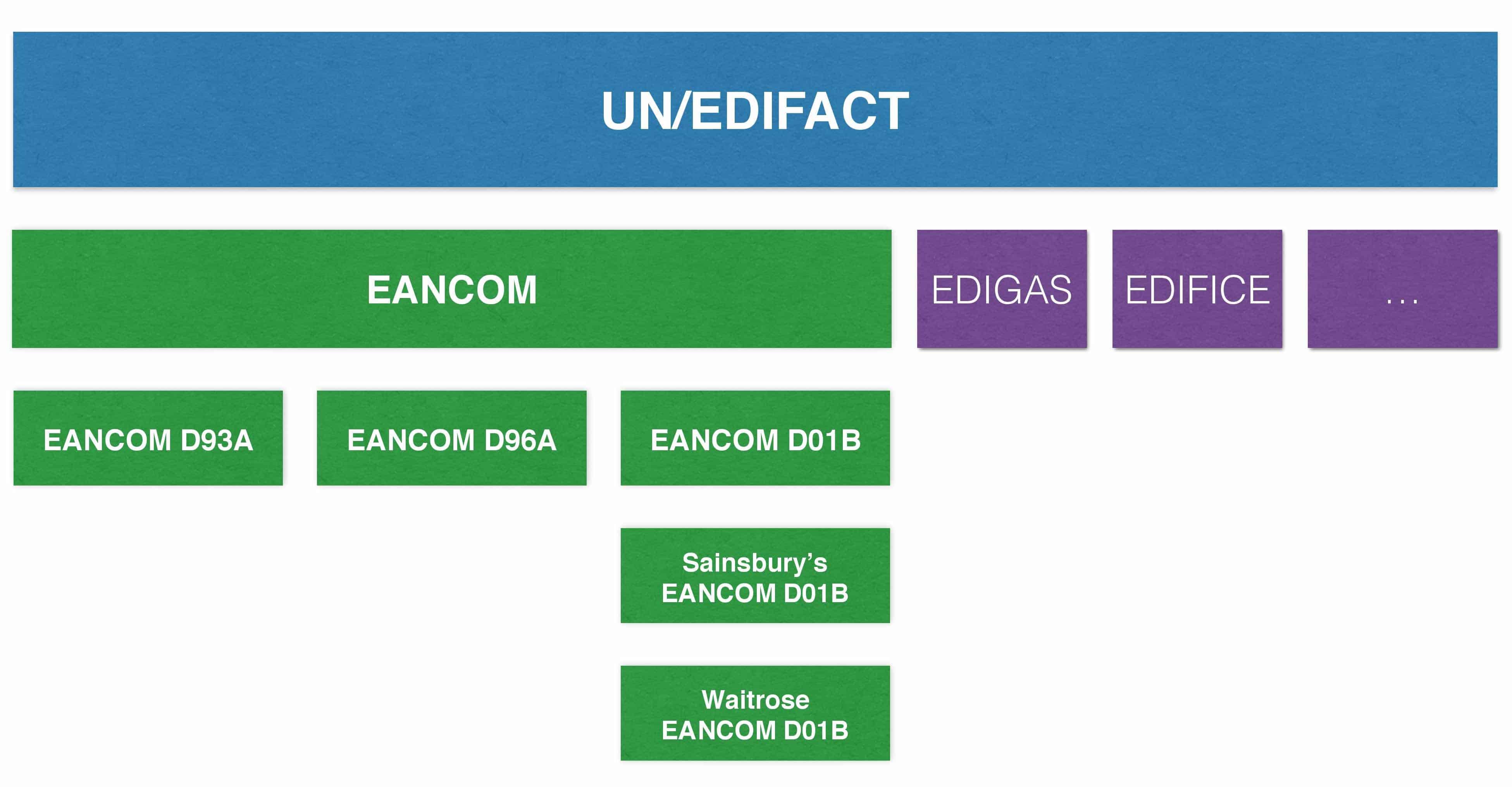
Individual subsets based on the UN/EDIFACT standard were defined for different industries. The globally most used EDIFACT subset is EANCOM (abbreviation of EAN + Communication) and GS1 is continuing its development for the consumer goods industry. Other subsets include, for instance, EDIGAS (gas industry) or EDIFICE (high-tech industry).
EANCOM exists today in three different versions (D93A, D96A and D01B). Major companies such as REWE or Metro are also defining their own subsets based on the EANCOM subset.
EANCOM-Subset
EANCOM is being developed by the GS1 organisation for global standards and is a 100% subset of the UN/EDIFACT standard for the consumer goods industry. Since the EANCOM standard is highly popular, it is by now also used in other industries, such as the health sector. As opposed to the very extensive UN/EDIFACT standard, EANCOM reduces the various EDI messages to essential fields that are mandatory to specific business processes or for specific message types. The EANCOM standard currently includes about 50 different message types.
As the name suggests already, the EANCOM standard is based on the GS1 identification system (GLN, GTIN,SSCC, etc.). The use of globally unique GS1 identification allows effective and uniform processing of EDI messages. Every sender and recipient will, for instance, be uniquely identified by it’s GLN – thus excluding confusion caused by proprietary identifiers. The same applies to product identification using GTINs and identification of packages using SSCCs.
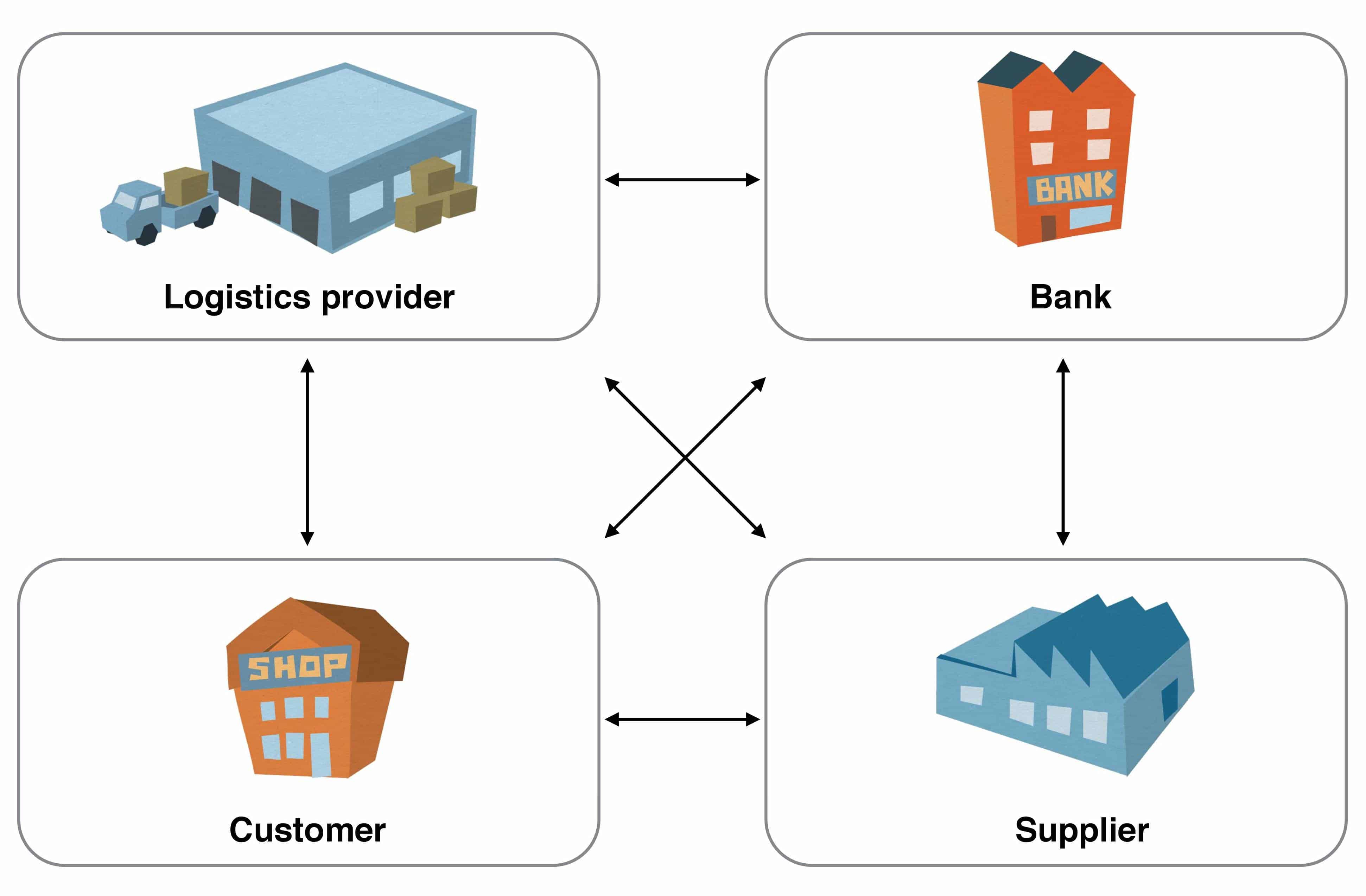
EANCOM also defines the logical sequence of messages used in a specific business area. The diagram below illustrates message flows that may be depicted with EANCOM. In addition to buyers and sellers, communication between logistics service providers and banks is also included.
EANCOM – Participating Companies
The individual EANCOM message types may be roughly classified into the following four categories:
- Master data reconciliation
These message types are used for the exchange of master data for products and for involved trading partners. The master data is therefore stored in the systems of the involved partners and used for message transactions afterwards. This will, for instance, ensure that only the most recent product identifiers and prices will be used. - Transactions
These message types are used to order goods, organise their transportation and pay for goods received. - Reporting and planning
These message types are used for the exchange of data allowing future planning. Examples include Sales Reports or Inventory Reports, used to communicate current product sales figures to a supplier. The supplier may use this information to plan his own production. - Miscellaneous
The message types in this category serve various purposes, such as the exchange of additional information required by the different industries.
Overview of EANCOM message types
The diagram below offers an overview of the most important EANCOM message types and the order of the message exchange.
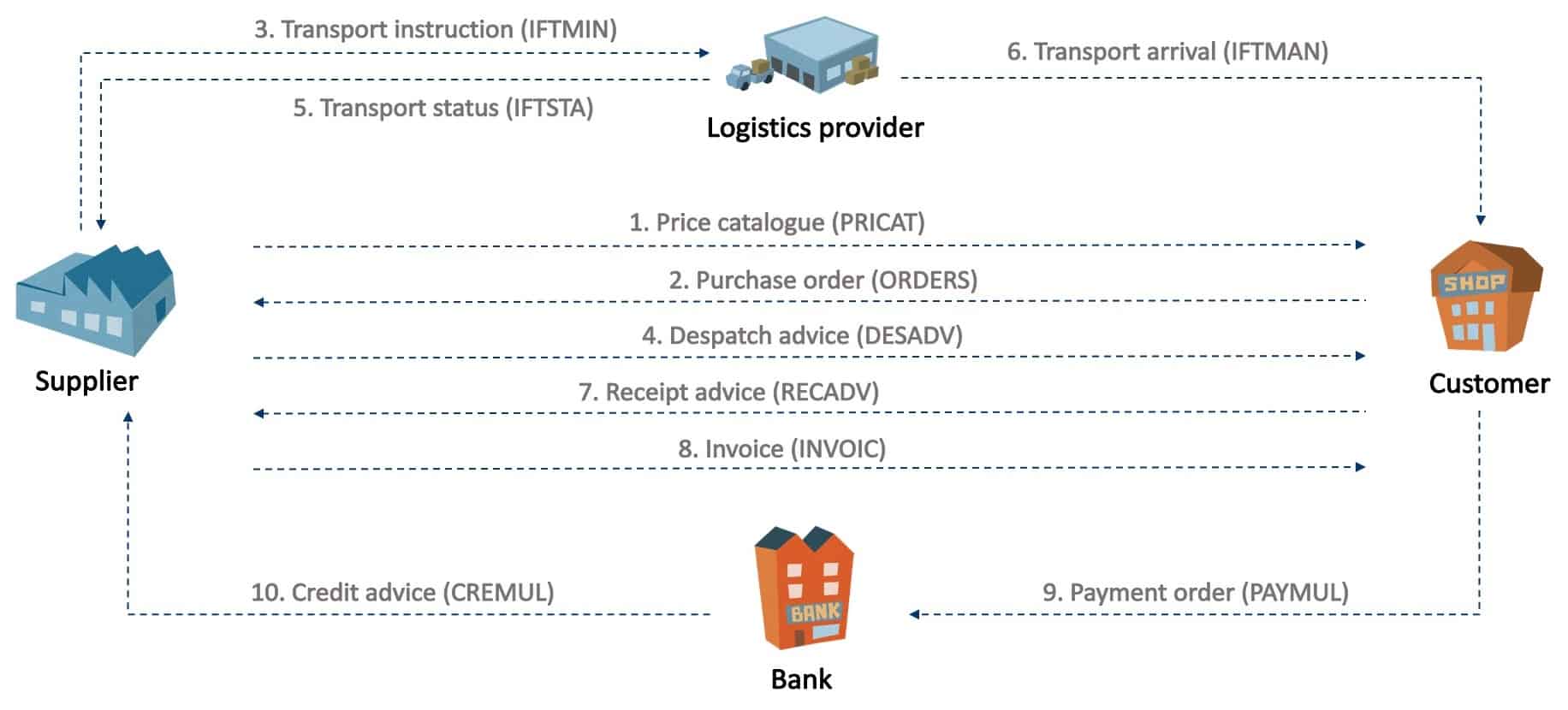
The three most important message types by far are ORDERS (order), DESADV (despatch advice) and INVOIC (invoice).
Price list/Catalogue (PRICAT)
A supplier will send a PRICAT message with a list of all relevant product data to his customers. A supplier will send a PRICAT message to customers whenever the product range changes.
Order (ORDERS)
A customer will transmit an ORDERS message to a supplier to order products and services. An order will typically also include the required quantity, date and place of delivery. The GTIN codes for the ordered products and services and the GLNs used will typically have been received via a previous PRICAT message.
It is also possible to leave out the master data reconciliation using PRICAT, if the parties have exchanged beforehand the lists with the product codes, e.g. on an Excel sheet. However, this might present a few drawbacks, such as input errors due to media faults, etc…
Transport order (IFTMIN)
A supplier will transmit an IFTMIN message to a logistics service provider to order transportation of goods.
Despatch message (DESADV)
Suppliers will send a DESADV message to notify customers of impending deliveries, prior to arrival of the goods at the customer. DESADV messages are particularly relevant to large companies since DESADV messages will allow coordination of their own goods receipt logistics (such as cross-docking warehouses).
Transport status (IFTSTA)
Logistics service providers will use IFTSTA messages to confirm shipment of an order to their client (in this case the supplier). The time of sending this message will be agreed on between the shipping agent and supplier. An IFTSTA message may, for instance, be sent once every day, at the time a shipment is executed, etc.
Arrival message (IFTMAN)
A shipping agent may send an IFTMAN message to the recipient of the goods (in this case the customer) to notify of imminent delivery. Similar to a DESADV, the purpose would be better planning of goods receipt logistic by the customer.
Goods receipt notification (RECADV)
Customers may send a RECADV message to confirm receipt of a specific shipment. This will allow the customer to, for instance, notify the supplier of deviations of quantities supplied or of his rejection of specific shipments.
Invoice (INVOIC)
The supplier may use an INVOIC message to transmit an invoice to his customer.
Banker’s order (PAYMUL)
The customer may use a PAYMUL message to transmit payment instructions to his bank. The bank will on receipt of this message pay the invoice amount to the account of the supplier.
Credit note (CREMUL)
A bank will use a CREMUL message to inform the supplier of payments made by his customer.
Questions?
Do you have any more questions about EANCOM? Please do contact us or use our chat – we’re more than happy to help!
Der Beitrag Overview of the EDIFACT EANCOM format erschien zuerst auf ecosio.
]]>Der Beitrag What is an SSCC number? erschien zuerst auf ecosio.
]]>When confronted with the topic of SSCCs and the unique identification of shipping units for the first time, the question of why this approach is necessary (and of course if the financial expense entailed is justified) will often arise.
On closer inspection one can recognise a number of reasons, why a company may benefit from the unique identification of its shipping units. In order to allow for an effective quality management, each shipment must be uniquely identifiable along the supply chain. Thereby, the affected parties such as consignor, consignee, carrier, freight forwarder, etc. shall reference a shipment using the same unique number.
The numbering system used should ideally:
A) prevent duplicates and be unique to every involved party.
Global uniqueness cannot be guaranteed with self-assigned numbers generated by, e.g. the consignor or the carrier.
B) be readable and processable by a machine.
This implies that the numbers shall be represented as bar codes and shall also be integrated in existing EDI processes (e.g. notification about an upcoming shipment using a despatch advice message).
Unique identification of shipping units will allow end-to-end control of goods movement. Machine processing of shipment data reduces staff costs and significantly increases the reliability of the recorded data (e.g. compared to paper-based delivery slips).
Another reason for the introduction of a unique shipment tracking are legal requirements, e.g. the tracing of food or pharmaceutical deliveries.
Learn how to unlock the potential of EDI with ERP integration
SSCC characteristics
The length of an SSCC is 18 characters and it is based the GS1 Company Prefix.
The guaranteed global uniqueness allows participating companies to use the SSCC for shipping unit identification without the risk of incorrect identification caused by duplicate codes.
The consignor generates the SSCC number, comprising a number and a bar code on a label, and attaches the label to the shipping units. The participating parties in the downstream process (e.g. carrier, freight forwarder, etc.) may scan and store the number. Furthermore, the SSCCs are included in EDI messages, which accompany the shipment, e.g. despatch advice messages. Using the scanned information together with the EDI messages the physically received goods (according to the scan) may be compared with the expected goods (according to the EDI message).
The combination of electronic transmission of SSCCs together with SSCC labels creates a traceable end-to-end process.
SSCC structure
As with all numbers in the GS1 numbering system, the SSCC is also based on the GS1 Company Prefix, which a company must aquire first. The GS1 Company Prefix may then be used to generate the different GS1 number types, for instance Global Location Numbers – GLN. In brief: a GLN is a globally unique and non-overlapping number to uniquely identify a company. Since the SSCC is also based on the GS1 Company Prefix, it is also globally unique and non-overlapping.
The following illustration depicts the precise structure of an SSCC.
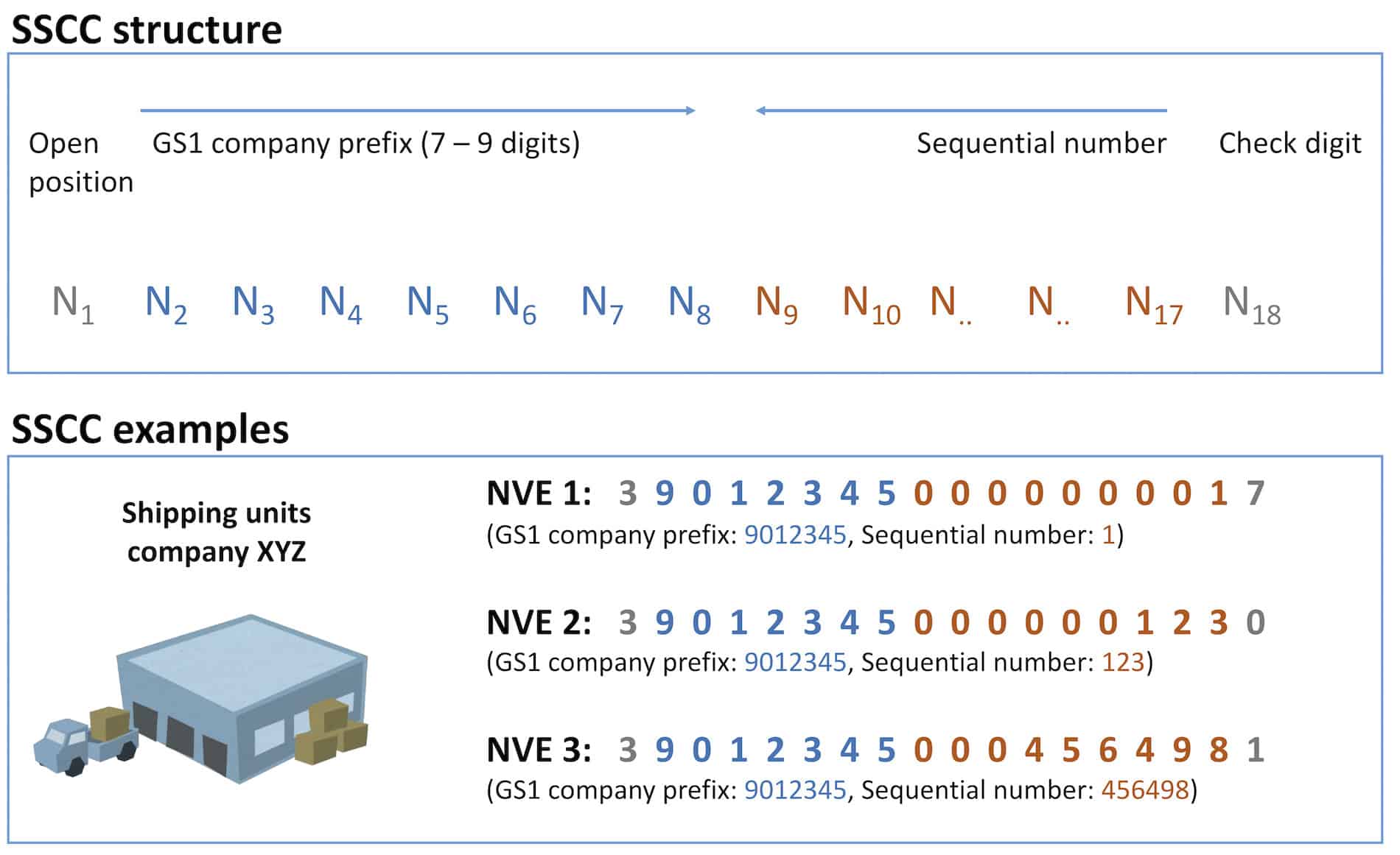
An SSCC starts with an open position that is selected by the company itself. It is followed by the 7 to 9-digit GS1 Company Prefix, depending on the type of GS1 Company Prefix, which is being used. The length of the company prefix determines the SSCC number range. A shorter company prefix allows for more SSCC numbers.
The company prefix is followed by a sequential number, used to identify the shipping units. Although GS1 has no specific requirements, a continuous ascending numbering system starting with 1 is recommended.
Considering the open position and the length of the company prefix, the numbering ranges are as follows:
9-digit company prefix: 100 million possible SSCCs
8-digit company prefix: 1 billion possible SSCCs
7-digit company prefix: 10 billion possible SSCCs
As with all GS1 numbers, the last digit is a “check digit” calculated using the previous 17 digits.
The GEPIR services of the various national GS1 locations may be used to find the company behind a specific SSCC:
Using SSCCs
The question of which shipping unit to mark with an SSCC often arises. Depending on the application scenario, shipping units may be entire containers, pallets, packages, small parcels, etc.
GS1 in general recommends the following:
An SSCC identifies the smallest physical unit of goods and freight, that is not permanently connected to physical units and that can be individually handled by the consignor and consignee.
Example: Boxes with pencils
- One EUR-pallet is loaded with individual boxes containing pencils.
The boxes are self-contained and are not connected (e.g. not wrapped using stretch wrap). In this case each box constitutes a shipping unit and may thus be marked with an SSCC. The pencils in the box will have a GTIN, independent of the SSCC. - The boxes may be wrapped using stretch wrap to prevent them from falling apart during transport. The pallet itself (comprising the individual boxes with pencils) is also a shipping unit and will be assigned an SSCC.
- Should the pencils be packaged in small parcels (e.g. 10 pencils each) inside the box, the small parcels could also be assigned an SSCC – for example, if some of these parcels are delivered by a logistics service provider.
Service providers along the supply chain may bundle individual shipping units to create larger units (e.g. by loading the pallets into a container). This creates a new shipping unit – in this case the container. The original shipping units will, however, remain unchanged and be used down the line (when emptying the container).
The level of SSCC granularity needs to be agreed upon by the participants along the supply chain. Typically, the larger business partner (e.g. a large retailer) defines the exact process requirements and all other suppliers, logistic providers, etc. have to comply with these requirements accordingly.
An SSCC is exclusively used for the identification of a shipping unit. If the shipping unit is also a standard trading unit that is being sold (e.g. a box with pencils), then the trading unit is also assigned its own GTIN in addition to the SSCC.
You can learn more about it in our article “What is a DESADV with SSCC and Why Should I Care?”.
Assigning SSCCs
The company manufacturing or assembling the shipping unit is responsible for marking the shipping unit with an SSCC.
All other participants along the supply chain are supposed to reuse the SSCCs already attached to the shipping unit. This ensures that a shipping unit retains its original SSCC number along the way from consignor to consignee.
Marking shipping units
GS1 recommends using GS1 transport labels in order to attach SSCC numbers to shipping units. A transport label is attached to the shipping unit (e.g. pallet) and may be scanned by participating companies along the supply chain, for instance to compare the shipped goods to EDI despatch notifications.
The illustration below shows a fictitious GS1 transport label of ecosio Ltd.
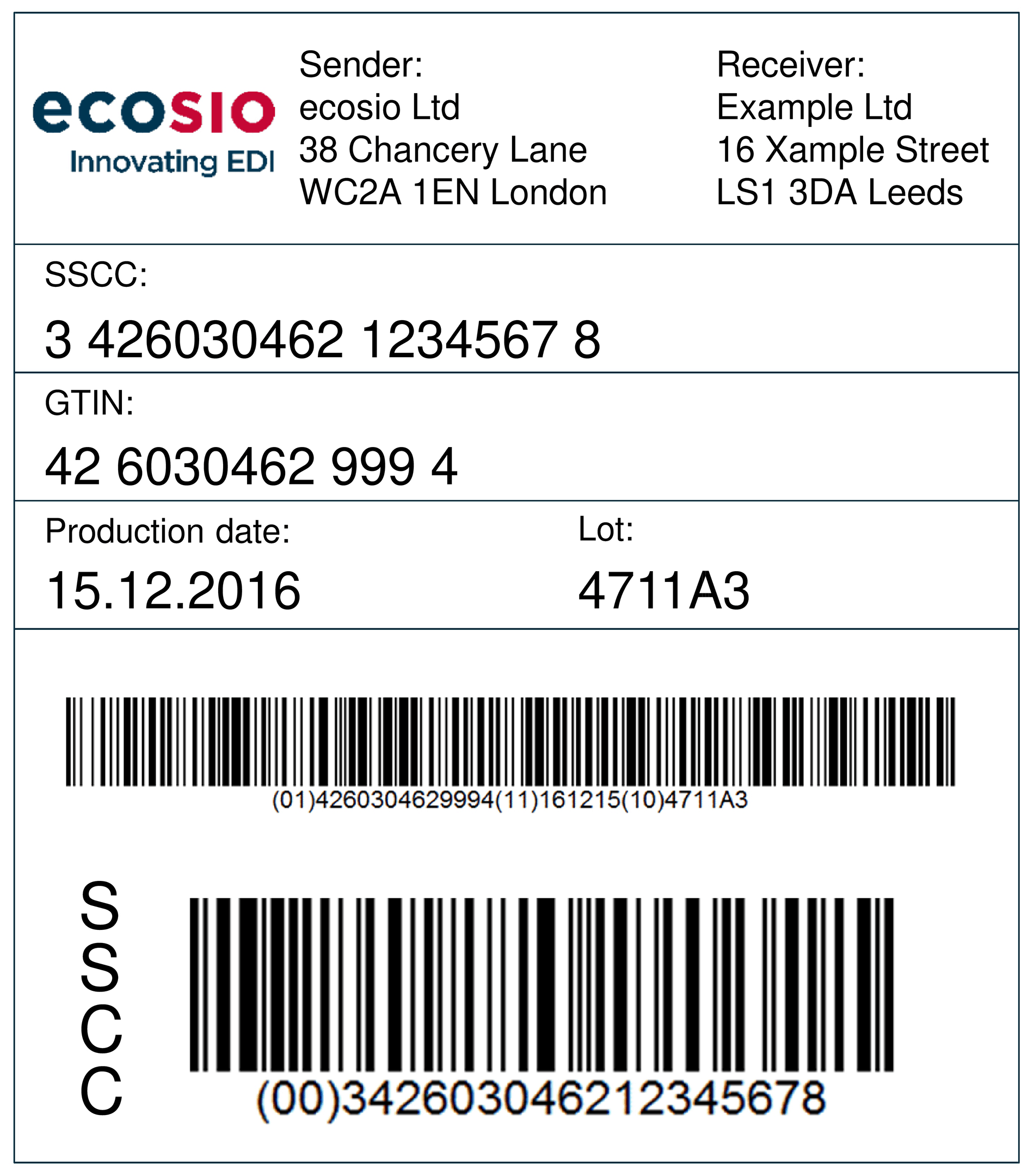
The core element of the transport label is the SSCC 342603046212345678, shown both as a visually readable number and as a GS1-128 bar code. GS1 specifications determine that the SSCC bar code should always be printed at the bottom of the label, as it represents the primary label information.
Additional information such as batch/lot number (4711A3), GTIN of the trading unit (4260304629994), etc. may also be shown on the label.
Introduction of SSCC processes in a company
SSCC labels may, depending on the company’s production process, be applied already at the end of production (if the production unit already constitutes a shipping unit) or later on at the loading ramp, where individual products are combined to create shipping units.
When introducing an SSCC process in a company, process and hardware adaptations are usually required, e.g. acquisition of label printers and SSCC scanners. The introduction of SSCC is often triggered by a larger business partner, which demands SSCC compliance from its suppliers. For a supplier the introduction of an SSCC process roughly implies:
- Generation of SSCC numbers. Generation can for instance occur in the ERP system.
- Transmission of an electronic despatch advice message (e.g. EDIFACT DESADV), which contains the SSCC information.
- Application of the SSCC label and shipment of the goods
Questions about SSCC or EDI?
Do you have any more questions about SSCC or EDI? Please do contact us or use our chat — we’re more than happy to help!
Der Beitrag What is an SSCC number? erschien zuerst auf ecosio.
]]>Der Beitrag The essential details of the VDA 4905 call off message erschien zuerst auf ecosio.
]]>VDA standards are maintained by the German Association of the Automotive Industry and represent one of the important families of standards used by that industry. VDA is the acronym of Verband der deutschen Automobilindustrie.
Standard definitions are given for a variety of applications, referring not only to the structure of electronic documents, but also specifying, for instance, labels and shipping documentation.
VDA 4905 delivery call-off
Delivery call-offs represent a key means of communication in the automotive industry, since tightly linked processes involving customers, suppliers, and upstream suppliers demand that changing supply chain dates and requirements must continuously be communicated “back up the chain”.
The principle is illustrated in the diagram below.
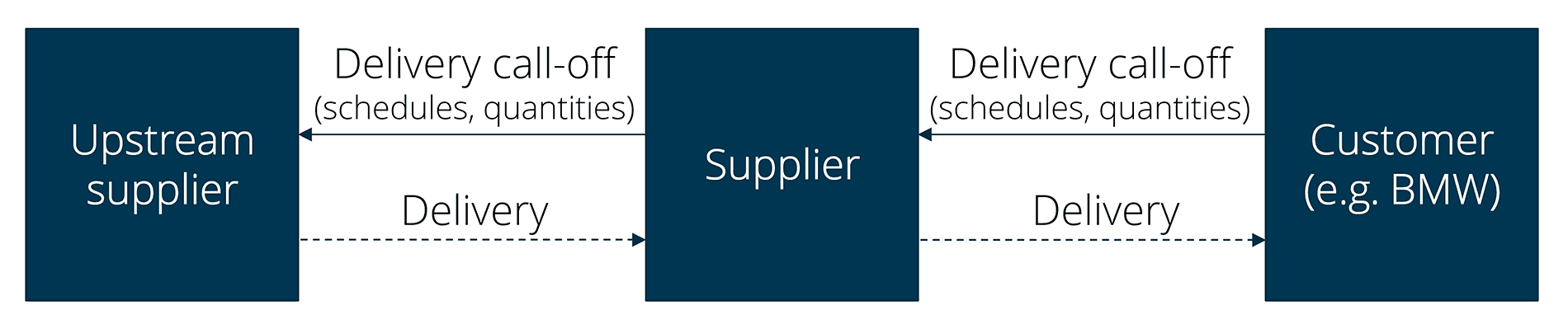
VDA 4905 delivery call-off principle
A new delivery call-off will fully override the previous delivery call-offs. Current requirements can therefore always be communicated back to the previous link in the logistics chain and up-to-date requirements are availabe to all business partners involved.
Learn how to resolve the key issues facing IT decision makers today
VDA 4905 delivery call-off structure
Similar to many other VDA standards, VDA 4905 delivery call-offs have a fixed dataset length of 128 characters. Adding a line break after every dataset will produce a sequence of rows. Each row starts with a three-character record type.
The diagram below illustrates the structure of a VDA 4905 message. The first three digits define the record type. M means, that the dataset is mandatory. K means, that the dataset is optional. M derives from the German muss, meaning must. K derives from the German kann, meaning can.
The last character indicates how often the dataset is allowed to be repeated, where n stands for as often as needed and 1..n for at least 1 to n times.
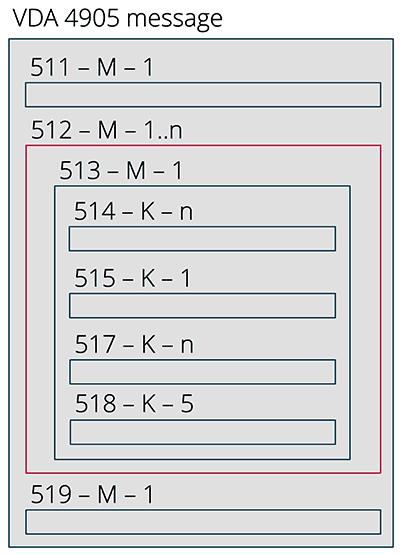
Structure of a VDA 4905 delivery call-off
The nested structure also indicates datasets, that can be repeated after a first dataset. The diagram shows, that transmission of delivery call-off data starts with record type 511 and will always end with record type 519.
A transmission must always contain record type 512 with the corresponding subordinate record types for every sorting parameter combination. In the VDA context, the sorting parameter combination includes the following parameters:
- Customer factory
- Customer material number
- Order number
- Unloading point
If, for instance, material number number a and number b and customer factory factory x and factory y are given and a call-off is required for both material numbers and both factories, the result will be as follows:
- 1 x 511
- 1 x 512 plus sub-record types (
material number ainfactory x) - 1 x 512 plus sub-record types (
material number ainfactory y) - 1 x 512 plus sub-record types (
material number binfactory x) - 1 x 512 plus sub-record types (
material number binfactory y) - 1 x 519
Differences compared to EDIFACT
The VDA standard has several special features compared to EDIFACT, which we briefly discuss below.
Sequential numbering
EDIFACT file transmissions are clearly identified by interchange references (provided in the UNB segment). Interchange references are issued by the sender and are numbered sequentially ascending. Using the interchange reference an EDIFACT transmission is easy to trace. In addition the message creation date and time in the UNB segment help with correctly identifying a transmission. Thus, wrong messages may, for instance, be traced and re-transmitted without a problem.
VDA has a different approach. A new transmission number and an old transmission number are transmitted for each transmission. New and old transmission numbers are unique references for the current and previous transmissions, respectively. No sequential numbering of the transmitted numbers is therefore required. Transmissions may furthermore be numbered differently, for instance in accordance with technical areas (e.g., orders for regular products as opposed to orders for spare parts).
Customer and supplier identification
It is customary in the trade that parties interchanging data (supplier, customer, invoice recipient, place of delivery, etc.) are identified by Global Location Numbers – GLN.
The automotive sector instead uses numbers that were exchanged bilaterally in advance. These may, for instance, include customer number, supplier number, customer’s factory number and unloading point.
Product identification
It is also customary in the trade that exchanged products are identified by a Global Trade Identification Number (GTIN). The GTIN is a number the producer assigns to his products. A consumer will recognise the GTIN as the number under the bar code, which can be found on almost all products in a supermarket shelf.
The automotive sector generally uses material numbers instead of GTINs. The supplier maintains his own list of individual customer material numbers, enabling him to assign them to his internal material numbers.
Cumulative quantity received
The cumulative quantity received comprises all negative or positive deliveries recorded by the customer, from a specific point in time. The quantity in transit will be the difference between cumulative delivery quantity by the supplier and cumulative quantity received at the customer.
The customer may also reset the cumulative quantity to 0 by sending a reset date in a delivery call-off. This date will then apply to all the parts of the supplier. Thus, the first call-off transmission after the reset shall contain all parts of the supplier relevant to the specific customer, allowing to start a new sequence.
Record type version numbers
Within the framework of VDA messaging (including VDA 4905) it is possible to assign version numbers to individual record types. EDIFACT does not provide for such version control on the record type level –- the only comparison would be EDIFACT directory version control -– e.g. EDIFACT EANCOM D96A vs. EDIFACT EANCOM D01B.
A common standard for all?
“The entire automotive industry relies on the VDA standard. Good news for all suppliers –- all companies in the automotive industry will be able to receive delivery call-offs using the same standard.”
Not quite, unfortunately…
Similar to EDIFACT, where the global EDIFACT standard (used in its pure form only by a few) has many subsets that are specific to certain industries and companies, the VDA also has versions that are specific to some companies.
This means, for instance, that German OEMs may have slightly different requirements under the VDA standard, that upstream suppliers will need to take into account.
More questions about VDA?
More questions on the topic of delivery call-off or other VDA standards? Please do contact us or use our chat — we’re more than happy to help!
Der Beitrag The essential details of the VDA 4905 call off message erschien zuerst auf ecosio.
]]>Der Beitrag What is a Global Location Number (GLN)? erschien zuerst auf ecosio.
]]>GLNs — short for Global Location Number — are used for the unique and unambiguous identification of legal entities and physical locations.
Legal entities may for instance be companies, administration bodies, customers, suppliers, service-providers, banks, etc. Physical locations may be addresses, single buildings, storage sites — even a single loading platform in a cross-docking warehouse. In addition GLNs may be used as unique identifiers for participants in electronic data interchange (EDI) — similar to email addresses in an email system.
The often used term GLN-number is actually wrong, since number is already contained in the acronym GLN. In the following only the term GLN is used.
For small and medium-sized businesses a single GLN is usually sufficient. Enterprises with several branches and large corporations require multiple GLNs. A reference value: Billa (a subsidiary of the German REWE corporation in Austria) has more than 1,000 GLNs in use in Austria. In Germany, EDEKA, which is by far the largest supermarket, uses more than 10,000 GLNs for the different branches, ware houses, cross docking locations, etc.
Today one may sometimes hear people affiliated with electronic data interchange talking about International Location Numbers (ILN). ILN is the old term for a GLN.
Learn how fully managed EDI could help to boost your business
What is the structure of a Global Location Number?
A GLN is a 13-digit number consisting of a GS1 company prefix, a location reference, and a check digit. The following figure shows the structure of a GLN and two exemplary GLNs.
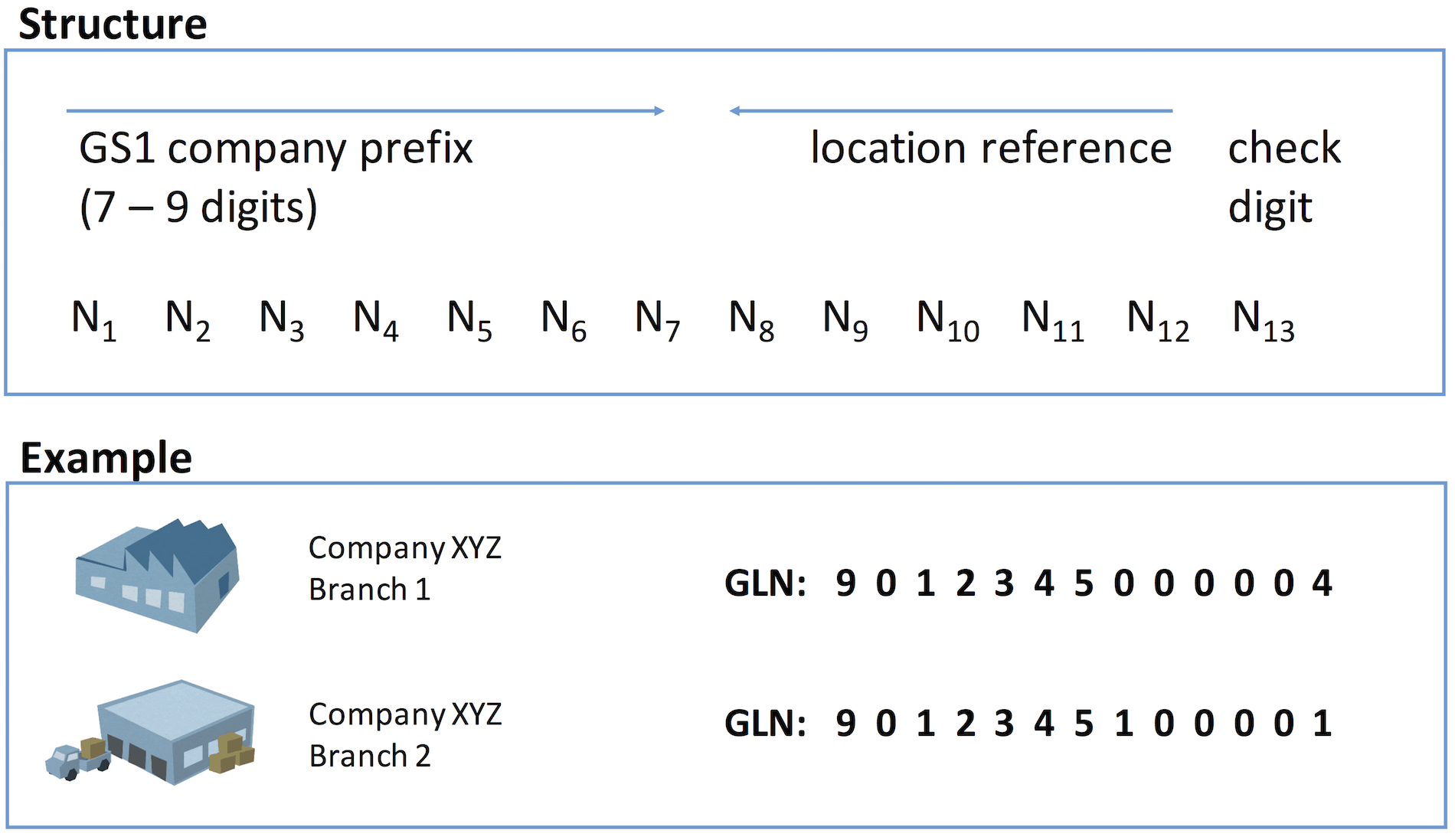
The GS1 company prefix is assigned by a GS1 member organization to a specific subscriber (e.g., a company).
The location reference is assigned by the company itself to identify a specific location.
The check digit is calculated from the first twelve digits and helps to ensure the integrity of the number.
One may not directly infer the company to which a GLN is assigned to, from the GLN digits directly, i.e., no company information is “coded” in the GLN. Instead one must fetch a directory service, offered by GS1, in order to retrieve the company details for a given GLN. The GS1 directory services are called GEPIR (Global Electronic Party Information Register).
Note, that not all companies publish their GLNs in the GEPIR directories. Although most of the companies do, there are some which deliberately choose to conceal the GLNs and the associated company details.
The GS1 company prefix forms the basis for additional identifiers, issued by GS1. For example GTINs (Global Trade Identification Numbers) or SSCCs (Serial Shipping Container Code) are generated on the basis of a GS1 company prefix.
GTINs are used for the unique and unambiguous identification of products and services. Just take a closer look at a bar code on an arbitrary consumer product near you — you’ll note the number below the bar code — this is a GTIN.
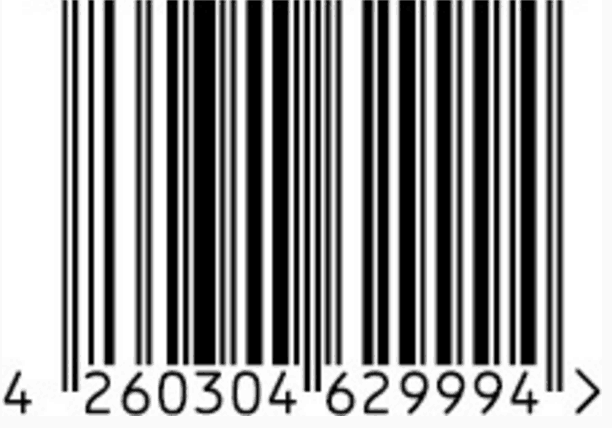
SSCCs, on the other hand, are used for the unique identification of logistic units, such as pallets, cases, cartons, or air traffic containers.
Why do I need a GLN when I have a postal address?
Postal addresses are indeed important for a company — the help clients to find your company using their GPS-based navigation device, they ensure that postal letters of your suppliers and customers end up in the right post box, etc. However, postal addresses are a bad identifier when it comes to electronic processes.
The following example shows the dilemma with postal addresses:
Store John Doe, L.A. branch, 4711 Park Avenue, CA 90210
John Doe Store, Los Angeles branch, 4711 Park Ave. Beverly Hills, CA 90210
A human quickly realizes that both addresses are semantically identical, but only written in a different way. IT systems, however, rely on unique and unambiguous identifiers. Thus, postal addresses represent bad identifier types, when it comes to IT-systems.
That’s where a Global Location Number comes into play.
In order to uniquely and unambiguously identify a company (or parts of a company) in an IT system, GLNs are used.
Who guarantees, that a GLN is unique?
GLNs are issued by Global Standards One (GS1) – usually by one of the national GS1 organizations. In the United Kingdom this is for instance GS1 UK or in the United States GS1 US. European examples include GS1 Germany, GS1 Austria, or GS1 Switzerland.
How much does a GLN cost?
GLNs are issued by the local GS1 organizations in the different countries. Thus, prices for GLNs may vary from country to country. The following prices are from GS1 Germany and may serve as a reference for the prices in other countries.
Currently, GS1 Germany offers GLNs in three different contingents. Depending on the type of GLN, different amounts of article numbers (GTIN) and logistic unit identifiers (SSCC) may be generated.
Small
Recommended for small enterprises with a limited set of articles.
Length of base number: 9 digits
Capacity: 1,000 article numbers and 10 million logistic units.
Costs: 230 EUR plus VAT
Medium
Recommended for medium-sized businesses.
Length of base number: 8 digits
Capacity: 10,000 article numbers and 100 million logistic units
Costs: 330 EUR plus VAT
Large
Recommended for large businesses
Length of base number: 7 digits
Capacity: 100,000 article numbers and 1 billion logistic units
Costs: 530 EUR plus VAT
Where can I apply for a GLN?
GLNs are issued by GS1. Contact your national GS1 office in order to apply for a GLN.
GLN, and then?
If you plan to use a GLN for your electronic data interchange processes, you require an EDI service provider. The EDI service provider takes care of connecting you local IT systems to the EDI processes of your business partners. In case you have any question in regard to EDI or GLN do not hesitate to contact us — we are happy to help you.
For information on how to apply for a GLN, feel free to read our article “How Can I Apply for a GLN / GTIN / SSCC?” on this subject.
Questions about GLN?
Do you have any more questions about GLN or EDI? Please do contact us or use our chat — we’re more than happy to help!
Der Beitrag What is a Global Location Number (GLN)? erschien zuerst auf ecosio.
]]>