Der Beitrag How Can I Apply for a GLN / GTIN / SSCC? erschien zuerst auf ecosio.
]]>Before we discuss how to apply for a GLN / GTIN or SSCC, let’s first look at the GS1 system…
GS1 is a global standardization organization with the goal of simplifying value creation processes by developing global standards. GS1 is funded by the fees that organizations pay to participate in the GS1 system. The developed standards revolve around the following four main areas:

GS1 identification numbers fall under the Identify category and are used for global, non-conflicting and unique identification. GLNs – Global Location Numbers are used to uniquely identify companies and divisions. GTINs (Global Trade Identification Numbers) are used to uniquely identify products and services and SSCCs (Serial Shipping Container Code) for the unique identification of carriers.
The basis for all numbers in the GS1 identification number system is a GS1 base number. Based on the GS1 base number, the other numbers such as GLN, GTIN or SSCC can then be formed.

Learn how fully managed EDI could help to boost your business
How to apply for a GLN number
GLNs are awarded by the country offices of GS1. To apply for a GLN, please contact your country organization.
Do you have any questions?
Do you still have questions about applying for a GLN / GTIN / SSCC? Feel free to contact us, we would love to help you!
Der Beitrag How Can I Apply for a GLN / GTIN / SSCC? erschien zuerst auf ecosio.
]]>Der Beitrag What is a DESADV with SSCC and Why Should I Care? erschien zuerst auf ecosio.
]]>Before we get into looking at DESADV with SSCC in detail, it is first necessary to understand the context. The retail trade has seen substantial changes in recent years. Most small grocery stores have closed down and branches from big retailers dominate the market. The difference between these small grocery stores (also known as convenience stores) and the modern supermarkets from today is, that supermarkets offer a much larger variety of products, which suppliers need to keep restocking.

An old fashioned grocery store
For retailers however this means that the ordering and shipping of goods from the manufacturers to the branches must take place smoothly and efficiently.
Depending on the type of goods, the companies rely on a direct store delivery or warehouse delivery.
Two things are crucial when it comes to deliveries:
- The goods arrival needs to be announced on time to allow correct planning of the inbound logistics for the retailer.
- The announced delivery and the physical delivery need to be clearly assigned.
The first case scenario is supported by the DESADV EDI message type. This EDI message needs to be sent before the goods physically arrive at the warehouse, as it describes the exact structure and content of the delivery.

The second case scenario is supported with identifiers, so called SSCC numbers (Serial Shipping Container Code). This number is fitted on the delivery as a physical, machine readable sticker with a barcode and is also contained in the DESADV message.
This allows the delivery process to the warehouse as illustrated in the image below: On the left side, we can see the goods have arrived in the warehouse and are being distributed to the correct shelves. In case of a cross docking delivery, the storing is bypassed and the goods are to be loaded on another truck right away.
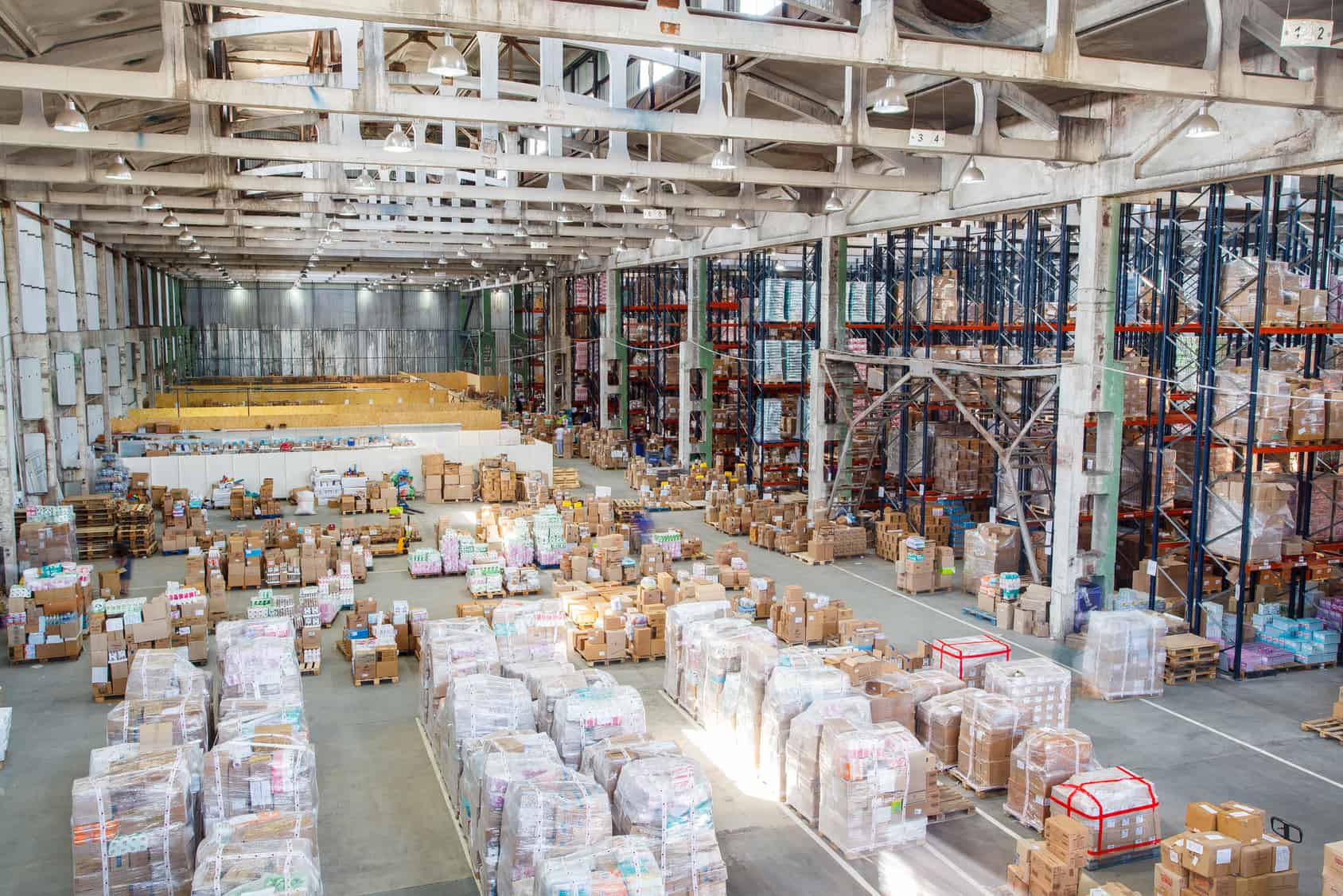
Inbound logistics in a warehouse
Thanks to the supplier’s prior notice, the warehouse employees can plan the shelf space and immediately know where the pallets need to go.
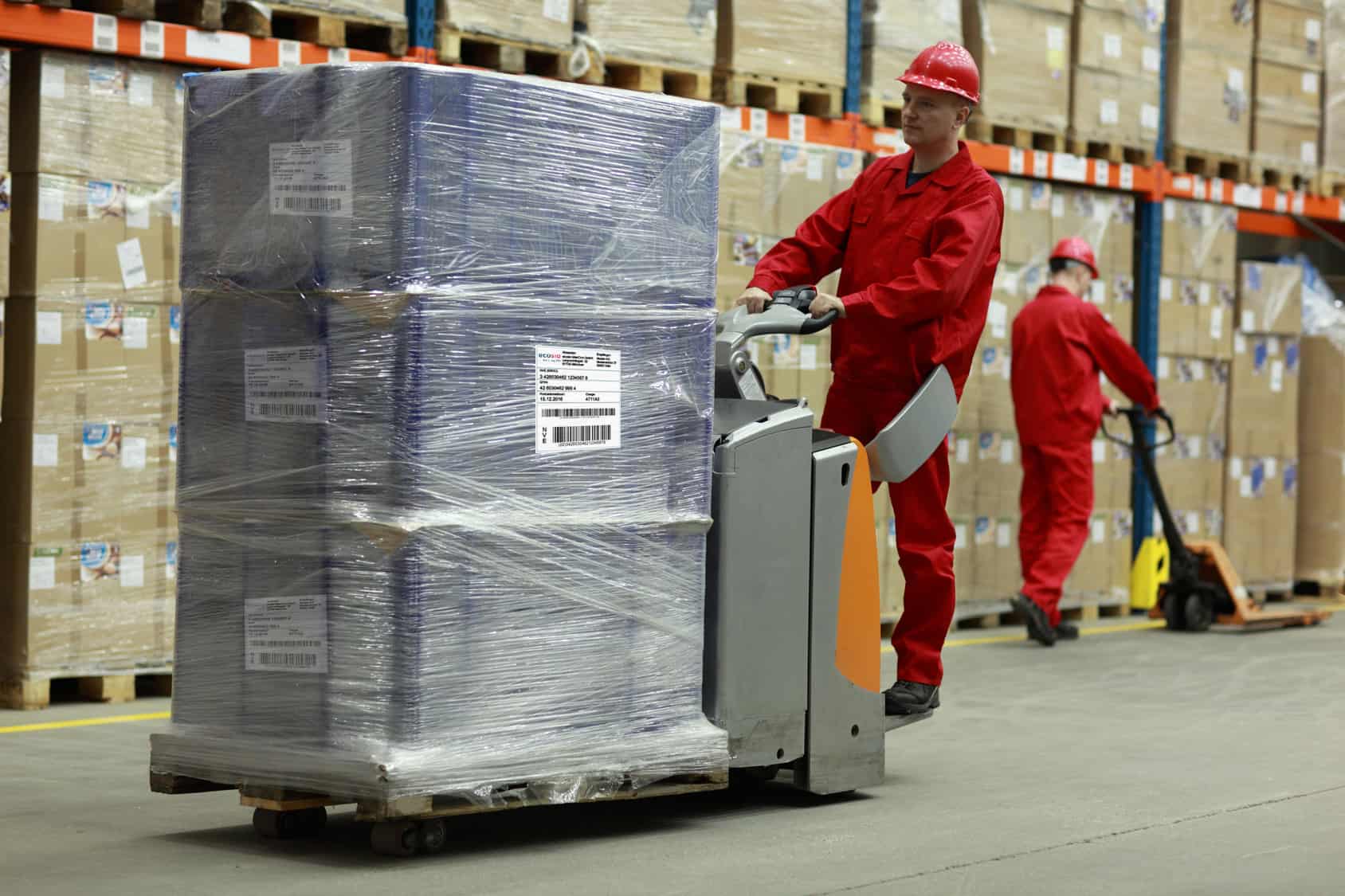
Furthermore the pallets are fitted with the SSCC labels, which the warehouse employees can scan by hand (see illustration below). The employees scan the SSCC numbers and compare them with the data from the DESADV that was sent earlier. This way, they can verify whether the quantity or the structure of the shipment is correct.

A hand scanner being used in a warehouse.
What becomes clear with the above description of the process, is that the cooperation of the suppliers is vital to ensure a smooth running of the logistics. The DESADV messages have to be sent electronically and long enough before the arrival of the goods, and they must contain the SSCC numbers, which are also mentioned in the label of the shipped goods.
SSCC number example
SSCC numbers are used for the clear identification of shipping units.
SSCC numbers are based on a GS1 company prefix, just like most GS1 identification numbers. Other GS1 identification numbers include for instance GLNs and GTINs. A GLN – Global Location Number is a global, unequivocal and non-overlapping identification for a specific business. GTINs (Global Trade Item Number) are used to clearly identify products.
SSCCs have 18 digits and are set up as follows:
- 1 reserve digit
- 7 – 9 digits of the GS1 company prefix
- A consecutive number for the shipping unit. The allowed length depends on the length of the GS1 company prefix.
- A verification number.
Let’s use the ecosio InterCom GmbH GLN 4260304620007 as an example to create a SSCC number. The GS1 company prefix is 426030462:
- Reserve number:
3 - GS1 company prefix:
426030462 - Consecutive number for the shipping unit:
1234567 - Verification number:
8
We now have the SSCC 342603046212345678. This number can be used for the clear identification of the shipping unit. Since it is built using the GS1 company prefix, it is guaranteed that this SSCC will not be used by another company.
Here you can find out more about creating a SSCC number.
SSCC transport label
In order to easily and efficiently process the SSCC number in the logistic chain, it is necessary to display it as a machine readable barcode. The barcode can be captured by an optical reader, thus allowing a complete delivery to be unloaded in the warehouse, without anyone having to manually type any data.
This is exactly what the GS1 transport label is for. Not only does it contain information that the human eye can read, but also machine readable data contained in the barcode. The following picture illustrates the set up of a GS1 transport label:

Set up of a GS1 Transport Label
The label is composed of a header segment, which contains free formatted information about the sender and receiver. The middle segment contains information in clear text, whose size can vary, depending on what it is used for. It must contain the SSCC number. The footer segment only contains the machine readable GS1-128 barcode.
The picture below depicts an example of a transport label. You will find in the middle segment, next to the SSCC number, the GTIN, the production date as well as the lot number. The bottom part contains two barcodes, the first one stands for the GTIN, production date and lot. The second stands for the SSCC number.

Example of a GS1 Label with SSCC
Incorporating the SSCCs on pallets
As the type and structure of the shipping unit can differ, using boxes or pallets for example, so can the incorporation of the SSCC labels. If the label needs to be put on a box whose dimensions are smaller than 1 meter, then you need to follow the instruction sbelow:
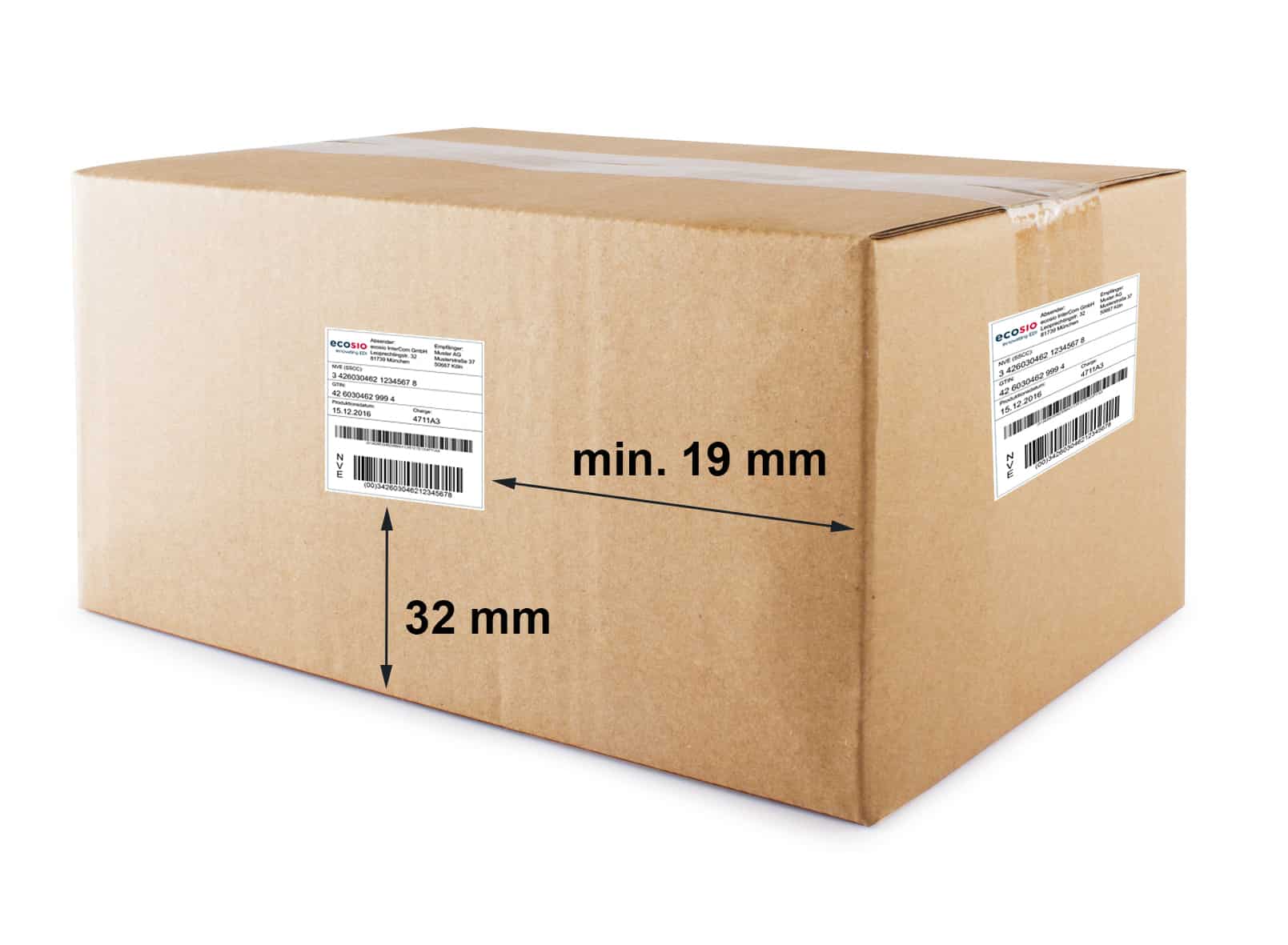
Example of a SSCC label on a box
The SSCC label must be present on at least two sides, the distance between the label and the bottom of the box needs to be at least 32 mm and 19mm from the right and left edges. In the logistic trade, boxes are mostly stacked on pallets, these can contain one sort of boxes or mixed boxes.
An unmixed pallet only contains goods which have the same article number, e.g. “gherkins in glass, 250g, GTIN 9001234567896”. The SSCC labels will need to be fitted on the pallet the same way as for the boxes, at least two of them on different sides.
Mixed pallets are pallets on which you will find goods with different article numbers. To allow them to be sorted, sandwich pallets will often be used. This type of stacking might remind one of a classic club sandwich. Tasty!

Mixed pallets are mostly used for direct store deliveries. Unmixed pallets and sandwich pallets are predominantly used for warehouse deliveries and in cross docking scenarios.
In a sandwich pallet, every single pallet will have its own SSCC label and the sandwich pallet itself will have a master SSCC label. The master label aggregates the SSCC labels from all the layers. The picture below illustrates this concept:
Example of an SSCC Label on a Sandwich Pallet
As you can see on the left side, each pallet layer has its own SSCC label (Layer SSCC Label). The sandwich pallet is wrapped in a plastic film, thus creating a new and unique shipping unit. The shipping unit as a whole has a Master SSCC label, as seen on the right side of the picture. When the goods arrive at their first unloading point, the warehouse employees will only scan the master SSCC label, since the plastic wrap often makes the scanning of the labels underneath impossible.
If the single pallets are isolated further down the processing line, the employees will then use the layer SSCC labels to clearly identify the layers.
Use of a SSCC in a DESADV
When DESADV messages are used to announce a delivery, the EANCOM Standard defines four different scenarios:
1 – No SSCC and no Shipping Structure
In this scenario only the article numbers and total quantities of the shipping are stated. There is no representation of the shipping structure and no SSCCs are being used. The shipping structure defines which boxes are on which pallets, how many pallets are being sent etc. This type of representation and its content correspond to a basic delivery note on paper.
2 – SSCC per Pallet without Shipping Structure
In this version article numbers and total quantities are given. The packages are also identified with the SSCCs. However, the shipping structure is not described.
3 – SSCC per Pallet with Shipping Structure
This option clearly describes the hierarchy of the shipping structure up to the content of the pallets. The DESADV will contain information about the article numbers and total quantity of the boxes per pallet. Furthermore it will contain the description of the hierarchy of the composition of the delivery (number of pallets, number of boxes per pallet, etc…). Each pallet will be clearly identified thanks to the SSCC. Sandwich pallets will have every layer also identified with their own SSCC.
4 – SSCC per Box and Pallet and with Shipping Structure
In this last option, the hierarchy of the shipping structure is described. Both pallets and boxes have SSCC numbers.
Example of an unmixed pallet
In the case of an unmixed pallet, the packing hierarchy can be described in two levels:
Level 1 = the whole shipping, which corresponds to three euro pallets in the example below.
Level 2 = per single pallet. This level dictates the representation of every single pallet, even if all pallets contain the same articles. The delivered units, usually boxes, are represented with GTINs. In the DESADV, you will find the distinction for the level hierarchy in the CPS segments.
Let us take a look at the three unmixed pallets below as an example. Each pallet has its own SSCC number. You will find different article types in each pallet, packed in individual boxes. The boxes have their own GTINs.
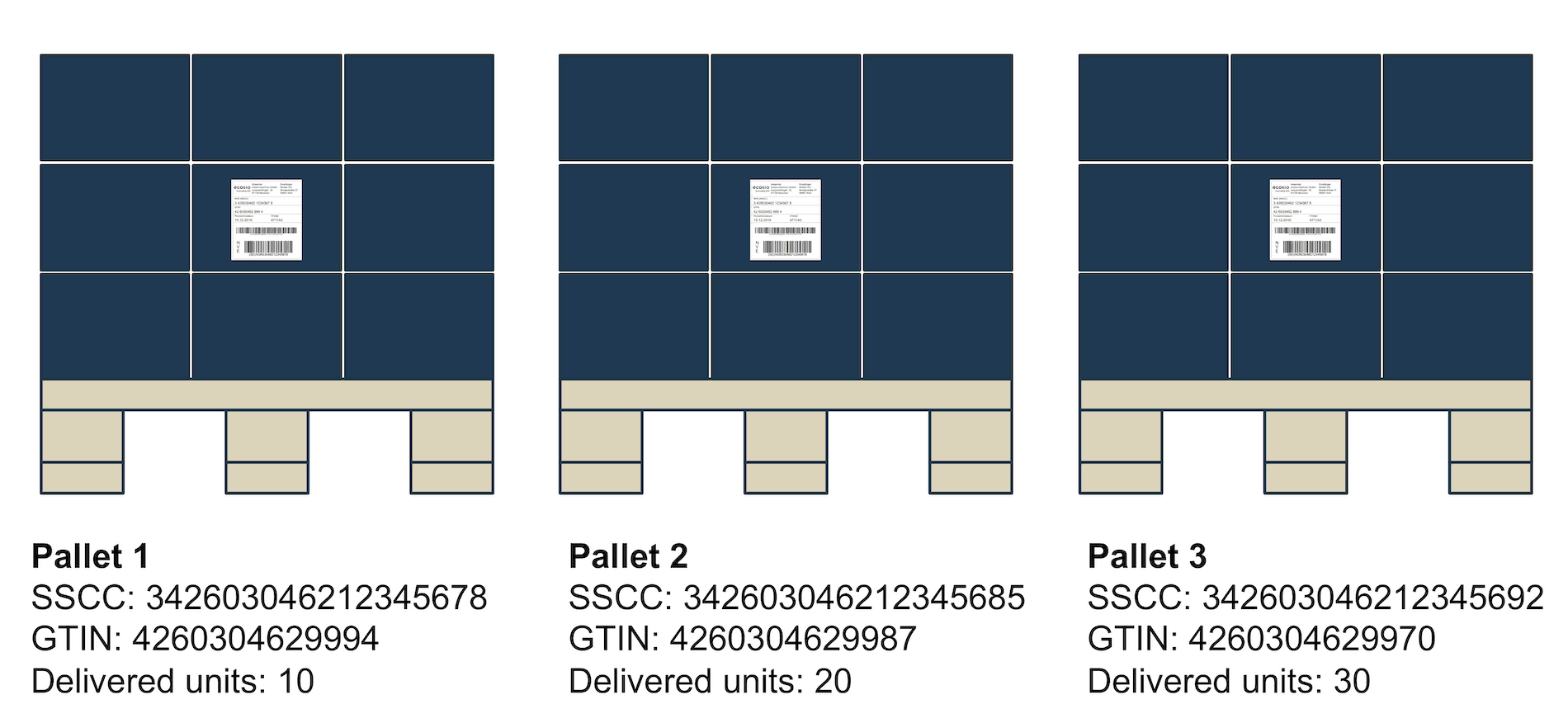
Example of three unmixed pallets
The resulting structure of the DESADV looks as follows (to make it clearer, we will only be showing the relevant CPS segments):
CPS+1'
PAC+3++201'
CPS+2+1'
PAC+1++201'
PCI+33E'
GIN+BJ+342603046212345678'
LIN+1++4260304629994:EN'
QTY+12:10:PCE'
CPS+3+1'
PAC+1++201'
PCI+33E'
GIN+BJ+342603046212345685'
LIN+1++4260304629987:EN'
QTY+12:20:PCE'
CPS+4+1'
PAC+1++201'
PCI+33E'
GIN+BJ+342603046212345692'
LIN+1++4260304629970:EN'
QTY+12:30:PCE'
The meaning of each segment is as follows:
CPS+1'
Corresponds to the highest order level.
PAC+3++201'
Number of packages in the whole delivery (3 euro pallets).
CPS+2+1'
Second hierarchy level (1st pallet). The 1 refers to the shipping. The 2 is the consecutive number of the hierarchy level.
PAC+1++201'
Number of packages in the current hierarchy level ( Pallet 1 = 1 euro pallet).
PCI+33E'
This shows the package is identified with an SSCC.
GIN+BJ+342603046212345678'
The SSCC number from pallet 1.
LIN+1++4260304629994:EN'
The GTIN of the delivered unit in pallet 1 (of the boxes).
CPS+3+1'
Second hierarchy level (2nd pallet). The 1 refers to the shipping. The 3 is the consecutive number of the hierarchy level. The other segments for pallets 2 and 3 are to be read in the same way.
Example of a sandwich pallet
In a sandwich pallet, the articles of the same type are stacked on each other. The single layers are separated by a euro pallet and have their own SSCC number. The whole pallet is then wrapped in plastic film and has its own master SSCC number. This number allows for the different layers underneath to be recognised during the unloading process.
The difference between unmixed and sandwich pallets is that the latter will have to have one more level in their hierarchy. Level 1 and 2 will be the same as for an unmixed pallet, however the master SSCC will be found on level 2. The delivered units are therefore represented in the third level.
Let us have a look at the sandwich pallet below with three levels.

Here is how the DESADV structure would look like:
CPS+1'
PAC+1++201'
CPS+2+1'
PAC+1++201'
MEA+PD+LAY+PCE:3’
PCI+33E'
GIN+BJ+342603046212345104'
CPS+3+2'
PAC+1++201'
PCI+33E'
GIN+BJ+342603046212345692'
LIN+1++4260304629970:EN'
QTY+12:30:PCE'
CPS+4+2'
PAC+1++201'
PCI+33E'
GIN+BJ+342603046212345685'
LIN+1++4260304629987:EN'
QTY+12:20:PCE'
CPS+5+2'
PAC+1++201'
PCI+33E'
GIN+BJ+342603046212345678'
LIN+1++4260304629994:EN'
QTY+12:10:PCE'
Here is what these segments mean:
CPS+1'
Stands for the first level (the actual shipping)
PAC+1++201'
Number of packaging in the whole shipping ( 1 euro pallet)
CPS+2+1'
Second level (the sandwich pallet)
PAC+1++201'
Number of packaging in the current level (1 euro pallet)
MEA+PD+LAY+PCE:3’
Number of layers in the sandwich pallet
PCI+33E'
Indicates a SSCC labeling is present
GIN+BJ+342603046212345104'
The SSCC number of the pallet (=Master SSCC)
CPS+3+2'
Third level for the description of the first layer. It refers to the pallet (with the “`2““)
PAC+1++201'
Number of packages (1 euro pallet)
PCI+33E'
Indicates a SSCC labeling is present
GIN+BJ+342603046212345692'
SSCC from the first layer
LIN+1++4260304629970:EN'
The GTIN from the delivered unit in the first layer
QTY+12:30:PCE'
The number of delivered units in the first layer
CPS+4+2'
Third level describing the second layer. The description for layer 2 and 3 is the same as for layer 1.
Benefits for all involved
Using DESADV messages with SSCC labels can be cumbersome at times, however the use of SSCCs has its advantages for the parties involved. It can help reduce the sending and picking times on the side of the supplier in the warehouse processing. The advanced notice of the delivery and the use of the SSCC allows the retailer to plan their logistics widely and optimise their workload and warehouse capacity.
As soon as the supplier delivers the goods, the unloading and storing can happen much quicker, reducing the time the trucks have to stay. The supplier then has more flexibility when booking time slots for the delivery. The retailer also benefits from the simplified processes when storing the goods. SSCCs can also guarantee transparency by complying with the legislation on products origins and tracing them back.
The automation of receiving goods also has benefits on the following processes, such as product recalls, confirmation of the goods reception etc. The use of DESADV with SSCC makes the suppliers competitive, as they can comply with the expectations of the retailers.
Should you wish to consult your crystal ball to see the future of DESADVs with SSCC in the retail industry, all you need to do is look at the the delivery processes in the automotive industry. The advanced notice of a delivery and the labelling are mandatory, so much so that it is a necessary pre-condition in establishing a partnership between a supplier and a buyer.
Do you have any questions?
You still have questions about DESADV and SSCC, or you need to implement those processes for one of your clients or suppliers? Feel free to contact us, we would love to help you!
Image credits
- An old fashioned grocery store: GNU Free Documentation License, Version 1.2, via Wikimedia Commons
- Club sandwich, Creative Commons CC0 1.0 Universal Public Domain Dedication
Der Beitrag What is a DESADV with SSCC and Why Should I Care? erschien zuerst auf ecosio.
]]>Der Beitrag Overview of the EDIFACT EANCOM format erschien zuerst auf ecosio.
]]>EDIFACT stands for Electronic Data Interchange for Administration, Commerce and Transport and has been in constant development by the United Nations since 1986. This standard is known under the name UN/EDIFACT. Whilst working on standardising the UN/EDIFACT format, numerous requirements from all industries needed consideration. However, although this may have helped broaden the UN/EDIFACT standard and make it more flexible, it also complicated its actual use.
A simple invoice may, for instance, include many optional elements and different identifiers may be used for the identification of the involved companies and products, etc. Before they can create an actual EDIFACT invoice, the sender and receiver need to agree on the subset of segments they will be invoked when exchanging files. If it were the case, that both parties always needed to agree on a specific subset, this would inevitably lead to a huge and unnecessary number of different subsets, and therefore reduce the benefits of EDI through the time needed to make the subsets compliant.

It is therefore advisable to agree on certain standard EDIFACT-subsets. These EDIFACT subsets are derived from the EDIFACT standard and were tailored to suit a specific user group. Mandatory elements are defined according to the EDIFACT subset and additional specifications laid down (e.g. identifiers to use, date formats, code lists, etc.).
These subsets apply to whole industries (e.g. paper, steel or consumer goods industry), including at the corporate level.
The diagram below illustrates the subset approach.
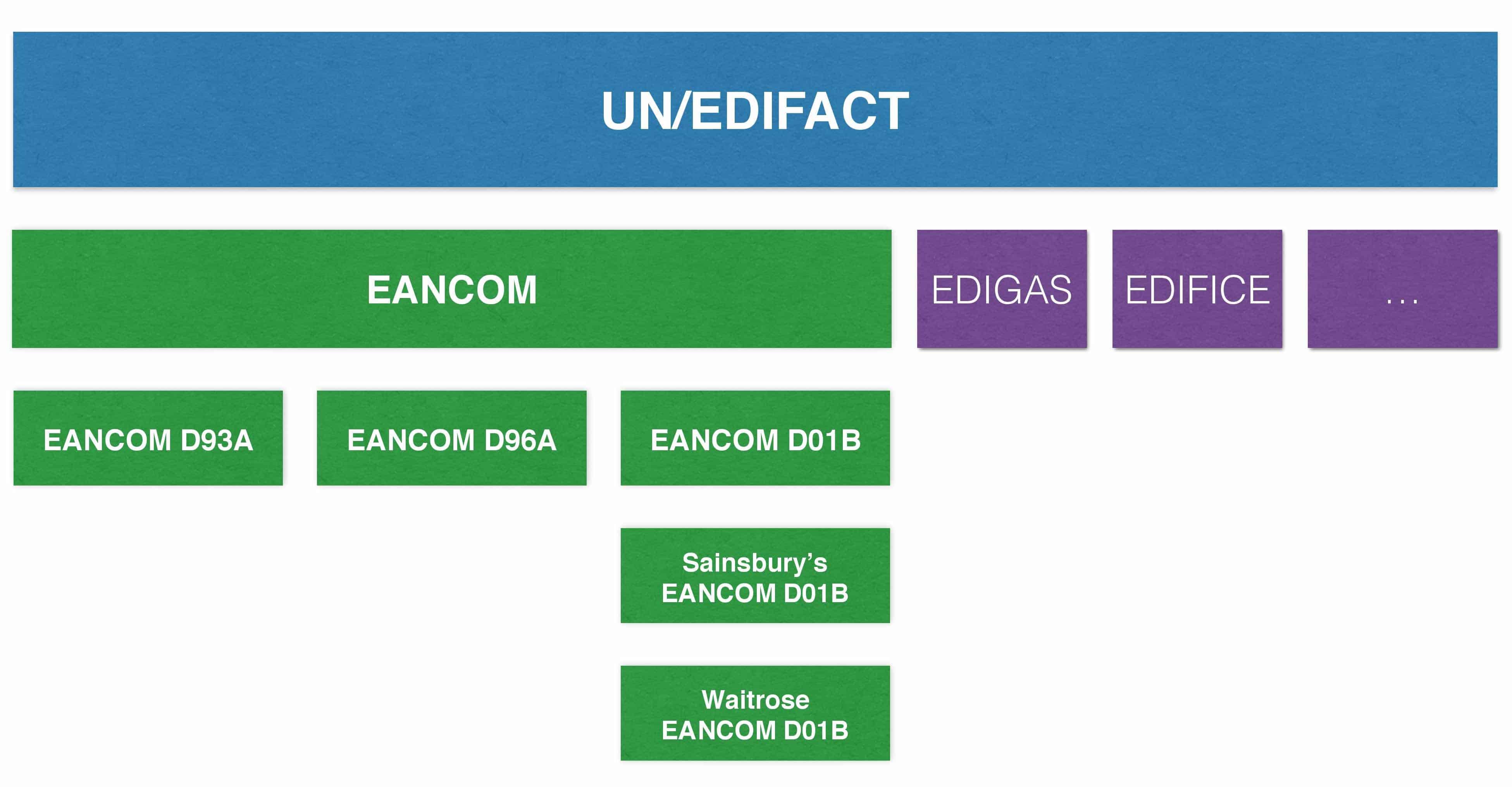
Individual subsets based on the UN/EDIFACT standard were defined for different industries. The globally most used EDIFACT subset is EANCOM (abbreviation of EAN + Communication) and GS1 is continuing its development for the consumer goods industry. Other subsets include, for instance, EDIGAS (gas industry) or EDIFICE (high-tech industry).
EANCOM exists today in three different versions (D93A, D96A and D01B). Major companies such as REWE or Metro are also defining their own subsets based on the EANCOM subset.
EANCOM-Subset
EANCOM is being developed by the GS1 organisation for global standards and is a 100% subset of the UN/EDIFACT standard for the consumer goods industry. Since the EANCOM standard is highly popular, it is by now also used in other industries, such as the health sector. As opposed to the very extensive UN/EDIFACT standard, EANCOM reduces the various EDI messages to essential fields that are mandatory to specific business processes or for specific message types. The EANCOM standard currently includes about 50 different message types.
As the name suggests already, the EANCOM standard is based on the GS1 identification system (GLN, GTIN,SSCC, etc.). The use of globally unique GS1 identification allows effective and uniform processing of EDI messages. Every sender and recipient will, for instance, be uniquely identified by it’s GLN – thus excluding confusion caused by proprietary identifiers. The same applies to product identification using GTINs and identification of packages using SSCCs.
EANCOM also defines the logical sequence of messages used in a specific business area. The diagram below illustrates message flows that may be depicted with EANCOM. In addition to buyers and sellers, communication between logistics service providers and banks is also included.
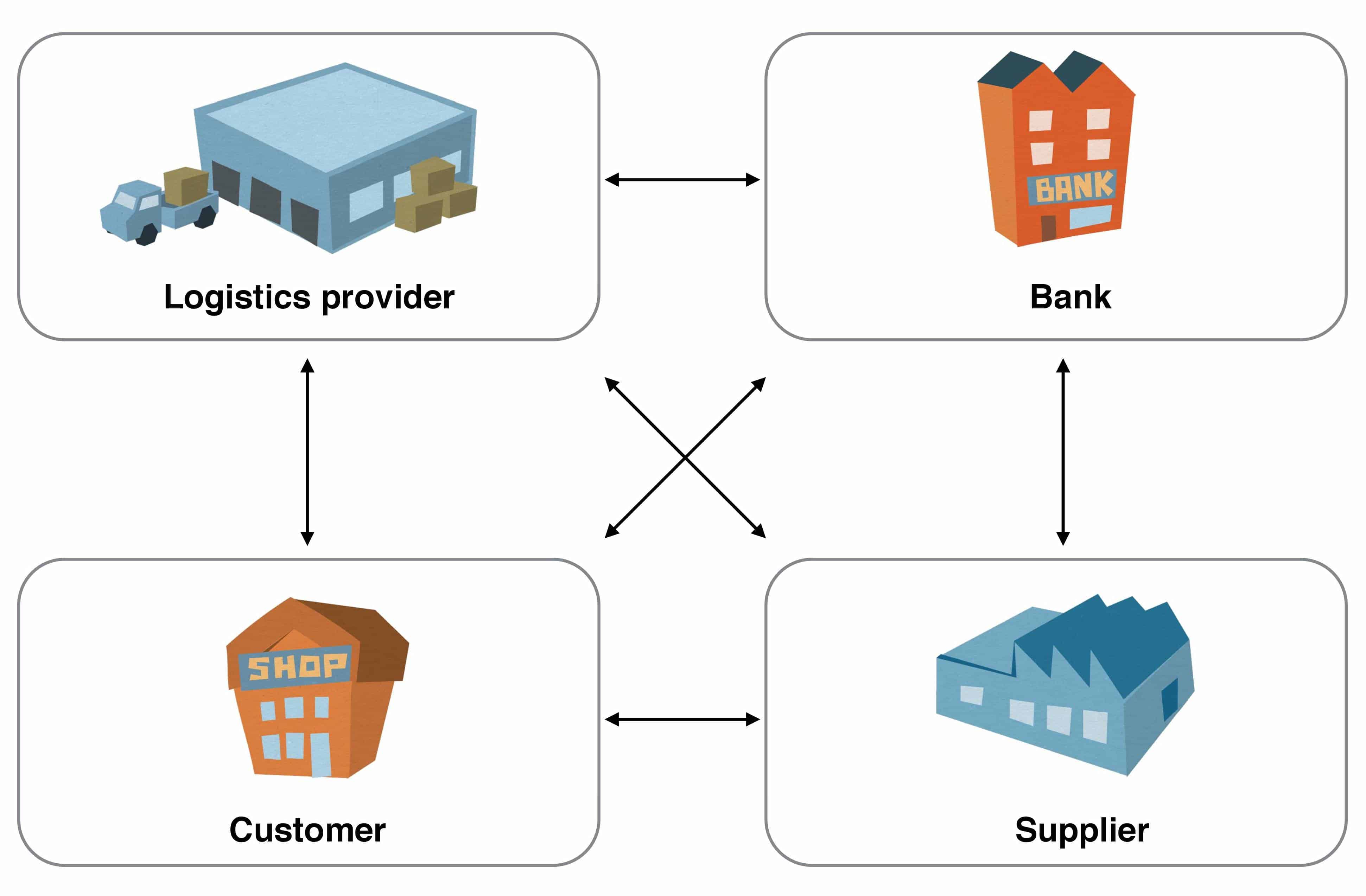
EANCOM – Participating Companies
The individual EANCOM message types may be roughly classified into the following four categories:
- Master data reconciliation
These message types are used for the exchange of master data for products and for involved trading partners. The master data is therefore stored in the systems of the involved partners and used for message transactions afterwards. This will, for instance, ensure that only the most recent product identifiers and prices will be used. - Transactions
These message types are used to order goods, organise their transportation and pay for goods received. - Reporting and planning
These message types are used for the exchange of data allowing future planning. Examples include Sales Reports or Inventory Reports, used to communicate current product sales figures to a supplier. The supplier may use this information to plan his own production. - Miscellaneous
The message types in this category serve various purposes, such as the exchange of additional information required by the different industries.
Overview of EANCOM message types
The diagram below offers an overview of the most important EANCOM message types and the order of the message exchange.
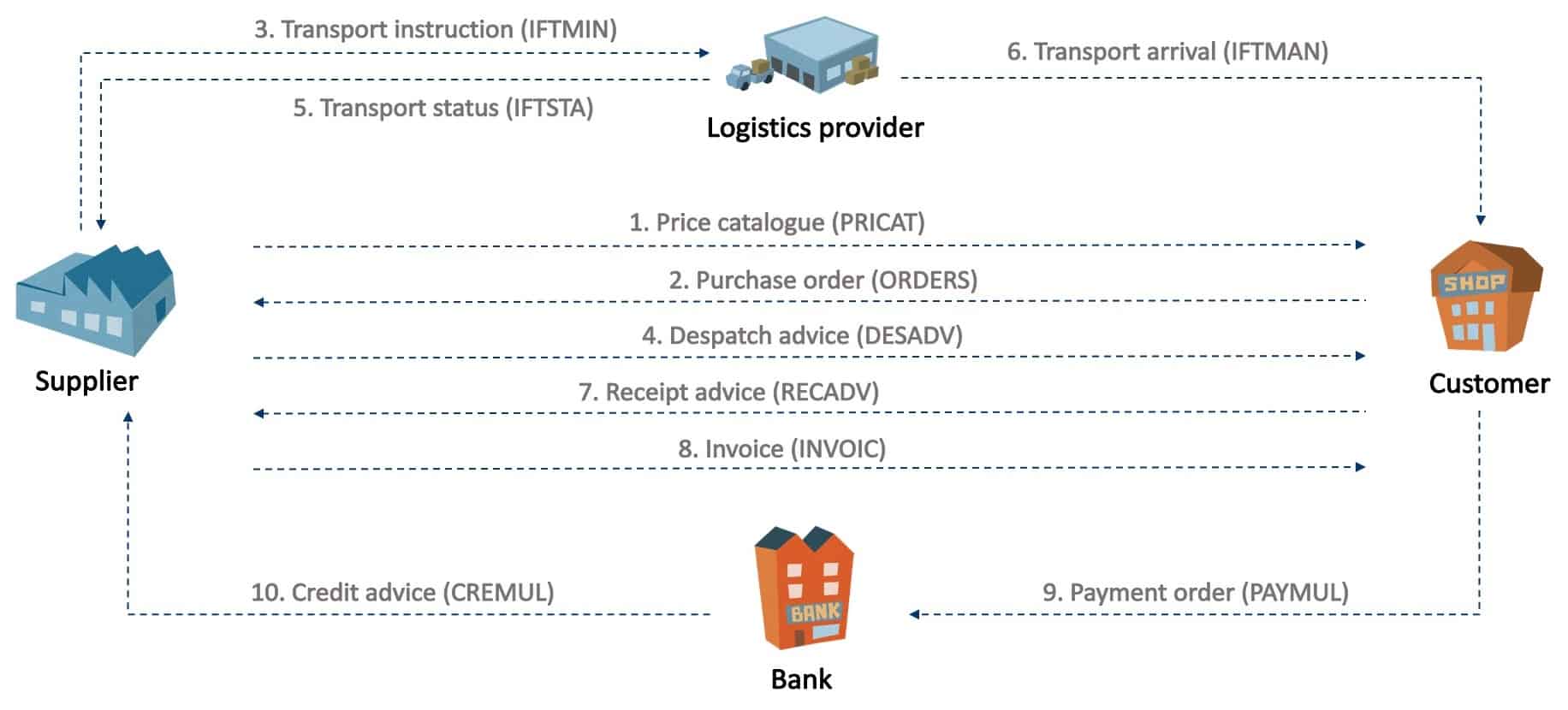
The three most important message types by far are ORDERS (order), DESADV (despatch advice) and INVOIC (invoice).
Price list/Catalogue (PRICAT)
A supplier will send a PRICAT message with a list of all relevant product data to his customers. A supplier will send a PRICAT message to customers whenever the product range changes.
Order (ORDERS)
A customer will transmit an ORDERS message to a supplier to order products and services. An order will typically also include the required quantity, date and place of delivery. The GTIN codes for the ordered products and services and the GLNs used will typically have been received via a previous PRICAT message.
It is also possible to leave out the master data reconciliation using PRICAT, if the parties have exchanged beforehand the lists with the product codes, e.g. on an Excel sheet. However, this might present a few drawbacks, such as input errors due to media faults, etc…
Transport order (IFTMIN)
A supplier will transmit an IFTMIN message to a logistics service provider to order transportation of goods.
Despatch message (DESADV)
Suppliers will send a DESADV message to notify customers of impending deliveries, prior to arrival of the goods at the customer. DESADV messages are particularly relevant to large companies since DESADV messages will allow coordination of their own goods receipt logistics (such as cross-docking warehouses).
Transport status (IFTSTA)
Logistics service providers will use IFTSTA messages to confirm shipment of an order to their client (in this case the supplier). The time of sending this message will be agreed on between the shipping agent and supplier. An IFTSTA message may, for instance, be sent once every day, at the time a shipment is executed, etc.
Arrival message (IFTMAN)
A shipping agent may send an IFTMAN message to the recipient of the goods (in this case the customer) to notify of imminent delivery. Similar to a DESADV, the purpose would be better planning of goods receipt logistic by the customer.
Goods receipt notification (RECADV)
Customers may send a RECADV message to confirm receipt of a specific shipment. This will allow the customer to, for instance, notify the supplier of deviations of quantities supplied or of his rejection of specific shipments.
Invoice (INVOIC)
The supplier may use an INVOIC message to transmit an invoice to his customer.
Banker’s order (PAYMUL)
The customer may use a PAYMUL message to transmit payment instructions to his bank. The bank will on receipt of this message pay the invoice amount to the account of the supplier.
Credit note (CREMUL)
A bank will use a CREMUL message to inform the supplier of payments made by his customer.
Questions?
Do you have any more questions about EANCOM? Please do contact us or use our chat – we’re more than happy to help!
Der Beitrag Overview of the EDIFACT EANCOM format erschien zuerst auf ecosio.
]]>Der Beitrag What is an SSCC number? erschien zuerst auf ecosio.
]]>When confronted with the topic of SSCCs and the unique identification of shipping units for the first time, the question of why this approach is necessary (and of course if the financial expense entailed is justified) will often arise.
On closer inspection one can recognise a number of reasons, why a company may benefit from the unique identification of its shipping units. In order to allow for an effective quality management, each shipment must be uniquely identifiable along the supply chain. Thereby, the affected parties such as consignor, consignee, carrier, freight forwarder, etc. shall reference a shipment using the same unique number.
The numbering system used should ideally:
A) prevent duplicates and be unique to every involved party.
Global uniqueness cannot be guaranteed with self-assigned numbers generated by, e.g. the consignor or the carrier.
B) be readable and processable by a machine.
This implies that the numbers shall be represented as bar codes and shall also be integrated in existing EDI processes (e.g. notification about an upcoming shipment using a despatch advice message).
Unique identification of shipping units will allow end-to-end control of goods movement. Machine processing of shipment data reduces staff costs and significantly increases the reliability of the recorded data (e.g. compared to paper-based delivery slips).
Another reason for the introduction of a unique shipment tracking are legal requirements, e.g. the tracing of food or pharmaceutical deliveries.
Learn how to unlock the potential of EDI with ERP integration
SSCC characteristics
The length of an SSCC is 18 characters and it is based the GS1 Company Prefix.
The guaranteed global uniqueness allows participating companies to use the SSCC for shipping unit identification without the risk of incorrect identification caused by duplicate codes.
The consignor generates the SSCC number, comprising a number and a bar code on a label, and attaches the label to the shipping units. The participating parties in the downstream process (e.g. carrier, freight forwarder, etc.) may scan and store the number. Furthermore, the SSCCs are included in EDI messages, which accompany the shipment, e.g. despatch advice messages. Using the scanned information together with the EDI messages the physically received goods (according to the scan) may be compared with the expected goods (according to the EDI message).
The combination of electronic transmission of SSCCs together with SSCC labels creates a traceable end-to-end process.
SSCC structure
As with all numbers in the GS1 numbering system, the SSCC is also based on the GS1 Company Prefix, which a company must aquire first. The GS1 Company Prefix may then be used to generate the different GS1 number types, for instance Global Location Numbers – GLN. In brief: a GLN is a globally unique and non-overlapping number to uniquely identify a company. Since the SSCC is also based on the GS1 Company Prefix, it is also globally unique and non-overlapping.
The following illustration depicts the precise structure of an SSCC.
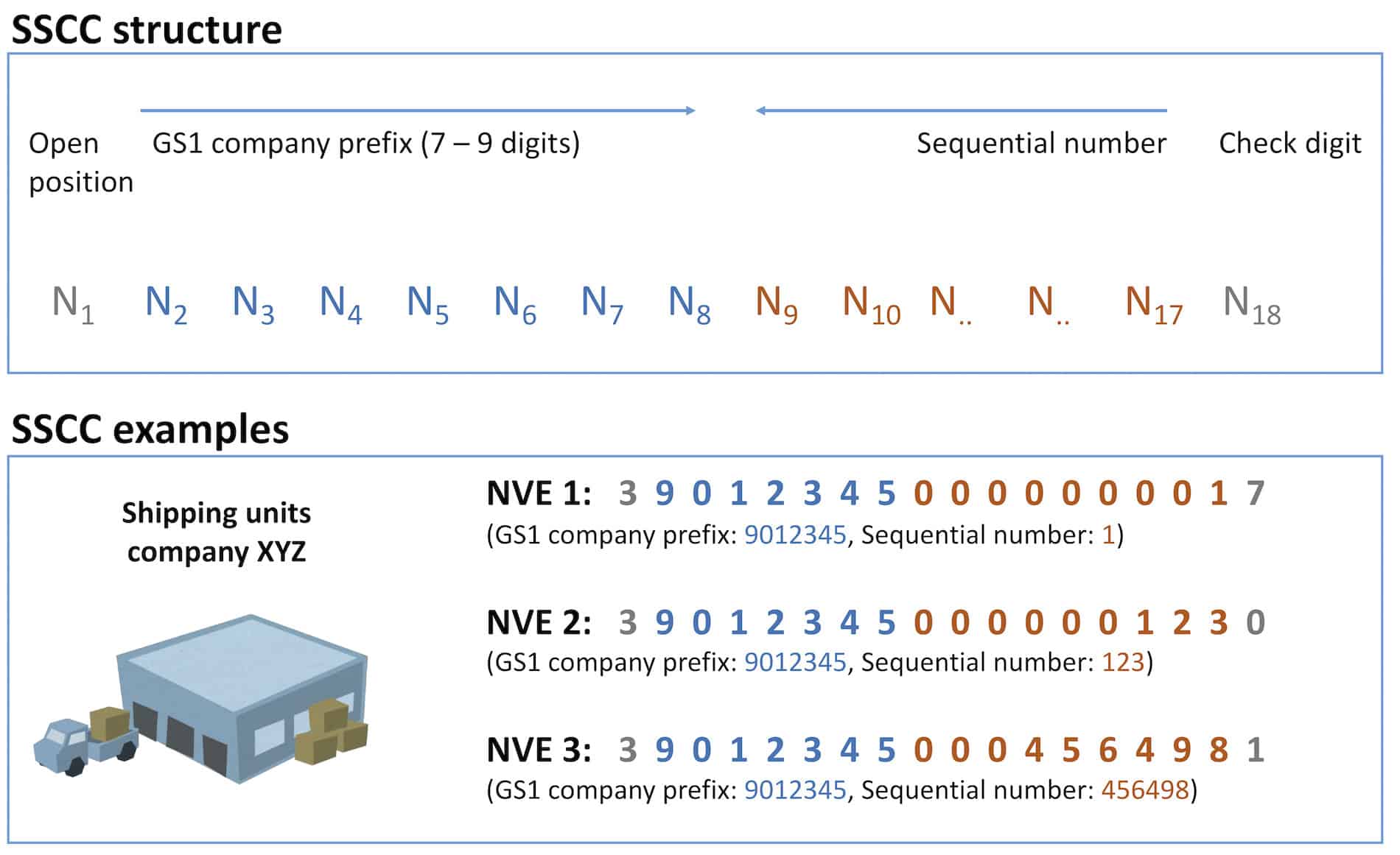
An SSCC starts with an open position that is selected by the company itself. It is followed by the 7 to 9-digit GS1 Company Prefix, depending on the type of GS1 Company Prefix, which is being used. The length of the company prefix determines the SSCC number range. A shorter company prefix allows for more SSCC numbers.
The company prefix is followed by a sequential number, used to identify the shipping units. Although GS1 has no specific requirements, a continuous ascending numbering system starting with 1 is recommended.
Considering the open position and the length of the company prefix, the numbering ranges are as follows:
9-digit company prefix: 100 million possible SSCCs
8-digit company prefix: 1 billion possible SSCCs
7-digit company prefix: 10 billion possible SSCCs
As with all GS1 numbers, the last digit is a “check digit” calculated using the previous 17 digits.
The GEPIR services of the various national GS1 locations may be used to find the company behind a specific SSCC:
Using SSCCs
The question of which shipping unit to mark with an SSCC often arises. Depending on the application scenario, shipping units may be entire containers, pallets, packages, small parcels, etc.
GS1 in general recommends the following:
An SSCC identifies the smallest physical unit of goods and freight, that is not permanently connected to physical units and that can be individually handled by the consignor and consignee.
Example: Boxes with pencils
- One EUR-pallet is loaded with individual boxes containing pencils.
The boxes are self-contained and are not connected (e.g. not wrapped using stretch wrap). In this case each box constitutes a shipping unit and may thus be marked with an SSCC. The pencils in the box will have a GTIN, independent of the SSCC. - The boxes may be wrapped using stretch wrap to prevent them from falling apart during transport. The pallet itself (comprising the individual boxes with pencils) is also a shipping unit and will be assigned an SSCC.
- Should the pencils be packaged in small parcels (e.g. 10 pencils each) inside the box, the small parcels could also be assigned an SSCC – for example, if some of these parcels are delivered by a logistics service provider.
Service providers along the supply chain may bundle individual shipping units to create larger units (e.g. by loading the pallets into a container). This creates a new shipping unit – in this case the container. The original shipping units will, however, remain unchanged and be used down the line (when emptying the container).
The level of SSCC granularity needs to be agreed upon by the participants along the supply chain. Typically, the larger business partner (e.g. a large retailer) defines the exact process requirements and all other suppliers, logistic providers, etc. have to comply with these requirements accordingly.
An SSCC is exclusively used for the identification of a shipping unit. If the shipping unit is also a standard trading unit that is being sold (e.g. a box with pencils), then the trading unit is also assigned its own GTIN in addition to the SSCC.
You can learn more about it in our article “What is a DESADV with SSCC and Why Should I Care?”.
Assigning SSCCs
The company manufacturing or assembling the shipping unit is responsible for marking the shipping unit with an SSCC.
All other participants along the supply chain are supposed to reuse the SSCCs already attached to the shipping unit. This ensures that a shipping unit retains its original SSCC number along the way from consignor to consignee.
Marking shipping units
GS1 recommends using GS1 transport labels in order to attach SSCC numbers to shipping units. A transport label is attached to the shipping unit (e.g. pallet) and may be scanned by participating companies along the supply chain, for instance to compare the shipped goods to EDI despatch notifications.
The illustration below shows a fictitious GS1 transport label of ecosio Ltd.
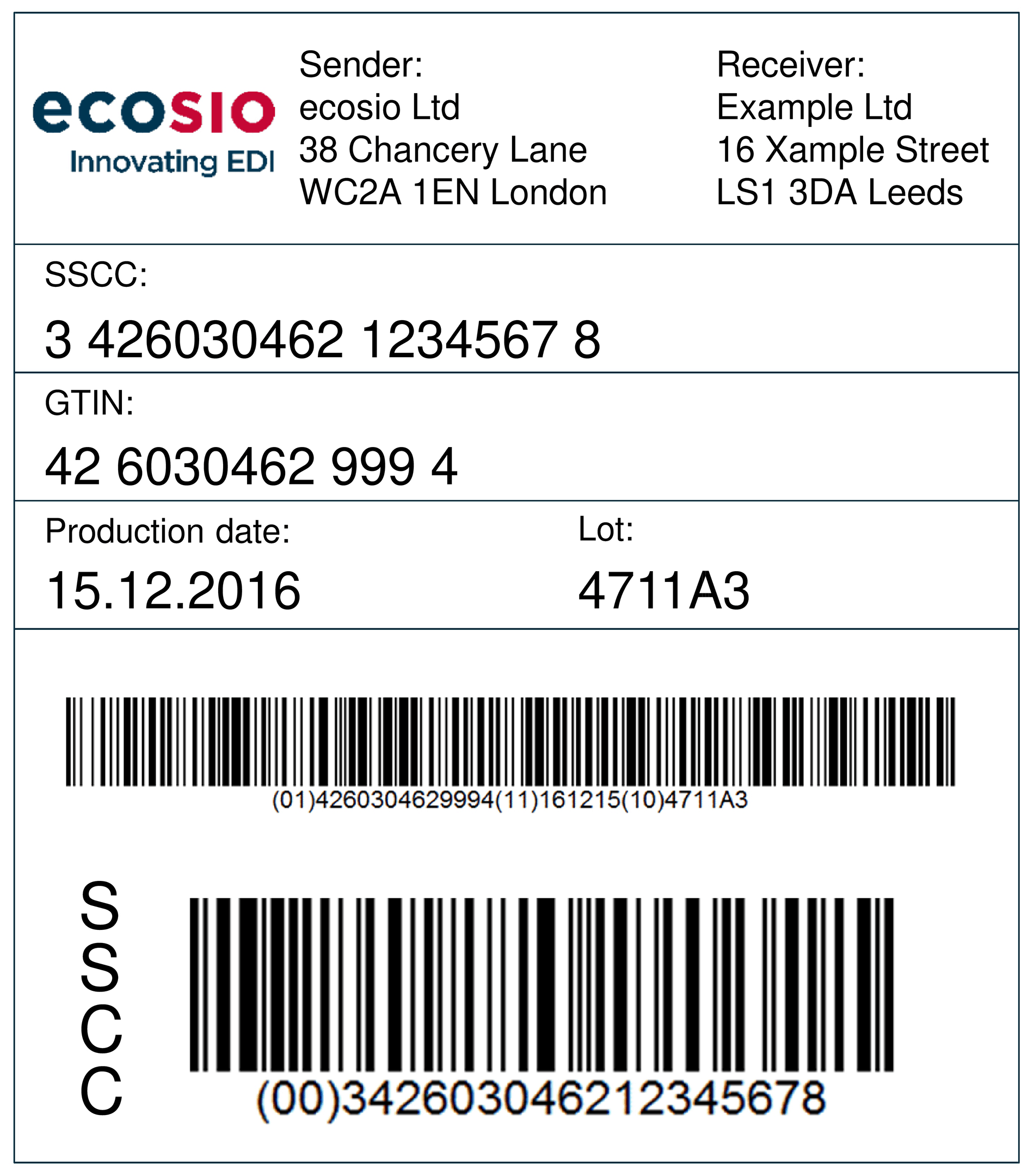
The core element of the transport label is the SSCC 342603046212345678, shown both as a visually readable number and as a GS1-128 bar code. GS1 specifications determine that the SSCC bar code should always be printed at the bottom of the label, as it represents the primary label information.
Additional information such as batch/lot number (4711A3), GTIN of the trading unit (4260304629994), etc. may also be shown on the label.
Introduction of SSCC processes in a company
SSCC labels may, depending on the company’s production process, be applied already at the end of production (if the production unit already constitutes a shipping unit) or later on at the loading ramp, where individual products are combined to create shipping units.
When introducing an SSCC process in a company, process and hardware adaptations are usually required, e.g. acquisition of label printers and SSCC scanners. The introduction of SSCC is often triggered by a larger business partner, which demands SSCC compliance from its suppliers. For a supplier the introduction of an SSCC process roughly implies:
- Generation of SSCC numbers. Generation can for instance occur in the ERP system.
- Transmission of an electronic despatch advice message (e.g. EDIFACT DESADV), which contains the SSCC information.
- Application of the SSCC label and shipment of the goods
Questions about SSCC or EDI?
Do you have any more questions about SSCC or EDI? Please do contact us or use our chat — we’re more than happy to help!
Der Beitrag What is an SSCC number? erschien zuerst auf ecosio.
]]>