Der Beitrag ecosio to Host SAP/EDI Workshop at UKISUG Connect 2021 erschien zuerst auf ecosio.
]]>What is UKISUG Connect?
UKISUG stands for the UK and Ireland SAP User Group. UKISUG Connect is this group’s large annual conference. At the conference SAP customers, consultants, employees and partners from across the UK & Ireland come together to discuss relevant topics, listen to expert talks and collaborate.

About UKISUG Connect 2021
This year’s event will welcome over 500 SAP customers, 200 SAP experts and 70 exhibitors. Delegates will be able to choose from 80+ sessions across the conference’s three days, as well as enjoy the many opportunities to network. The full schedule can be found here.
At this year’s event ecosio will be exhibiting and will therefore be available throughout the conference to answer any SAP or EDI-related questions.
At the 2021 event ecosio will also be running a workshop, entitled “Electronic Data Interchange (EDI) and e-Invoicing with SAP ERP and SAP S/4HANA – Technical Foundations and Best Practices”.
What ecosio’s workshop will cover
In ecosio’s workshop SAP expert Philipp Liegl will explore how a cost-effective, efficient and sustainable EDI solution can be implemented in SAP systems, detailing several positive steps you can take to ensure your SAP/EDI project is a success – no matter what the target SAP system is or whether it’s yours or a client’s.
Thanks to the number of different SAP systems and EDI integration options out there, identifying which solution makes the most sense for your specific situation can be difficult. Available solutions are numerous, including local EDI converters, SAP PI/PO, SAP Integration Suite with its Cloud Integration component, and fully managed solutions from external service providers. This session will help you identify which of these represents the best option.
Attendees will discover how to access full EDI functionality via their SAP system’s existing user interface and turn their SAP into their own EDI control centre with a seamlessly integrated and customisable solution. They will also learn what the different options for EDI and e-invoicing integration in SAP are, how to reduce the strain on in-house resources and the secrets to long term EDI success.
Interested in attending?
Registration for the event is still open and tickets can be purchased here.
We look forward to seeing you there!
Der Beitrag ecosio to Host SAP/EDI Workshop at UKISUG Connect 2021 erschien zuerst auf ecosio.
]]>Der Beitrag SAP® EDI Project Roles – A Breakdown erschien zuerst auf ecosio.
]]>Given the many different SAP systems available and the myriad ways in which EDI capability can be achieved, however, it can be difficult to know exactly how to go about integrating a new solution. To help, in this article we provide an overview of the different roles involved in a successful SAP EDI project and which tasks are handled by each role.
For the purposes of this article we will look specifically at the roles required to integrate fully managed EDI, as this constitutes the most comprehensive EDI solution available to SAP users – and crucially requires the least internal effort from you. In this approach to EDI integration in SAP, the roles and responsibilities are typically spread across four key players: your EDI provider (ecosio in this example), your business, your SAP consultancy and your partners (e.g. customers/suppliers/relevant governmental agencies)…
Your EDI Provider (ecosio)
Thanks to ecosio’s fully managed approach, it is ecosio, rather than your internal team, that handles the vast majority of EDI tasks (click here for a more detailed breakdown of the amount of internal effort required to setup and operate different EDI solutions).
ecosio’s team of EDI and SAP experts manages the EDI SAP integration process from setup and testing to maintenance and error handling. This way you are able to experience all the benefits of EDI with none of the hassle.
A key part of the success of the ecosio approach is the nature of the two roles involved…
1) Integration Engineer

Every ecosio customer is assigned a dedicated Integration Engineer. This ecosio Integration Engineer is your very own EDI hero and acts as a single point of contact for all things EDI.
As well as being an expert in EDI protocols and formats, they also understand the underlying IDoc structure and the correct data representation. More importantly, they know your company, are familiar with your needs and are easy to get hold of. Contrary to many other EDI support personnel, our Integration Engineers really care about every EDI message exchanged!
Their key responsibilities include (but are not limited to)…
- Managing the SAP EDI integration/migration process end-to-end
- Liaising directly with relevant parties so you don’t have to
- Handling industry-specific EDI issues within SAP
- Proactively identifying and resolving errors to ensure ongoing success
Main contacts: Your internal project manager, the ecosio Onboarding and Operations team, your SAP consultancy project manager, your partners’ EDI contact people
2) Onboarding and Operations Team

Working alongside and supporting your Integration Engineer is ecosio’s Onboarding and Operations team. The job of this team is to provide your ecosio Integration Engineer with support in regard to onboarding, document mappings, connection testing and any other EDI tasks whenever needed. Significantly, there is no need for your organisation to liaise with this team directly, as everything is handled via your Integration Engineer.
Main contacts: ecosio Integration Engineer, SAP consultancy project manager, your partners’ EDI contact people
Your Business
With ecosio’s fully managed EDI solution, there are three different EDI roles that must be filled by individuals in your business:
1) Project Manager

The first and most important role is that of the project manager. They are essential as they understand your business and what you want to achieve better than anyone.
Their responsibilities include…
- Developing the project strategy in line with your ecosio Integration Engineer
- Ensuring your project stays on time and on budget
- Collecting feedback from internal users
- Communicating regularly with your ecosio Integration Engineer and alerting them to any issues or changes in strategy (e.g. a change in the agreed order of partner onboarding)
Main contacts: ecosio Integration Engineer, key users, business users
2) Key Users

These users have the most comprehensive understanding of SAP/EDI. They are responsible for providing feedback during the mapping/testing phase and checking that messages are coming through as desired. They should also alert the project manager if any issues or opportunities for optimisation are spotted. Key users may also be used to help train business users.
Main contacts: Internal project manager, business users
3) Business Users

A business user is simply an employee who uses the final product. Their responsibilities are limited to using the product correctly and alerting the project manager should they spot any issues.
Main contacts: Internal project manager, key users
SAP Consultancy
When it comes to your SAP consultancy, there are four related roles:
1) Project Manager

The SAP consultancy project manager oversees all work done in relation to your project by that organisation. Their main task is to liaise with the ecosio Integration Engineer and pass any relevant information on to colleagues to ensure any SAP ERP issues are resolved as fast as possible. Their focus should be keeping your SAP system working and ensuring your project stays on time and on budget.
Main contacts: ecosio Integration Engineer, SD/MM/FI consultant, ABAP programmer, SAP basis administrator
2) SD/MM/FI Consultant

The SD/MM/FI consultant manages the necessary adjustments to your SAP system to enable seamless integration of your new EDI solution. This involves testing and carrying out acceptance. SD/MM/FI consultants are experts when it comes to SAP problem solving.
Main contacts: SAP consultancy project manager, ABAP programmer
3) ABAP Programmer

The ABAP programmer’s role is to realise custom code when the normal SAP means aren’t sufficient. Effectively, they step in when the SD/MM/FI consultant is unable to fix an issue.
Main contacts: SAP consultancy project manager, SD/MM/FI consultant
4) SAP Basis Administrator

The SAP basis administrator is like the SAP mechanic. They oversee SAP system operation and fix any issues relating to memory / processor use, network, etc.
Main contact: SAP consultancy project manager
Your Partners (Customers / Suppliers / Governmental Agencies)
For other partners, there is only one relevant EDI project role:
EDI Contact Person

This individual acts as the sole contact point for your ecosio Integration Engineer, who will liaise with them directly during onboarding to get them connected. Your ecosio Integration Engineer may also need to contact them post go-live to fix any subsequent message exchange issues.
Main contact: ecosio Integration Engineer
About ecosio and Connections That Work
At ecosio we are experts in providing EDI Connections That Work and have helped hundreds of businesses to experience the benefits of automated document exchange in SAP®.
Our expert Integration Engineers and Onboarding and Operations team takes care of everything from setup and testing to maintenance and error handling. With our solution virtually zero internal effort is required for you to experience successful EDI in SAP®.
To find out how you can experience streamlined, future-proof EDI in your SAP system, get in touch today. We are always happy to answer any questions you may have!
Want this information as a handy one-page infographic?
To help you visualise SAP EDI project roles, we’ve condensed the information in this article into a helpful, printable infographic.
Der Beitrag SAP® EDI Project Roles – A Breakdown erschien zuerst auf ecosio.
]]>Der Beitrag What SAP ERP or SAP S/4HANA version are you using? erschien zuerst auf ecosio.
]]>- Open SAP GUI → “Status” → zoom into SAP System data to check your installed version
- SAP ERP 6.0 (Business Suite 7) versions are shown via SAP_BASIS and SAP_APPL values
- SAP S/4HANA versions use a YYMM format (e.g. 1909 = September 2019), visible via the S4CORE component
- Knowing your version is key for EDI integration and upgrade planning
How to find your SAP version number
To find out which SAP ERP or SAP S/4HANA system you are using, open the SAP GUI and select “Status” in the menu.

SAP Menu
© 2020. SAP SE or an SAP affiliate company. All rights reserved. Used with permission of SAP SE.
Then click on the zoom button in the SAP System data section.
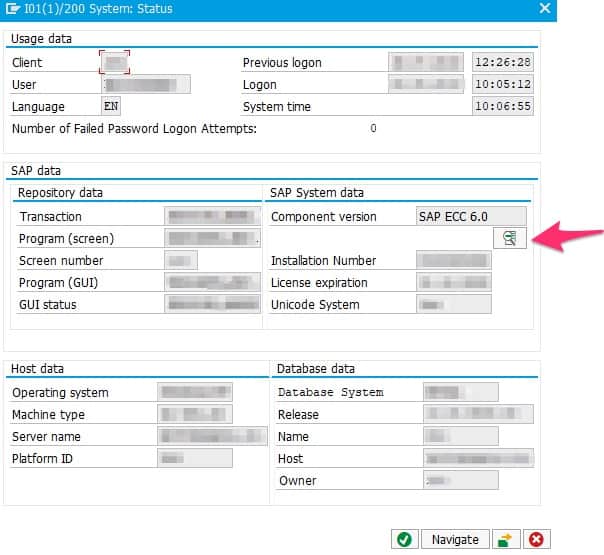
SAP Details
© 2020. SAP SE or an SAP affiliate company. All rights reserved. Used with permission of SAP SE.
Depending on the SAP version and depending on whether you run SAP Business Suite 7 or SAP S/4HANA, details may be shown in different ways.
SAP Business Suite 7
SAP ERP 6.0 is the central core component of SAP Business Suite 7 and the predecessor of SAP S/4HANA. Over the years new capabilities have been added to SAP ERP 6.0, which are called Enhancement Packages (or EHP in short). The latest EHP is EHP 8.0, which was released in 2016. The following screenshot has been taken from SAP Business Suite 7. The Installed Product Versions tab gives an overview of the currently used product versions.
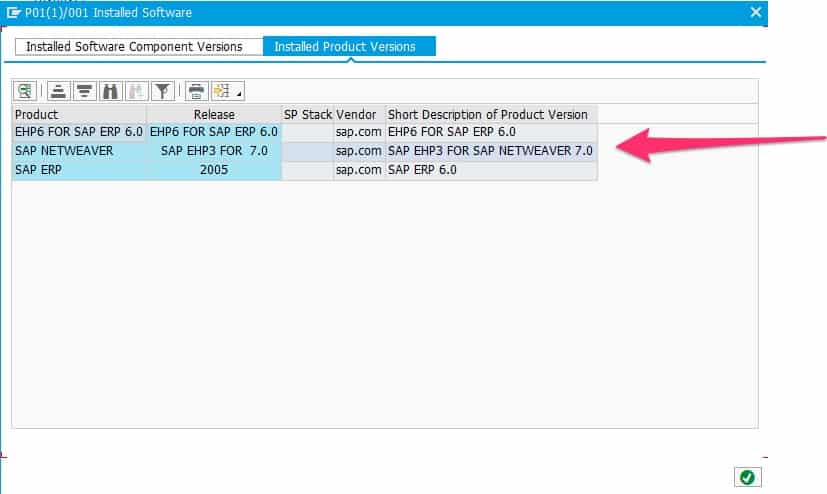
SAP product versions
© 2020. SAP SE or an SAP affiliate company. All rights reserved. Used with permission of SAP SE.
Where no tab exists, the version may be obtained by inspection of the two SAP_BASIS and SAP_APPL types. SAP_BASIS indicates the version of the underlying NetWeaver server and SAP_APPL the version of the used SAP ERP 6.0 component.
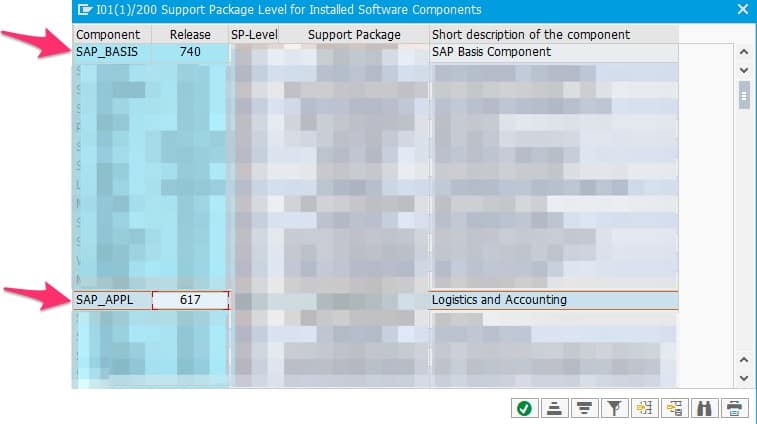
SAP product details
© 2020. SAP SE or an SAP affiliate company. All rights reserved. Used with permission of SAP SE.
A SAP_BASIS type 740 indicates a SAP NetWeaver Server Version 7.4, SAP_BASIS 750 would indicate SAP NetWeaver Server Version 7.5 and SAP_BASIS 702 would indicate SAP NetWeaver 7.0 with Enhancement Package 2. Thus, the first two digits of SAP_BASIS indicate the SAP NetWeaver version and the last digit the NetWeaver enhancement package (if applicable).
A SAP_APPL type 617 indicates a SAP ERP 6.0 with EHP7. A middle digit 1 indicates that the system is enabled for HANA databases. A SAP_APPL 605 indicates a SAP ERP 6.0 with EHP 5. Since the middle digit is 0, the system is not enabled for HANA.
SAP S/4HANA
SAP S/4HANA is short for SAP Business Suite 4 HANA and is the newest ERP system of SAP. In SAP S/4HANA versions are named after the year and the month they were released (YYMM). Users of Microsoft Windows will find that naming convention quite familiar, as the same concept is used there.
Thus, an SAP S/4HANA system version 1909 indicates the release date of September 2019.
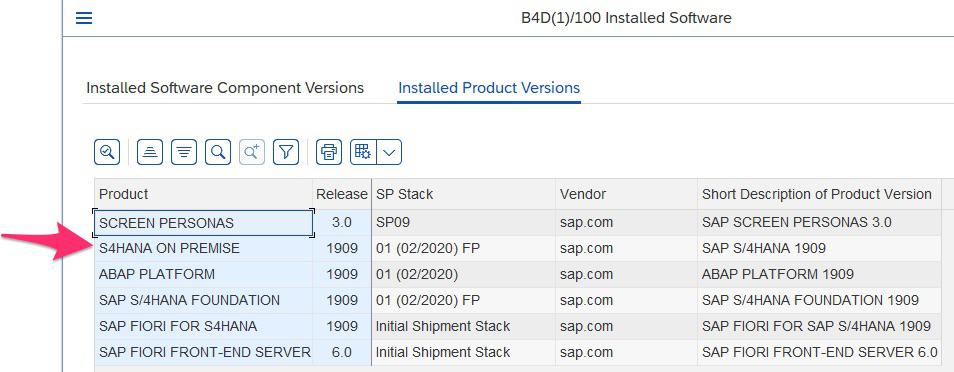
S/4HANA systems have a dedicated component called S4CORE (common questions regarding this component can be found in the SAP Community). The S4CORE version also indicates the used S/4HANA version.
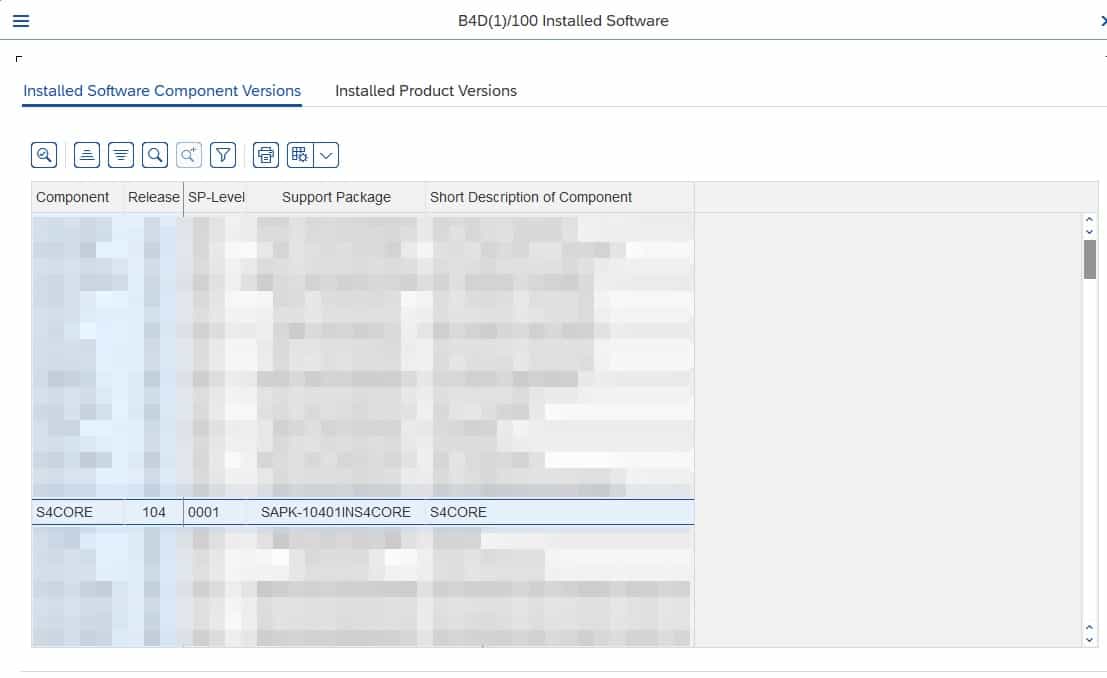
© 2020. SAP SE or an SAP affiliate company. All rights reserved. Used with permission of SAP SE.
S4CORE 102 means you are running an SAP S/4HANA 1709, S4CORE 103 means 1809, S4CORE 104 means 1909, etc.
Any questions about SAP ERP?
Got any questions about SAP and electronic data interchange (EDI)? Please contact us – we look forward to assisting you! You can also chat directly with one of our experts online.
SAP ERP and SAP S/4HANA are the trademarks or registered trademarks of SAP SE or its affiliates in Germany and in several other countries.
Der Beitrag What SAP ERP or SAP S/4HANA version are you using? erschien zuerst auf ecosio.
]]>