Der Beitrag What is a Core Invoice Usage Specification (CIUS) erschien zuerst auf ecosio.
]]>The European e-invoicing norm EN 16931-1 was developed by the EU member states in accordance with the EU directive 2014/55/EU. The norm EN 16931-1 represents a semantic data model of an invoice’s core elements. This means that the requirements for the most important elements of an invoice are defined in a syntax-independent form. In other words, the norm EN 16931-1 is essentially a PDF document, in which the invoice requirements are described in a readable language and independently from the syntax.
In addition you will find conversions in the technical syntaxes, based on UBL (Universal Business Language) and CII (Cross Industry Invoice).
Philip Helger, who co-wrote the European norm, offers a good overview of the components of the EN 16931 on his website. Unfortunately the norm itself is not available publicly, but needs to be purchased.
Core invoice usage specification
The semantic data model EN 16931-1 can include more data elements and definitions than required in certain situations or applications. Furthermore, there is often a requirement, where some elements of the norm are not optional but mandatory.
This is where Core Invoice Usage Specification (CIUS) is used to further define this invoicing norm base.
A CIUS example
The Republic of Austria has defined their own CIUS for e-invoices sent to the Austrian authorities. This CIUS is called CIUS-AT-NAT Austrian National Core Invoice Usage Specification and limits the extent of both EU invoice syntaxes UBL and CII.
Those looking for information on how to create and process UBL documents with attachments in SAP can find our article “Create and Process UBL Documents with Attachments in SAP” on this topic.
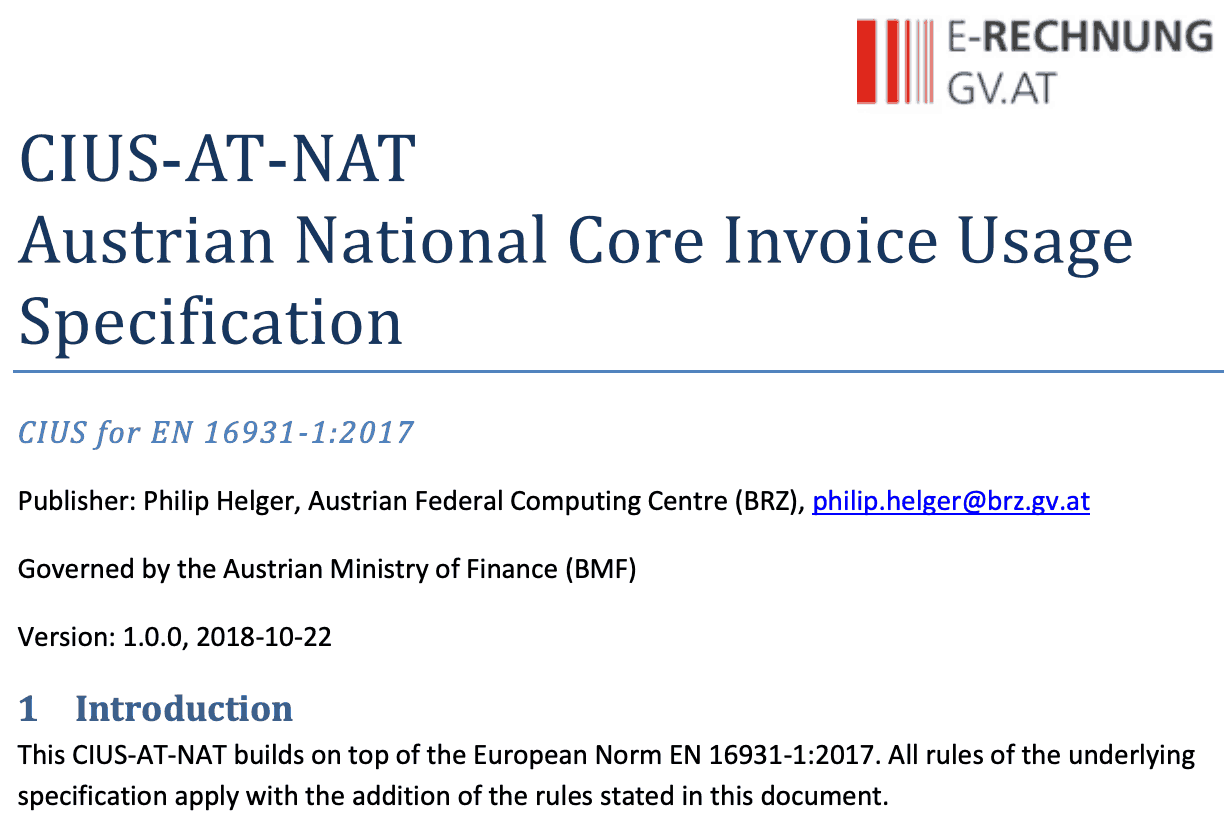
You can access the Austrian CIUS at the following link.
Do you have any questions?
Do you still have questions about e-invoices? Feel free to contact us, we would love to help you!
SAP ERP and SAP S/4HANA are the trademarks or registered trademarks of SAP SE or its affiliates in Germany and in several other countries.
Der Beitrag What is a Core Invoice Usage Specification (CIUS) erschien zuerst auf ecosio.
]]>Der Beitrag How to connect SAP to Peppol to allow the exchange of XRechnung erschien zuerst auf ecosio.
]]>XRechnung overview
Things are getting serious as of November 27th 2018 – all federal ministries and constitutional bodies In Germany must be able to accept electronic invoices according to the XRechnung standard. All the other federal organisations will follow up a year later, on November 27th 2019, and will also have to accept XRechnung. Suppliers, on the other hand, will still be able to send paper and PDF invoices.
Paper invoices will then completely disappear from November 27th 2020 in this sector – suppliers will henceforth have to generate all their invoices electronically in XRechnung format for the public bodies. Paper invoices will not be accepted anymore after that. Therefore, it is time for any supplier of a federal agency to deal with the topic of XRechnung.
But what exactly is an XRechnung?
The XRechnung was developed in Germany as part of the implementation of the EU directive 2014/55/EU. This EU directive dictates the creation of an individual European standard for the core elements of an electronic invoice. The public bodies of the EU-member states will have to accept electronic invoices which comply with this European standard. The EU directive has already become reality – the EU-member states already developed the standard: today it is known as the EU invoice standard EN 16931.
Since every EU member state will have specific requirements for electronic invoices, the need arose to develop so called Core Invoice Usage Specifications (CIUS). As a matter of fact, the XRechnung is a CIUS for Germany, even though it is not the only CIUS in Germany.
From a technical point of view, an XRechnung is an XML file, which complies with the XML schema according to the European standard EN 16931 and further restrictions dictated by the XRechnung. The European Standard EN 16931 provides two types of XML schemas: Universal Business Language (UBL) and UN/CEFACT Cross Industry Invoice (CII).
For SAP systems this represents the first challenge. SAP systems are unable to populate UBL or CII data on the SD side (Sales and Distribution) out of the box.
Learn how to unlock the potential of EDI with ERP integration
Why Peppol?
Further to define a uniform e-invoicing standard, the protocol to be used to send e-invoices to the authorities must also be determined. In theory one could use the whole spectrum of communication protocols, the same way they are being used for B2B transactions, such as SFTP, AS2, X400 etc. This would result in the authorities having to support all those protocols, including the disadvantages each one may represent.
In order to define a uniform standard, the legislator had to fall back on a rather popular standard in the B2G area within the EU: Peppol. Peppol is the acronym for Pan-European Public Procurement OnLine and was developed by the European Union. Its goal is to simplify the communication between suppliers and public bodies for e-procurement.
Technically, Peppol is the definition of a delivery infrastructure for electronic documents.
Peppol consists of:
- The Peppol e-delivery network
- The Peppol document specifications, which determine the structure of the electronic documents (Peppol Business Interoperability Specifications – BIS)
- A legal framework, which regulates the collaboration within this network (Peppol Transport Infrastructure Agreement)
In order to send and receive via Peppol, one must be equipped with a Peppol Access Point. Since it might prove quite costly from a technical and organisational point of view to create and register an Access Point, most companies will resort to a specialised service provider, through which one can reach the Peppol network.
Do you have any questions?
Do you have further questions about XRechnung or how to connect SAP to Peppol? Feel free to contact us, we would love to help you!
Are you aware of our free XML/Peppol document validator?
To help those in need of a simple and easy way to validate formats and file types, from CII (Cross-Industry Invoice) to UBL, we’ve created a free online validator.
SAP ERP and SAP S/4HANA are the trademarks or registered trademarks of SAP SE or its affiliates in Germany and in several other countries.
Der Beitrag How to connect SAP to Peppol to allow the exchange of XRechnung erschien zuerst auf ecosio.
]]>